


A campaign works better when it has a clear purpose. A local shop wants people walking through the door, while a SaaS company wants demo requests from people who might actually buy. A crypto wallet often has to earn some trust before anyone downloads the app. Each of those jobs calls for different advertising techniques, and each uses different numbers to measure success.
Knowing the available advertising methods makes it easier to decide where the money goes, how to word the message, and what to fix when a campaign underperforms. Below are 36 techniques with examples covering traditional media, digital ads, audience targeting, performance advertising, and newer Web3 options.
What are advertising techniques?
Advertising techniques are the methods an advertiser uses to put a message in front of the right people and move them toward an action. These include storytelling, audience segmentation, retargeting, comparative ads, and personalisation. To understand the types of advertising, it helps to separate the channel from the technique first.
Channels are where an ad runs: search engines, social networks, TV, and websites. Formats are what it looks like: a text ad, a banner, a video spot. Techniques are the specific approaches used, such as retargeting or an emotional appeal. Advertising strategies sit above all of that. It sets the goal and the budget and decides how the pieces fit together.
Digital advertising techniques
1. Search engine advertising
Search ads put a paid listing next to the results for a query. The appeal is that you reach someone who is already looking, and you show up straight away. The catch is competition. Popular keywords get bid up, so cost per click keeps rising, and you only stay profitable by revisiting keywords and campaign settings often. Crypto advertisers also face licensing requirements.
2. Display advertising
Display ads are the visual placements you see on websites and in apps, usually banners in standard sizes or HTML5. They serve to introduce a brand, display an offer, or expand reach. Clear design and a single call to action help. Their main limitation is attention: an impression does not guarantee that someone noticed or remembered the message.
3. Native advertising
Native ads take on the look and flow of the page around them but are still labeled as ads. Sponsored articles and recommended-content widgets are common examples, and they give you room to explain a complicated product properly. Because they read like content, people notice them more than banners and are less likely to tune them out. Label them clearly, though. Readers who feel tricked stop trusting the publisher and the brand.
4. Contextual advertising
Contextual ads are selected according to the content of a page or app, rather than relying primarily on an individual’s browsing history. A blockchain security firm, for example, could run beside an article on smart-contract exploits. Because they don’t rely on personal data, they sit comfortably with privacy rules like GDPR and CCPA, though you still need to check consent and data requirements for your setup. Relevance is the strength, and a loosely related placement loses it quickly. The trade-off is precision. Contextual ads lack individual user history data and have less precision than behavioural targeting.
5. Social media advertising
Paid social puts your ads in front of people on Instagram, TikTok, Facebook, X, and LinkedIn. It suits product discovery, community building, lead generation, and retargeting, and the demographic and interest targeting is detailed. The formats are visual and interactive. The downsides are familiar to anyone who runs them: algorithms change often, audiences tire of repeated ads, and platform policies can be strict, especially for financial and crypto products.
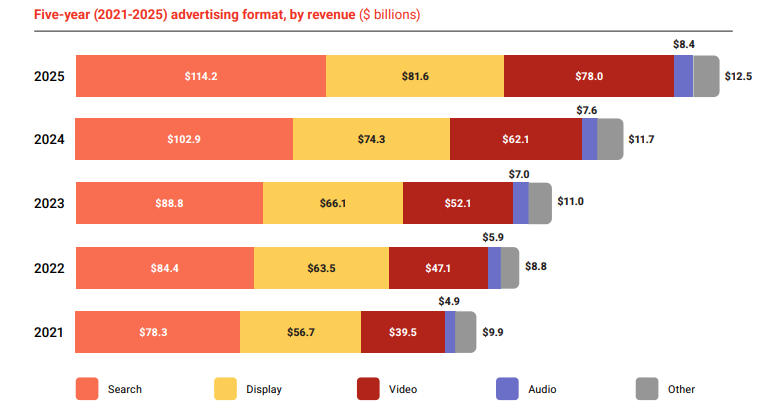
6. Video advertising
Video ads run as pre-roll, mid-roll, or out-stream on YouTube, streaming apps, and web articles. Motion helps when a product is hard to explain in a still image, like a DeFi protocol or a SaaS tool, and it works for storytelling and demos. IAB projects US digital video spend at $81.9 billion this year, so competition for attention is real. Add captions, since many people watch on mute. Production costs more than most formats, and viewers skip when they can. An IPG Mediabrands study found that 65% of people skip online video ads as soon as the skip button appears.
7. Mobile and in-app ads
Mobile and in-app advertising reaches people inside apps, mobile sites, and games. They suit Web3 games and wallets where the install is the goal. Small screens need readable text and landing pages that load fast. Desktop creative rarely survives the move to mobile without changes. Mobile ads can also feel intrusive when the timing is off, and programmatic mobile traffic carries fraud risk.
8. Programmatic advertising
Programmatic advertising uses algorithms to automatically buy digital advertising space through a real-time bidding process, determining which impressions are worthy of a bid. It’s good for big campaigns that need to reach a lot of sites but with a tight hand on spending. You can control publishers, devices, and formats from one dashboard, with buying and optimisation happening quickly. Weak placement controls can push ads onto irrelevant or low-quality inventory, so these campaigns need ongoing monitoring and clear brand-safety rules.
Emerging advertising approaches
9. Connected TV advertising
Connected TV (CTV) ads run on internet-connected televisions through streaming services and apps. They give you the storytelling of TV with the controls of a digital campaign, which makes CTV a good fit for building a brand with people who have dropped traditional linear TV. IAB now forecasts 15.6% US CTV growth this year, while linear TV declines 1.5%. CPMs are higher, and measurement standards are still catching up across streaming platforms.
10. Interactive and playable ads
Interactive ads invite users to do something, such as try a mini-game or quiz before clicking. An NFT game might let prospective players try a simple mechanic before visiting its website. Interaction can reveal intent, although builds take longer, and file weight affects load speed.
11. Retail media advertising
Retail media places ads within a retailer’s website, app, or store environment, often using shopping-related audience signals. It is useful when the advertiser wants to reach people close to purchase. Crypto-native openings are limited, but hardware wallet and gaming-gear sellers can use them.
Performance advertising and targeting
12. Retargeting and remarketing
Retargeting serves ads to people who previously visited a website or interacted with a brand. It offers the advantage of exceptionally high conversion rates because the audience is already familiar with your brand. Remarketing is also used for re-engagement campaigns, including email in many marketing contexts. Both can bring interested prospects back, but stale offers and excessive repetition create ad fatigue. Follow applicable consent and platform rules.
13. Affiliate advertising
Affiliates promote a product through referral links or codes and earn a commission under an agreed deal. SaaS companies and online retailers use this a lot to bring in new customers. The main draw is the pricing: you pay when a defined result happens, such as a sale or a sign-up, and partners with an audience people already trust carry your brand further than your ads could. It isn’t entirely risk-free, though, because you still carry the cost of the program and the partner’s behaviour. If an affiliate uses misleading claims, your reputation suffers, so someone needs to check what they publish.
14. Lead generation advertising
Lead generation ads exist to collect contact details: an email, a phone number, and sometimes a wallet connection. People usually hand them over in exchange for a gated guide or a short quiz. This fits B2B crypto services such as custody or analytics, and it builds a first-party database you can nurture over months. The offer has to be worth the person’s details, or nobody fills in the form. Lead quality also varies a lot, so expect to filter out the weak ones.
15. Conversion-focused advertising
Conversion-focused campaigns, often called direct response, push for one measurable action right now: “Buy Now,” “Mint NFT,” or “Register for Webinar.” They suit sales spikes, flash promotions, app installs, and token pre-sale allocations. Results are easy to track, which is the appeal. The risk is that a campaign built only around immediate sales leaves nothing behind for the brand over the longer term.
16. Audience segmentation
Segmentation splits a broad audience into groups based on needs, interests, behaviour, or customer status. A crypto platform might treat new visitors, verified users, and existing customers as three separate audiences. Ads then speak to people more directly, which tends to help click-through rates and stops budget going to the wrong group. The price is more work. You need reliable tracking, and every segment needs its own creative, which multiplies what your team has to produce and manage.
Targeting and optimization
17. Behavioural targeting
Behavioural targeting relies on permitted data about past actions, such as visiting a product page or making a previous purchase, to decide who sees an ad. It’s useful for e-commerce retargeting, trading-app promotions, and software recommendations and separates casual browsers and people ready to act. Results are highly dependent on data quality and privacy regulation. Stricter rules and the decline of third-party cookies are forcing it harder to track people across different sites.
18. Demographic targeting
Demographic targeting selects audiences by characteristics such as age or, where appropriate and permitted, household or professional attributes. It helps a campaign reach a relevant customer group and prevents wasted spending on completely irrelevant demographics. Demographic assumptions are broad proxies, however, and may exclude people who would actually be interested.
19. Geotargeting
Geotargeting delivers ads according to geographic areas, a user’s country, city, ZIP code, or real-time physical proximity to a specific boundary. It works well for local store promotions and event marketing and for compliance, such as keeping crypto ads out of countries where they are restricted. It cuts wasted reach, but a location setting doesn’t tell you whether the person is actually there or wants to buy.
20. Lookalike audiences
Lookalike tools find new people who resemble your existing customers or another source audience you choose. They work best once you have enough reliable first-party data to feed them. The results depend on how effective that source list is, what the platform allows, and its eligibility rules. Someone who looks like your customers still might not convert.
21. AI-assisted ad personalisation
AI tools can produce and adapt creative variations, product recommendations, and messages for different segments. They handle large e-commerce catalogs, build dynamic ads, and launch localized campaigns in several languages. An online store could test product-specific headlines across hundreds of items. It saves production time. A person still has to check accuracy, bias, privacy, brand voice, and any claims the product can’t back up.
22. A/B testing
A/B testing puts controlled variations against each other, like different headlines, images, calls to action, or landing pages. Change only one meaningful element at a time and measure the result against the campaign’s actual goal. Small sample sizes or constant tweaking can produce misleading results, so give each test enough time and data to be reliable.
23. Sequential advertising
Sequential advertising delivers a planned series of ads to the same person – a brand intro, followed by a product demo, then an offer. The audience sees a continuous narrative rather than repeated creative, which reduces ad fatigue while moving them through the marketing funnel. This strategy requires a complex funnel setup and robust tracking across multiple touchpoints to be effective.
24. Frequency capping
Frequency capping simply limits how often any single person is shown an ad in a given timeframe. It stops the budget from being wasted on the same eyes and keeps the audience from getting irritated, especially useful in pure awareness campaigns. The right limit depends on the format and how long the buying cycle usually lasts: show the ad too often and people tune out; show it too rarely and they may never remember the brand.
Traditional advertising techniques
25. Print advertising
Print ads run in newspapers, magazines, and trade publications in physical or digital editions. Trade titles reach niche B2B readers, and some financial and luxury publications have a readership that fits specific brands. Readers tend to trust print, and the ad has a physical presence that a banner doesn’t. It is slow to produce and hard to measure.
26. Television commercials
Traditional TV commercials reach audiences through scheduled broadcast or cable programming. TV’s combination of motion, sound, and full-screen format supports emotional narrative in ways most digital formats cannot match. Production and placement are expensive. The broadcast infrastructure relies on wide demographic distributions, it remains exceptionally difficult to precisely target niche digital audiences through this format.
27. Radio and audio advertising
Radio spots, streaming audio, and podcast ads reach listeners during workouts or other audio-first activities. Host-read ads carry personal trust and cost little to produce. With no visuals, the message has to fit a short script. Advertisers face the constant challenge of listener distraction, as audiences frequently tune out or switch stations during ad breaks.
28. Outdoor advertising and billboards
Out-of-home (OOH) advertising puts a message in public spaces, such as billboards and digital screens in city centers. It builds local visibility and can give a big launch some physical presence. How well it works depends on where the ad sits and how often people pass it. Attribution is the hard part. Unless you add a trackable URL or a QR code, you can’t tell who saw the ad and acted on it.
29. Direct mail
Direct mail sends something physical to a chosen list of addresses: a catalogue, a flyer, a postcard, or a personalized offer. In a world of crowded inboxes, a letter on the doormat stands out. It suits local service businesses, luxury real estate, B2B enterprise outreach, and customer retention. Printing and postage are slow, add costs, and are often perceived as junk mail if not highly personalized.
30. Sponsorship advertising
Sponsorship ties a brand to an event, an organization, a team, or a creator. A gaming company, for example, could sponsor an esports tournament and meet its audience where they already are. It builds brand association and goodwill in the community and in the crypto and Web3 world this is usually achieved through conference activations and B2B networking. Direct conversions are hard to measure. There is also a risk that the sponsored party lands in a PR crisis and your brand is standing next to it.
Creative and community-based techniques
31. Influencer advertising
Influencer advertising means paying someone your audience already trusts, such as a YouTuber, a podcaster, or a Web3 Key Opinion Leader, to talk about your product. Pick the person by how relevant their audience is, not by follower count. It’s a strong route for credibility, token launches, gaming app installs, and lifestyle products. There is a constant risk of audience skepticism if the sponsorship feels inauthentic or forced. The FTC’s endorsement guidance explains disclosure responsibilities.
32. Content marketing promotion
Paid content promotion pushes useful articles, guides, research, or tutorials out to a wider audience. It works especially well for B2B education, complex technical products such as zero-knowledge rollups, and any campaign focused on building trust. The approach helps establish thought leadership and gently moves prospects further down the funnel. Results take longer to appear, and the strategy needs a serious investment of time and resources because only high-quality, authoritative content will actually work.
33. Emotional advertising
Emotional appeals are persuasive techniques in advertising that draw on feelings such as belonging, curiosity, excitement, security, and nostalgia. A community-driven game can focus on the experience of playing, with friends. The driver of brand loyalty and social sharing is emotional relevance. Fearmongering and over-promising breaks trust.
34. Comparative advertising
Comparative ads contrast a product with alternatives using specific, supportable differences, such as price or processing time. A software brand might compare free-plan limits with competitors’ published terms. Fair comparisons help buyers evaluate options, while selective or misleading claims invite reputational and legal problems.
35. Testimonial advertising and user-generated content
UGC is based on content created by customers or members of the community, while testimonials are based on customer experience. A game studio might showcase a player’s gameplay clip or a verified customer’s experience with the product. Real voices lend credibility. Marketers must obtain permission, avoid fabricated reviews, and never imply typical outcomes from exceptional cases.
36. Community-based promotion
Community-based promotion means advertising and offering incentives inside the places where people already gather – Discord servers, Telegram groups, forums, and other decentralised communities. It fits gaming guilds, open-source projects, Web3 protocol launches, and specialised hobby brands particularly well. Loyalty builds slowly, and the channel requires a dedicated moderator.
Advertising for crypto, exchanges, and Web3 games
In crypto, platform policy first constrains technique choice. Google, for example, requires exchanges and software wallets advertising in the EU to hold MiCA authorization and Google certification, and Indonesia now requires an OJK license for the same products. Many advertisers therefore shift budgets to crypto-native networks, sponsored media, Telegram, and creators.
Practical pairings differ by business. Exchanges tend to combine search, affiliate, and retargeting for registrations. Wallets lean on contextual and native placements that explain security. NFT marketplaces rely on influencers, community, and genuine scarcity. Web3 games pair playable ads and in-app placements with creators and geo-filtered displays.
How to choose and combine techniques
No technique is universally best. The most effective advertising techniques depend on the audience, the objective, the creative quality, and the measurement. Start with the goal:
| Goal | Lead with | Support with |
| Awareness | CTV, video, display, sponsorships | Frequency capping |
| Acquisition | Search, social, affiliate, programmatic | Lookalikes, incentives |
| Engagement | Community, interactive ads, UGC | Sequential messaging |
| Conversion | Retargeting, personalisation | A/B testing, scarcity |
Budget and journey stage narrow the list further. A small budget rarely supports TV, while a complex product needs content before conversion ads. A typical combination: creators introduce a game, playable ads let people try it, geo-targeted display adds reach, and retargeting recovers drop-offs.
Measuring performance
Use metrics that match the goal. CPM is cost per thousand impressions; CPC is cost per click; CTR is clicks divided by impressions; and CPA is cost per acquisition or another defined action. Conversion rate is the proportion of relevant visits or interactions that lead to the desired action. ROAS is a ratio of attributed revenue to ad spend, whereas CAC is a measure of how much it costs to acquire customers across the costs included in the calculation.
And neither measure tells the whole story. A high CTR with a low conversion rate can indicate a mismatch between the ad promise and landing page. A low CPA can still be unattractive if the customers churn quickly or generate little revenue. CTR flatters awareness campaigns, so judge acquisition by CPA, ROAS, and quality after sign-up, such as deposits or retention.
Common advertising mistakes
People often go wrong by casting the net too wide, recycling the same creative for too long, chasing clicks when the real goal is sales, relying on traffic that hasn’t been properly checked, or promising more than the product can deliver. Start with a clear baseline, change only one meaningful thing at a time, keep an eye on where the ads actually appear, and move budget only when the numbers justify it. Google Ads’ campaign experiments documentation shows how to run controlled tests that compare a proposed change against the current setup.
Compliance needs extra care in financial and Web3 advertising. The rules differ by country, product, channel, and audience. Google’s cryptocurrency advertising policy lists the product categories and markets that may require certification, and it notes that applications for certification shifted into Google Ads accounts from June 2026. TikTok’s financial services policy also lays out market-specific conditions for promoting crypto and NFTs.
For relevant EU crypto-asset offers, MiCA requires marketing communications to be clearly identifiable, fair, clear, and not misleading, and to include the required disclosures. Check the applicable MiCA marketing rules and get legal advice for the specific product and market. Influencer partnerships and native ads need transparent commercial disclosures as well; the FTC’s native advertising guide explains why the commercial nature of the content must not be hidden from readers. Privacy and consent rules also apply to any audience data, tracking, and personalisation you use.

Related Posts