






Digital advertising has changed significantly over the past decade. What once required phone calls and days of negotiation now happens in milliseconds, driven by algorithms and data. For marketers in competitive verticals like crypto, iGaming, and finance, understanding how programmatic advertising works is a baseline competency for any performance-driven advertiser.
What is programmatic advertising?
Programmatic advertising refers to the automated buying and selling of digital ad inventory using software, algorithms, AI, and real-time data. Unlike traditional media buying, where humans negotiate placements and prices, programmatic ad buying removes the manual layer entirely. A campaign manager sets parameters: budget, audience, geography, device type, and bid caps. From there, machines handle the rest.
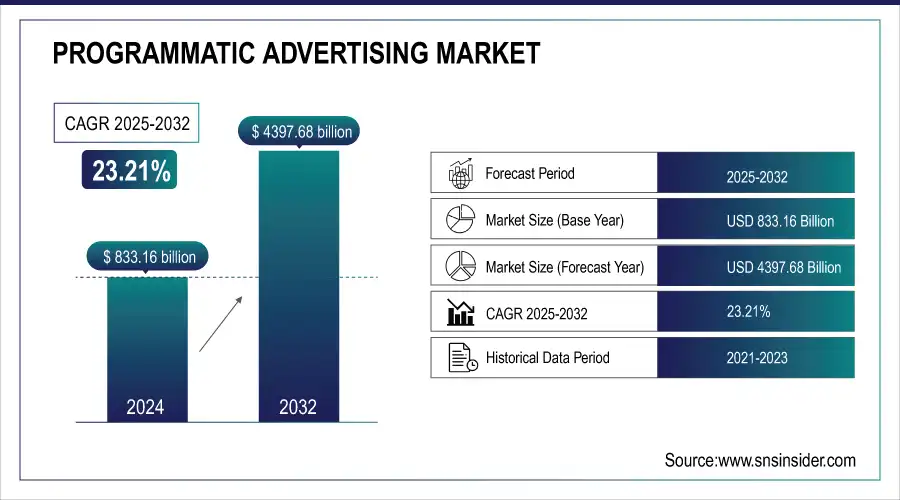
What defines programmatic marketing is the mechanism rather than format: automated, data-driven decision-making at scale and speed no human team could replicate. According to SNS Insider, global programmatic ad spend reached approximately $833.16 billion in 2024 and is forecast to approach $4397.68 billion by 2032.
How does programmatic advertising work?
A single programmatic impression involves multiple systems launching in a row, all in about 100 milliseconds:
- User visits a website. The publisher’s system detects that ad spot is about to become available.
- Impression goes to auction. The publisher’s Supply-Side Platform (SSP) sends a bid request to ad exchanges, broadcasting the user’s anonymized profile, location, device, and contextual page signals.
- Advertisers bid in real time. Demand-Side Platforms (DSPs) evaluate the bid request against campaign criteria. If the impression matches, the DSP submits a bid, the entire real-time bidding process completes before the page finishes loading.
- The winning bid serves the ad. The highest qualifying bid wins, and the advertiser pays only for that targeted impression.
The key components powering this ecosystem:
DSP (Demand-Side Platform): The advertiser’s command center. DSP advertising platforms like The Trade Desk or Google DV360 allow buyers to set targeting parameters, manage budgets, and optimize across multiple exchanges through a single interface.
SSP (Supply-Side Platform): The publisher’s equivalent. SSPs connect publishers to demand sources and help maximize revenue by showing their inventory to as many buyers as possible.
Ad exchanges: The marketplace where buyers and sellers meet. Exchanges collect inventory from SSPs and send bid requests to DSPs.
Data providers and DMPs: Third-party data providers and Data Management Platforms supply audience signals that help target better than what a publisher’s own data can offer.
Types of programmatic advertising
Real-Time Bidding (RTB)
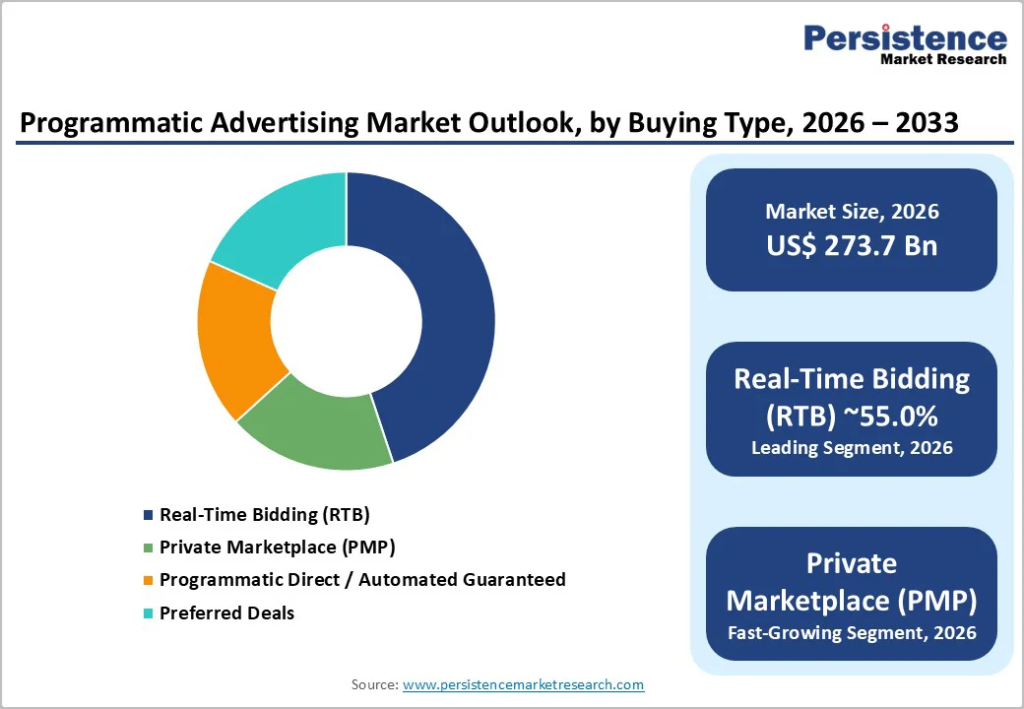
RTB is the open-auction model and the most widely used form of programmatic buying. Impressions are sold one at a time in open exchanges, with any qualified advertiser able to bid. Real-time bidding dominated with a 42% share of the global programmatic market in 2024, which puts it as the default for reach-focused campaigns. The tradeoff is less control over placement and higher exposure to ad fraud risk.
Private Marketplace (PMP)
PMPs operate on the same RTB infrastructure, the difference is access. Publishers invite specific advertisers to bid on premium inventory at agreed floor prices. For advertisers in regulated sectors like crypto or finance, PMPs offer better brand safety, higher viewability, and more transparent placement without the full commitment of a direct deal.
Programmatic Direct
In programmatic direct, a single advertiser secures guaranteed inventory from a publisher at a fixed price, negotiated in advance. The execution is still automated, but there is no auction. This model suits campaigns with precise placement requirements, for example, a crypto exchange wanting exclusivity on a major financial news site during a product launch.
Preferred Deals
Preferred deals sit between PMPs and open RTB. A publisher offers a specific advertiser the first right of refusal on inventory before it hits the open market, at a negotiated fixed CPM. The advertiser is not obligated to buy, but gets priority access when the impression matches.
Benefits of programmatic advertising
The advantages of programmatic over manual buying show up across every stage of a campaign, beginning with activation to reporting.
- Precision targeting at scale: Programmatic advertising platforms layer behavioral, contextual, geographic, and device signals simultaneously reaching audiences that manual buying cannot isolate with the same efficiency.
- Speed: Campaigns that once took weeks to negotiate go live in hours. Budget adjustments and creative swaps happen in real time.
- Measurable ROI: You can see how many impressions and conversions you get. Advertisers optimize mid-flight based on actual performance data, not estimates. For Web3 advertisers specifically, combining standard programmatic attribution with on-chain and off-chain analytics gives a fuller picture of wallet activity and transaction data that sit alongside click and conversion metrics.
- Global reach: A single DSP accesses inventory across thousands of publishers worldwide, essential for advertisers targeting classified audiences like DeFi users or retail traders across multiple regions.
Programmatic advertising vs traditional advertising
Traditional media buying depends on human negotiation at every stage, which makes it slow. A buyer negotiates with a publisher’s sales team, approves insertion orders, then waits for reporting that arrives days later.
Programmatic ads replace every manual step with automation. The gap is stark: traditional buys target audiences indirectly through content channels, while programmatic targets the specific person using verified behavioral data. Measurement shifts to impression-level attribution tied directly to outcomes. The result is why programmatic ad buying now accounts for an estimated 88% of all digital ad impressions globally, based on Persistence Market Research’s report.
Use cases: Why advertisers rely on programmatic
Programmatic’s real value becomes clear when you look at how specific industries actually use it in active campaigns.
Crypto campaign scaling
Crypto advertisers face distributed global audiences and restrictions on mainstream social platforms. Programmatic platforms built for Web3 allow brands to reach verified crypto-interested users across thousands of publishers and scale spend rapidly when market windows open.
Retargeting high-intent users
A user visits a crypto exchange’s landing page but does not register. Programmatic retargeting reaches that user across thousands of environments in the following days with adjusted messaging and higher bids reflecting their demonstrated intent. Platforms with smart bidding capabilities automate this prioritization in real time.
Global audience reach with compliance
In iGaming and finance, targeting precision is both a commercial and legal requirement. Programmatic platforms allow geo-targeting down to the city level, serving compliant creatives in licensed markets while excluding restricted regions automatically.
Performance marketing
DSP advertising is increasingly integrated with CPA and CPC models. Advertisers set cost-per-acquisition targets and let machine learning adjust bids dynamically across millions of impressions. For finance platforms with clear conversion events, such as a new account or a first deposit, this turns programmatic display advertising into a measurable direct-response channel.
Challenges and risks
Programmatic advertising offers huge scale and efficiency, but its automated nature introduces significant challenges and risks that can impact budget and performance.
- Ad fraud: Bot traffic expands impression counts without delivering real audiences. Private marketplaces, ads.txt verification, and third-party tools from providers like DoubleVerify are standard ways in any serious programmatic strategy.
- Brand safety: Automated buying can place ads in inappropriate environments. Running through selected PMPs with trusted publishers reduces this risk substantially, as do keyword blocklists and category exclusions at the campaign level.
- Privacy compliance: GDPR and CCPA have strict rules on data activation in advertising. Programmatic buyers must ensure DSPs and data providers operate within these frameworks, which are critical for financial services advertisers. As Ari Brandt, VP of Grow Programmatic Solutions at Unity, said:
“Data and navigating addressability will define the future of programmatic advertising in 2025 and beyond. Brands must be flexible in embracing first-party data and privacy-safe solutions.”
- Supply chain transparency: The ANA’s 2024 Programmatic Transparency Benchmark found that 43.9 cents of every dollar now reaches consumers, an improvement over the 36-cent baseline from 2023, but still a sign that supply chain efficiency deserves serious attention. Header bidding and Supply Path Optimization (SPO) help advertisers reduce middleman fees and improve working media ratios.
Why programmatic advertising powers top campaigns in 2026
Programmatic advertising is the primary infrastructure of modern digital marketing. For advertisers, it delivers what traditional buying never could: precise audiences at a global scale, in real time, with outcomes tied directly to business performance.
Those who engage seriously with the levers available: bidding strategy, audience segmentation, supply path quality, and creative optimization will consistently outperform those who treat it as a set-and-forget thing. The shift to automated advertising is already complete. The competitive advantage now belongs to marketers who use it with intention.

Related Posts