






The 2025 Hubspot’s State of Consumer Trends report indicates that 75% of consumers view privacy as a fundamental right and desire control over their data’s collection and usage. Since 2019, significant changes have been taking place in the world of data collection and tracking.
Cookie deprecation timeline:
- 2019 – Firefox introduced Enhanced Tracking Protection
- 2020 – Safari completely blocked third-party cookies
- 2021 – Apple’s App Tracking Transparency in iOS 14.5+ eliminated Facebook attribution
- 2025 – Google announced it would introduce a new interface in Chrome that would allow users to make informed choices about their web browsers.
Alphabet (Google) is working on the Privacy Sandbox initiative, aimed at improving online privacy and supporting digital businesses by eliminating third-party cookies.
Privacy regulations have created what analysts call a “$50 million attribution problem.” The gap prevents marketers from accurately representing marketing spend and measurable results. This change further impacts cryptocurrency advertisers, given sensitive audience data and evolving global privacy regulations. This article explains how to measure marketing success in a cookieless world.
The end of third‑party cookies and its impact
Before we dive into cookie-less attribution and tracking, let’s go back to the basics.
Cookies are small text files that collect information about users while they browse the web. There are two types of cookies: first-party and third-party. You may have noticed websites requesting your consent to use cookies, as illustrated by the pop-up banner below:

- First-party cookies are stored by the website you’re visiting and are used to improve your experience.
- Third-party cookies are created and stored by other websites and used for online advertising purposes.
Browsers like Firefox and Safari have already discontinued support for third-party cookies. Even when Google finally phases out cookies in 2025 or later, websites will still be able to collect user data using first-party cookies.
Due to these regulations and restrictions on cookie use, advertisers face a significant reduction in the amount of data they can collect. This, in turn, severely limits their ability to deliver relevant and targeted ads without cookies.
Challenges for crypto advertisers in marketing without cookies
The primary challenge for crypto advertising in a cookieless environment is the loss of reliable cross-site tracking, which complicates user identification, segmentation, and retargeting.
Cryptocurrency audiences are already fragmented and privacy-conscious, such as using VPNs, switching wallets, switching between exchanges, and consuming content on dozens of specialized websites. Cookies had been the primary scalable method for unifying these touchpoints into a cohesive user experience.
Without them, crypto marketers lose:
- Accurate attribution
- Retargeting power
- Interest-based segmentation
- Budget efficiency
Cryptocurrency marketers lose the ability to track the user journey.
Why contextual advertising is the way forward
With the phasing out of third-party cookies, a key question arises: How can advertisers determine ad placement without consumer behavior data?
This is where the cookieless solution comes in. Contextual advertising appears on webpages based on the website’s content. Such cookieless advertising can also be carefully selected offers.
For example, a media outlet might curate news articles by category for readers with specific interests:

As another example, take a look at the “Real Estate” section of The Wall Street Journal. It features classic ads for real estate content, assuming users visiting this section have already shown interest in it.

Contextual advertising aims to align with the platform’s form and function. Such cookieless ads are placed alongside relevant, high-quality content targeted to a specific demographic.
Embracing attribution without cookies
Cookieless attribution means many existing campaigns will require a fresh approach and a lot of work up front. But once you create these new personas based on cookieless data, you can continue your marketing efforts as usual.
Using first-party data
Even with the disappearance of third-party cookies, marketing teams can still leverage first-party data gathered from newsletter sign-ups, email forms, surveys, account registrations, and other on-site interactions. Here are some ways to collect first-party data to help you:
- Online surveys
- Registration forms
- Newsletters
- Community surveys
- SMS responses
- Mobile notification responses
- Direct mail
First-party data is generally more accurate than third-party cookies. When you purchase third-party data, you may find that another company is likely purchasing the same information. The advantage of collecting first-party data is that your competitors don’t have the same data. You alone possess unique customer insights and the tools for precise data source identification.
Track performance metrics
One metric that doesn’t require cookies to analyze is conversions. Another metric that doesn’t rely as heavily on cookies is customer acquisition cost, which helps ensure the long-term profitability of your advertising campaigns.
While these metrics are not as straightforward as revenue and CAC, they offer equally valuable, granular insights.
Conversion modeling
Conversion modeling is a preferred method in a cookieless environment due to its lower data requirements and ease of control. This method uses machine learning algorithms to estimate the impact of all marketing activities when actual conversions are not observable.
Here’s how the process works:
- All measurable events, including page visits, clicks, traffic sources, device info, and session data, are gathered through server-side tracking or APIs.
- The system turns this data into key behavioral features, such as visit depth, repeat visits, interaction time, and channel combinations.
- When real conversions can’t be observed, the model estimates the probability that a visitor or cohort would have converted.
- Based on these probabilities, the system assigns an estimated conversion value to the marketing channels that most likely influenced the result.
- As new data comes in, the model updates and improves accuracy by comparing predictions with verified conversions.
The shift toward Web3 attribution
Web3 attribution is a cookieless marketing analytics method that combines blockchain technology with traditional tracking methods. With Web3 attribution software, you can easily track each user’s journey from the moment they click on a targeted ad.
Advantages of Web3 attribution over traditional tracking methods:
- Enables user interaction tracking across platforms, including websites, mobile apps, and on-chain activity.
- Includes blockchain transaction data and smart contract interactions.
- Uses wallet addresses for more reliable user identification.
- Provides a more robust attribution model, thanks to blockchain’s decentralized nature.
Web3 Attribution uses the following methods to collect information:
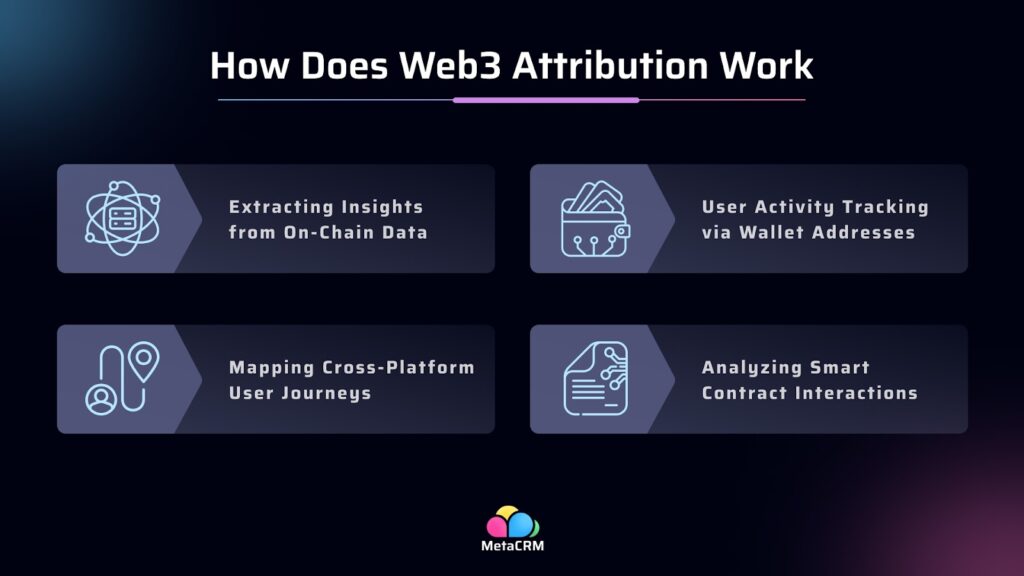
Here are several metrics you can obtain about user behavior and campaign effectiveness:
- Total value locked
- Number of active wallets
- Transaction volume
- Time to activation
- Attribution by channel
- User retention rate
- Revenue per user
These metrics will allow you to conduct a comprehensive analysis of advertising campaign effectiveness and user behavior just as effectively as cookies.
Practical steps for effective cookieless campaigns
Numerous cookieless attribution techniques are available for tracking user behavior. Here are practical, future-ready steps any crypto marketer can take to prepare for a cookieless future:
- Build a strong first-party data foundation
As third party cookies disappear, directly shared user data becomes your most valuable asset. Collect and organize information from onboarding, newsletter subscriptions, in-app and on-site behavior, product analytics, surveys, user feedback, and sign-up forms.
- Use wallet-level insights
Crypto wallets in Web3 are the closest equivalent to user profiles. Whenever compliant and privacy-safe, use wallet-linked signals to understand which contracts or dApps they interact with, how often they transact, and their level of on-chain activity.
- Lean into contextual targeting
If cross-site user tracking is not possible, prioritize ad placement where user intent is evident. Take a look at:
- the type of page or content
- publisher categories that align with your product
- community hubs.
- Apply pseudonymous tracking
Modern analytics solutions enable attribution without storing personal data. This ensures accurate cookie-free targeting solutions without compromising user trust. Look for systems that rely on:
- pseudonymous wallet IDs
- decentralized or distributed data storage
- zero-knowledge or privacy-first tracking mechanisms.
Conclusion
Most marketing departments use third-party cookies to launch, measure, and optimize marketing campaigns. The impact of a cookieless future has forced marketers to seek new ways to track customers and attribute conversions.
Cookieless attribution methods are also valuable as they offer aggregated insights into user behavior and website performance. There are a variety of methods that can be used to track user behavior. Device tracking allows users to be tracked in the same way as if the website used cookies, but without violating privacy laws. Another method is API-based tracking, which uses advertising and marketing data from web servers or CRM systems. You can also use this data to target a more general audience as part of your marketing strategy.
A practical starting point begins with auditing the current analytics stack, identifying cookie-dependent touchpoints, and replacing them with privacy-compliant alternatives such as server-side tracking, API connections, and wallet-based analytics. Then conduct a test and build a measurement framework that relies on no third-party data.
As soon as crypto brands adapt to new data collection methods for marketing, the faster they will outpace competitors and more effectively establish themselves.

Related Posts