






Every business eventually faces the same question: where should I actually put my message? Advertising today refers to everything, including a billboard or a 6-second ad served to a hyper-targeted audience on YouTube, and understanding the different types of advertising is a core business skill rather than just a marketing concern.
In 2025, global ad spending crossed $1 trillion, according to Best Media Info. Digital channels now account for nearly 73% of worldwide ad investment, a share that was just under 50% as recently as 2018. Traditional advertising still holds ground in specific contexts. Understanding your options and knowing when to combine them are the true skills.
What are the main types of advertising?
At the fundamental level, advertising splits into digital and traditional. Digital runs across internet-connected platforms like search engines, social media, websites, and apps. Traditional covers offline media, such as television, radio, print, and outdoor formats.
Within those buckets, further differences matter: paid vs. earned attention, brand awareness vs. direct response, broad reach vs. precision targeting. Some formats, like native advertising or programmatic advertising, blur category lines entirely.
Digital advertising types
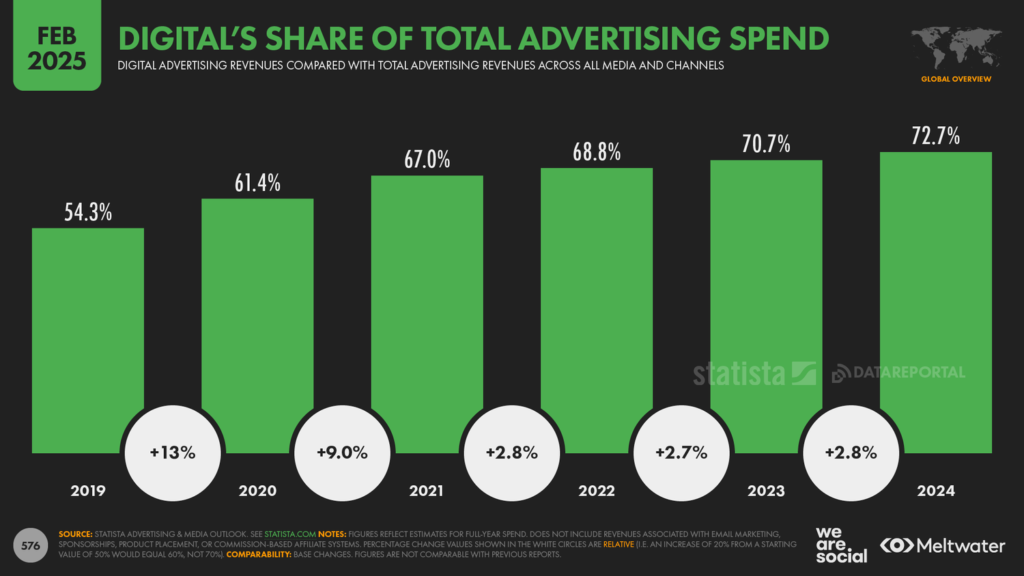
Digital formats dominate today’s ad spend because they offer measurable results and the flexibility to start small and scale quickly.
Search advertising (PPC)
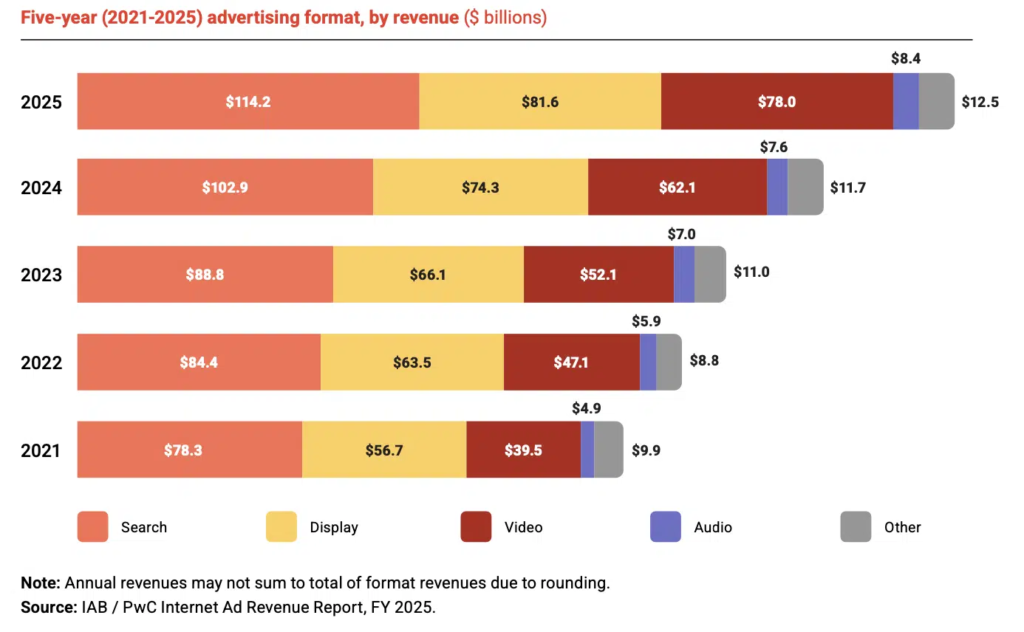
Search advertising – pay-per-click – puts your ad in front of people the moment they’re actively looking for what you offer. You bid on keywords and pay per click. According to the IAB’s 2025 report, US search advertising generated $114.2 billion, accounting for nearly 38.8% of total US digital ad revenue. However, clicks can be costly in competitive markets like legal or SaaS. It rewards tight targeting and disciplined testing.
Display advertising
Display advertising covers banner ads and image placements shown across websites and apps. It’s particularly effective for retargeting, staying visible to people who have already shown interest, and building awareness at scale. It generates lower direct-response rates than search on its own, but plays a valuable role in keeping a brand present throughout the customer journey.
Social media advertising
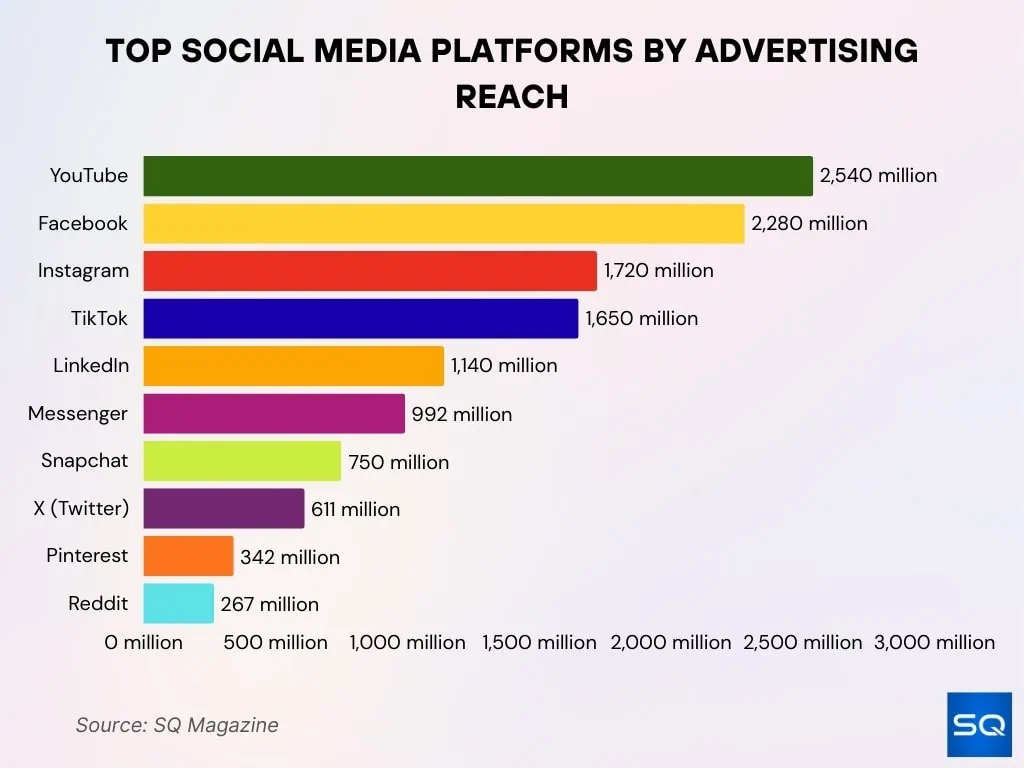
Social media advertising has become the default entry point for most businesses. Platforms like Meta, TikTok, and LinkedIn offer targeting built around audience data, such as age, interests, job title, and behavior, rather than keyword intent. TikTok alone generated over $33.1 billion in ad revenue in 2025, and Meta commands over 23% of global digital ad spend. The right platform depends heavily on your audience: Instagram and Facebook for consumer brands, LinkedIn for B2B, and TikTok and Reels for younger demographics.
Native advertising
Native advertising is designed to blend into surrounding content, which appears as an article recommendation, promotional content, sponsored post, or editorial-style piece rather than a traditional banner. The difference is obvious, but visually slight. Platforms like Taboola and Outbrain distribute this content at scale across publisher sites. High-quality implementation provides educational value that aligns with brand objectives, whereas low-quality placements produce low engagement and risk harming publisher credibility.
Video advertising
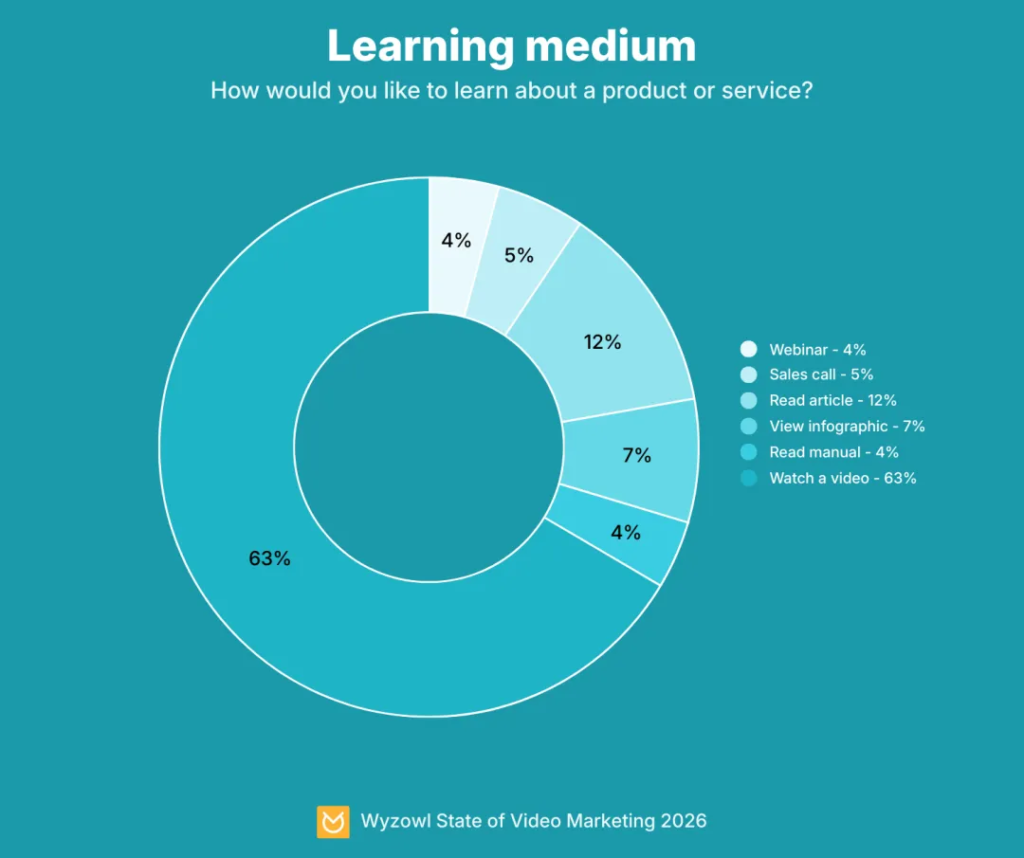
Video advertising has become dominant in digital marketing. US digital video ad revenue rose 25.4% year-over-year to $78 billion in 2025, per the IAB/PwC Full Year 2025 report, up from $62.1 billion the prior year and the fastest-growing major format. Wyzowl’s research finds that 63% of consumers prefer to learn about a product through a short video rather than text. Formats include skippable pre-rolls alongside non-skippable connected TV spots, and the rise of TikTok, Reels, and YouTube Shorts has made this channel accessible even to brands without big production budgets.
Affiliate marketing
Affiliate marketing is performance-based: publishers like bloggers, influencers, comparison sites, and content creators promote your product and earn a commission on sales or leads. You only pay for results, which makes it cost-efficient for e-commerce, SaaS, finance, and travel. The main risk is quality control; low-credibility affiliates can damage brand reputation while still generating clicks.
Influencer marketing
Influencer marketing partners brands with creators who have built trusted audiences on Instagram, YouTube, LinkedIn, or TikTok. The global influencer marketing industry reached $32.55 billion in 2025, per SQ Magazine data. The trend has shifted toward micro-influencers (10k-100k followers) with smaller, niche followings and higher engagement, who often deliver better ROI than celebrity partnerships at a small percentage of the cost.
Programmatic advertising
Programmatic advertising is the automated technology layer behind most digital ad buying. Rather than negotiating placements manually, advertisers use demand-side platforms (DSPs) to bid on impressions in real time across millions of sites and apps. In 2024, global programmatic ad spend reached an estimated $595 billion, according to Statista, and in the US, 91.5% of all display ads are purchased programmatically now. It’s increasingly extending into connected TV, digital out-of-home, and audio inventory.
Traditional advertising types
Despite the digital shift, offline formats still reach audiences that digital alone can’t fully capture, and for brand building at scale, some of them are still very effective.
TV advertising
TV remains unmatched for reaching a mass audience with emotional storytelling, particularly during live events. But linear TV is under structural pressure: GroupM forecasts linear TV ad revenue will decline 3.4% in 2025, while streaming TV advertising grows 19.3%. For most mid-market brands, connected TV (CTV) is the more accessible and measurable alternative.
Radio advertising
Radio’s resilience comes from its community reach and low production costs. Audio advertising, including podcast sponsorships and Spotify ads, is growing alongside traditional terrestrial radio. It works for local targeting and brand recall, though it lacks the visual storytelling and tracking precision of digital formats.
Print advertising
Print has seen sustained declines in circulation and ad revenue. It still carries a credibility signal that some digital formats lack. Traditional advertising examples in print work best when the medium fits the message: a luxury brand in a premium magazine, a B2B company in a trade publication, an enterprise software provider placing an ad in a specific industry trade journal, or a local business in a community newspaper.
Outdoor advertising (OOH)
Outdoor advertising, like billboards, transit ads, bus shelters, and airport displays, is one of the oldest formats and one of the more resilient ones. Unlike digital formats that can be closed or bypassed, outdoor placements offer permanent physical visibility to commuting audiences. Digital OOH (DOOH) has added programmable creative that changes by time of day or weather conditions, and programmatic buying is increasingly available for outdoor inventory. For urban brand awareness campaigns, outdoor advertising still performs.
Emerging and modern advertising trends
The advertising landscape is constantly changing, so three formats in particular are reshaping how brands reach audiences in ways that didn’t exist a decade ago.
Contextual advertising
Contextual advertising is having a renaissance as third-party cookies fade and privacy regulations tighten. It targets based on the content someone is currently reading rather than their behavioral profile – less invasive and often highly relevant.
Mobile advertising
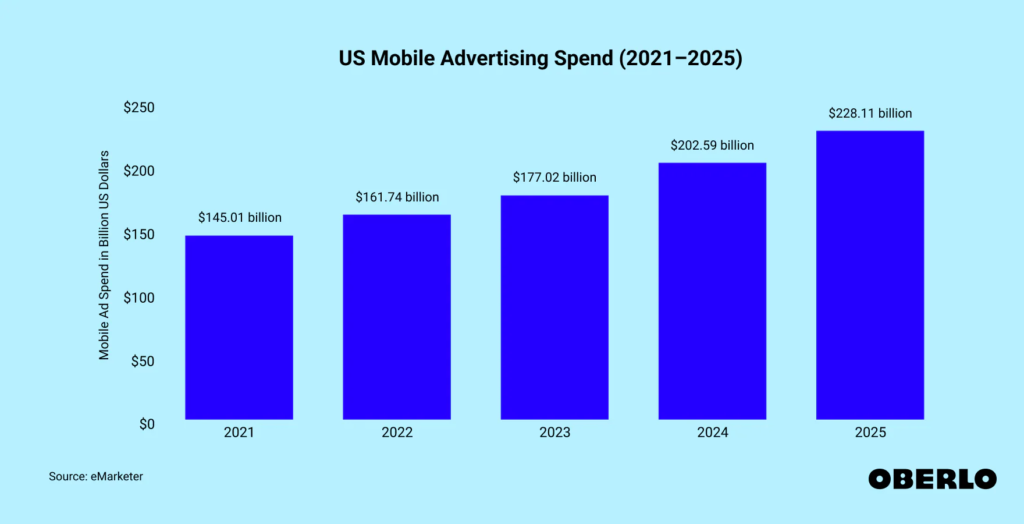
Mobile advertising isn’t a separate format so much as a mandatory lens. US mobile ad spending reached around $203 billion in 2024, which marks a 14.4% year-over-year increase. Any approach that disregards the mobile experience is unstable.
Crypto and Web3 advertising
Web3 advertising and cryptocurrency are no longer experimental. Global Web3 and crypto advertising spend surpassed $12 billion in 2025, with over 659 million crypto users worldwide. The audience is substantial. Platforms like Bitmedia, a crypto-native ad network that has served over 150 billion impressions across 6,000+ crypto-related websites, illustrate how purpose-built infrastructure is filling the gap left by mainstream platforms like Google and Meta due to their crypto ad restrictions.
The advertising infrastructure, such as decentralized ad networks and token-incentivized attention models, remains fragmented compared to mainstream platforms. For brands targeting crypto-native or gaming audiences, it’s already a profitable channel; for mass-market brands, the infrastructure still needs to mature.
How to choose the right type of advertising
Four factors tend to determine which format fits: What’s your goal? What’s your budget? Who is your audience? How quickly do you need results?
For direct conversions, search and performance-focused social media campaigns deliver the clearest results. Video and programmatic display, together with outdoor advertising, all work well to increase brand awareness. Tighter budgets generally perform better concentrated in one channel than split across several. LinkedIn and industry-specific media usually perform better for B2B than general consumer channels.
The funnel matters more than the format. Most purchases don’t happen on first exposure. A customer might discover a brand via a YouTube pre-roll, research it through search, see a retargeting banner, and then convert via a social promotion. These formats work together, so attribution usually goes to the last click, but the earlier touchpoints matter too.
Pros and cons of different advertising types
| Ad type | Cost | Targeting | Scalability | Best for |
| Search (PPC) | Medium-high | Very high | High | Direct conversions |
| Display | Low-medium | Medium (high for retargeting) | Very high | Retargeting, awareness |
| Social Media | Low-high | Very high | Very high | Brand building, e-commerce |
| Native | Medium | Medium-high | Medium-low | Mid-funnel consideration, native storytelling |
| Video | Medium-high | High | High | Brand awareness, demos |
| Affiliate | Performance- based | Medium | Medium | Cost-controlled acquisition |
| Influencer | Variable | Medium | Medium | Trust and product launches |
| Programmatic | Low-medium | Very high | Very high | Scale, multi-channel reach |
| TV | Very high | Low-medium | Very high | Mass brand awareness |
| Radio | Low-medium | Medium | Medium | Local reach, recall |
| Medium | Low-medium | Low | Niche/trade audiences | |
| Outdoor (OOH) | Medium-high | Location- based | Medium | Urban brand presence |
No single ad format wins every time
There’s no universal answer to which advertising type performs best, so a high-growth SaaS company and a local bakery have fundamentally different needs. What the data makes clear is that digital now dominates, with search, social media, video, and programmatic advertising growing fastest. But traditional formats like outdoor advertising and TV aren’t disappearing, and they’re finding their role alongside digital rather than being replaced by it.
The most effective advertisers treat their channel mix as something to test and refine. You can begin with the formats that match your audience and goals, measure what’s working, and build from there.

Related Posts