

A publisher quotes you an $8 CPM for a banner slot, and you have $5,000 to spend. How many times will your ad show? If that takes more than a few seconds to answer, this guide is for you.
CPM sits under most impression-based ad buys, and the math behind it fits on one line. Below you’ll find the formula, a CPM calculator that solves for whichever number you’re missing, indicative 2026 CPM ranges for eight verticals, and the reasons a cheap CPM can be an expensive mistake. Bitmedia prices its ads per thousand impressions, so we’ll borrow its bidding options as examples where they help.
CPM meaning: what does CPM stand for in advertising?
CPM stands for cost per mille, also written as cost per thousand (CPT). “Mille” is Latin for a thousand, so cost per mille is the price of 1,000 ad impressions. An impression is counted each time your ad loads on someone’s screen, whether or not they notice it.
The pricing model is simple. You set a budget at an agreed rate per thousand impressions, and the platform or network serves your ad until that budget runs out. Exposure is what you pay for, whether or not anyone clicks, so visits and sign-ups depend on how well your creative and targeting fit the audience. At a $5 CPM, 200,000 impressions cost $1,000.
Where CPM pricing is used
Display is the classic home of CPM advertising: banners and the pop formats that many ad networks run are sold per thousand views, because page loads are what a publisher can count and sell with certainty. Native ads, which match the look of the page around them, and video ads, including pre-roll and connected TV, typically follow the same model.
Programmatic buying puts all of these formats into automated auctions. Advertisers bid a CPM for each impression, and the winning bid takes the slot in milliseconds. Bitmedia’s network works this way. You set a CPM bid for your campaign, either fixed or adjusted automatically by Smart Bid, and the bidding strategy guide explains how each one behaves.
The CPM formula and how to calculate CPM
The standard CPM formula looks like this:
CPM = (Total ad spend ÷ Total impressions) × 1,000
Say you spent $2,500 and your ad was shown 400,000 times. Divide $2,500 by 400,000 to get 0.00625, then multiply by 1,000. Your CPM is $6.25.
Rearrange the same formula and you can plan a buy before it starts:
Impressions = (Budget ÷ CPM) × 1,000
Budget = (Impressions ÷ 1,000) × CPM
With $5,000 at an $8 CPM, you get (5,000 ÷ 8) × 1,000 = 625,000 impressions. If you want 1,200,000 impressions at a $4.50 CPM, you need (1,200,000 ÷ 1,000) × 4.50 = $5,400.
Calculate based on your actual spend, and ensure that both spend and impressions are matched to the same dates and currency. When you run several campaigns, a common mistake is to average their CPMs. The correct figure is the blended CPM: total spend divided by total impressions, times 1,000. Take $1,000 that bought 200,000 impressions (a $5 CPM) and $4,000 that bought 400,000 (a $10 CPM). The simple average says $7.50. The blended figure is $5,000 ÷ 600,000 × 1,000, or $8.33.
Publishers use the same formula from the other side. eCPM is earnings per 1,000 ad impressions served, and RPM (revenue per mille) is earnings per 1,000 pageviews, so it also reflects how many pageviews actually carry an ad.
CPM calculator
Pick the number you’re missing, enter the other two, and the answer appears instantly. Add a click-through rate and a conversion rate if you like, and the calculator also shows your cost per click and cost per acquisition.
Try a $300 daily budget at a $3 CPM. That buys 100,000 impressions a day, which is also the minimum daily budget for Smart Bid on Bitmedia, so it’s a realistic size for a first test.
2026 CPM ranges by vertical
What counts as a “good” CPM depends on who you’re trying to reach. The table below gives indicative 2026 ranges. They come from published studies and network price lists that measure different things over different periods, so use them to sanity-check your own plan.
What pushes CPM up or down
CPM is an auction price, so it follows demand.
- Industry and competition. When many advertisers want the same audience, the price climbs. Sectors where one customer is worth a lot, such as insurance or legal services, pay more per thousand impressions than food or apparel. One 2026 Meta roundup lists insurance at $21.40 and food and beverage at $8.14.
- Geography. Audiences in the US, UK, Canada, and Australia often cost more than audiences in developing markets. Tier-1 markets sit at the higher end of its CPM ranges.
- Audience quality. Narrow targeting and retargeting both raise CPM, because fewer people qualify and more bidders want them. In crypto the gap is easy to see. Blockchain-Ads’ 2026 benchmarks put most Web3 network CPMs at $2-$15, while wallet-targeted campaigns on premium inventory reach $20-$40.
- Format. On Cointraffic, pop-unders typically run €1-€3 per thousand, against €8-€9 for display banners. Native ads sit in between at €6-€8. A 2026 CPMKit roundup puts video pre-roll at $8-$15 and connected TV at $25-$40, though it calls its own figures directional.
- Seasonality. In Supermetrics’ Meta data for retailers, CPMs in Black Friday week were 22% to 57% higher than in September, depending on the sector.
- Ad placement. An ad below the fold can be counted as an impression without anyone seeing it. Under the MRC standard, a display ad counts as viewable only when half its pixels are on screen for one continuous second.
- Traffic quality. Bots inflate impression counts and return nothing. HUMAN Security’s 2026 State of AI Traffic report found automated traffic growing eight times faster than human traffic year over year. A low CPM on a site full of bots saves you nothing.
CPM vs CPC vs CPA
The three models charge for different events, and each fits a different job.
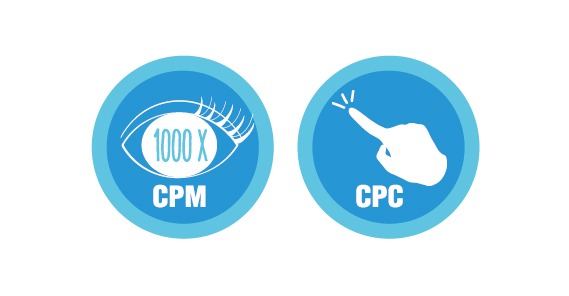
You can move between them with two steps. Divide the CPM by the number of clicks you get per 1,000 impressions to find the CPC. Then divide the CPC by your conversion rate to find the CPA. CPM’s main advantage is a clear price for reach: you know what 1,000 impressions cost before you buy, and the figure compares cleanly across campaigns of different sizes. Its main drawback is that it says nothing about what those impressions produced, and you pay the same whether or not the ad was seen. Many advertisers use CPM to reach cold audiences and switch to CPC or CPA once they have something to measure.
Why the lowest CPM rarely wins
Compare two hypothetical placements bought with the same budget. The inputs sit inside the typical 2026 crypto-network ranges of 0.1-0.3% CTR for display and 0.5-3.0% for native, and both placements convert 3% of clicks.
The native placement costs 80% more per thousand impressions and 70% less per customer. Picking the display banner on CPM alone is a common mistake because it costs more per customer.
Viewability also affects what you pay per view. Typical rates run between 50% and 70%, so a share of what you buy is never seen. Viewable CPM (vCPM) divides spend by viewable impressions: $1,000 that bought 200,000 impressions is a $5 CPM, but if only 55% were viewable, the vCPM is $1,000 ÷ 110,000 × 1,000, or $9.09.
How to optimize CPM campaigns
- Set the budget from the impressions you need. Work backward: decide how many impressions a test requires, multiply by the CPM, and divide by the number of days. A test of 500,000 impressions at a $4 CPM costs $2,000, which is about $143 a day over two weeks. Keep part of the budget aside to scale whatever works, and leave room for peaks. In Supermetrics’ 2025 data, the lowest-cost advertisers began ramping up on October 6, five weeks before everyone else, so build audiences and test creatives early and budget for higher CPMs when demand peaks.
- Choose a bid that reaches the traffic you want. In Bitmedia’s own guide, a $0.30 CPM bid only reaches publishers whose floors sit at or below that, so inventory priced at $3 or $10 stays out of reach. Bitmedia recommends starting with its Recommended Bid. With Smart Bid, you set a target CPM (the guide’s example is $1.51), and the algorithm mixes cheaper traffic at around $0.35 with premium traffic at $8. The average stays near your target.
- Test geographies and placements separately. Split campaigns by country tier and by site package so you can see which audiences cost more and which pay back. Exact Bid packages work as whitelists, and you can remove sites that underperform. Favor slots where the ad sits in view and drop sources with weak viewability, since a site with fewer impressions at a higher CPM can still give you more real views per dollar.
- Cap frequency. Showing one person the same ad ten times in a day burns budget. Bitmedia’s frequency cap limits how many times each visitor sees an ad within a set window, such as a day or a week.
- Read CPM next to the other metrics. Track it weekly alongside CTR, CPC, CPA, and conversion rate, and build a baseline from one to three months of history. A higher CTR lowers your effective cost per click at the same CPM, so a creative refresh can cut costs without touching the bid. Ask your network for viewability and invalid-traffic reporting. Then put your real spend and impressions into the calculator above and plan against that number.

Related Posts