





Static banners still have a job, but attention is harder to earn when every placement competes with content, feeds, notifications, and familiar ad patterns. Playable ads change the sequence: instead of asking for a click immediately, they give the user a short interaction, a result, and then a clear reason to continue. Bitmedia is bringing this format to its advertising platform with five ready-to-use templates: Spin the Wheel, Scratch Card, Quiz, Pick a Box or Card, and Tap to Reveal.
The launch comes as interactive advertising continues to expand. MMR’s current market estimate puts the global interactive advertising sector at a 15.3% CAGR for 2026-2034, while rewarded and playable in-game placements are projected to grow at 10.89% annually through 2035.
The release also marks a step in Bitmedia’s growth from a Web3-only network into a global advertising platform with interactive display ads built into the same dashboard.
Banner blindness: why static banners hit a ceiling
Banner blindness describes the tendency to overlook advertising that has become visually familiar or easy to classify as an ad. The challenge is not that static banners have suddenly stopped working. It is that users have learned how to filter them. Rank Lyx currently cites research indicating that internet users ignore more than 80% of digital ads, alongside a figure of 63% of millennials using ad blockers.
A standard display creative usually asks the audience to make one decision: notice it or move on, then click or continue browsing. Static image ads remain valuable when the message is simple or the placement favors quick visual recognition. Bitmedia continues to support those types of display ad formats alongside HTML5 and Playable Ads, so advertisers can choose according to the campaign objective.
The opportunity with interactive display ads is to introduce a smaller decision before the outbound click. A user can tap, answer, scratch, spin, or reveal something inside the ad. The interaction creates a moment of participation without requiring the person to leave the page.
What are playable ads?
Interactive advertising is any ad that asks the viewer to take part instead of just watching. Types of interactive advertising include polls, quizzes, mini-games, augmented reality try-ons, and shoppable video. A playable ad is the display-slot version: a short, self-contained interaction that runs inside a standard banner placement. It joins Bitmedia’s existing image, HTML5, and video banner formats as a new creative type.
Play, see the result, then click
The flow has three beats. The user performs a short interaction inside the ad slot, such as a spin, a scratch, or an answer. The ad then shows a result. After that, a clearly separated call to action sends the user to the advertiser’s landing page.
The result matters as much as the interaction. A user who has just won a prize tier or received a personalized answer arrives at the CTA with a reason to click. Clicks from people who have already engaged tend to be more deliberate than clicks on a static image.
Only the final click counts
Interactions inside the ad are never counted as ad clicks. Spinning the wheel, tapping a card, or choosing an answer does not register as outbound traffic. Only the final CTA click, the one that takes the user to the landing page, counts.
On Bitmedia, the same rule applies: in-banner interactions stay inside the ad, and the final CTA takes the user to the campaign’s Click URL, so the whole banner is not a single click-through area. Stating this publicly is a trust signal for advertisers, who pay for real outbound traffic, and for anyone reviewing how clicks are measured.
Playable ads vs rich media ads
Rich media ads are the broad category: video, audio, expandable experiences, animation, interactive elements, games, and HTML5 banner ads, often built in dedicated third-party platforms. Playable ads on Bitmedia are a curated slice of that category. Its defining feature is a short interactive experience built around participation before the user reaches the CTA. Advertisers choose from approved templates instead of writing custom code.
That choice involves a trade-off. Advertisers give up unlimited creative flexibility because only the approved templates are available in the self-serve flow. In return, they get no coding or design skills required, lower QA and security risk, faster moderation, and an interactive format bundled into the network they already use. There is no separate rich media license to buy. Bitmedia also supports third-party rich media tags from platforms such as Celtra, Adform, Flashtalking, and Google Studio, so teams that already work with those tools keep that option.
Sizes: 300×250, 336×280, 300×600, 320×480
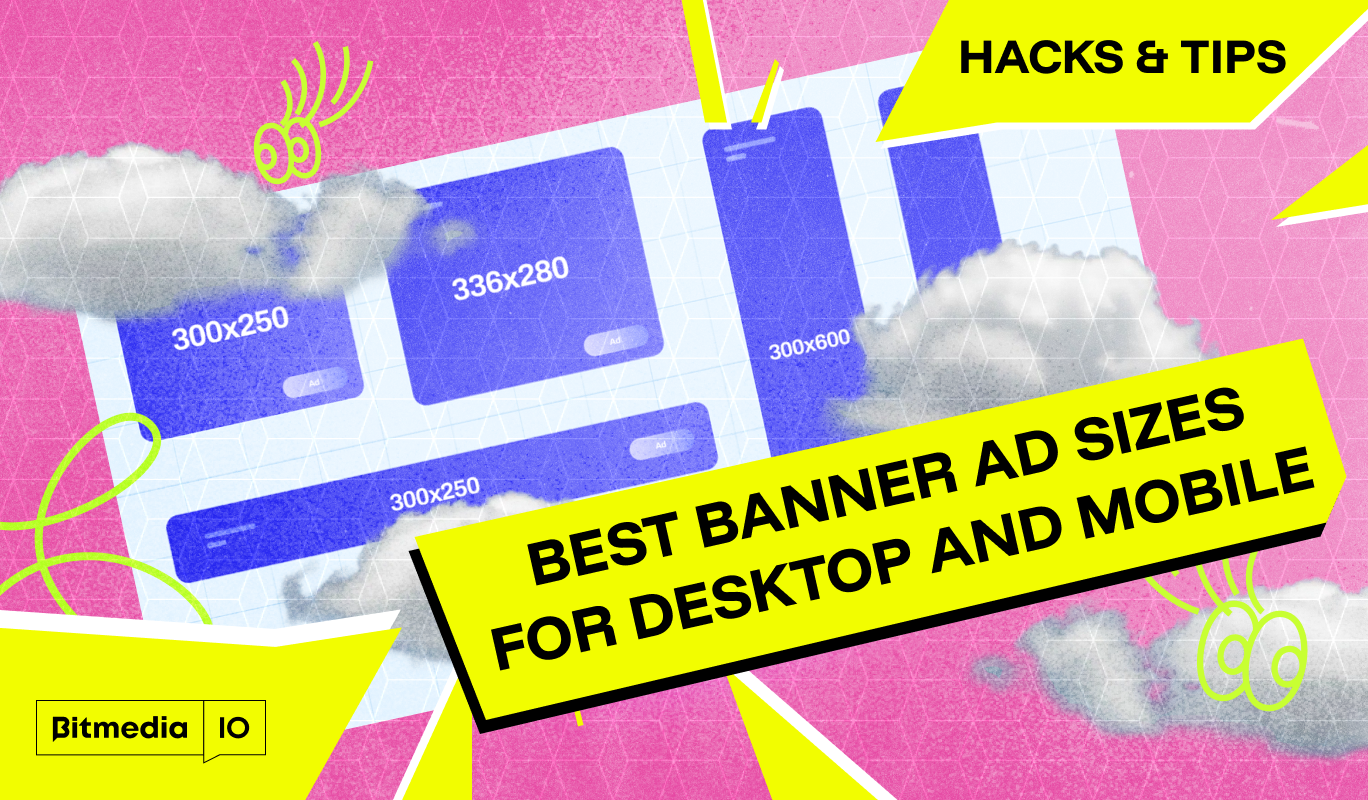
Playable ad units run in four standard display sizes: 300×250, 336×280, 300×600, and 320×480. The mix covers common desktop placements and a mobile-friendly vertical size. They cover common rectangular and portrait placements while keeping the interaction inside a familiar display-ad footprint.
5 playable ad templates, with examples
The five launch templates give advertisers several ways to turn a conventional creative into an interaction. These are practical playable ad examples, but the right choice depends on the audience, offer, compliance requirements, and the decision you want the user to make.
Spin the Wheel
Spin the Wheel uses a familiar chance-based mechanic. The user activates the wheel and receives one of several predefined outcomes before seeing the CTA.
For iGaming, this may feel close to an existing product experience. A sportsbook or casino can use the visual language of a lobby or promotional mechanic without forcing the user directly into a landing page. The format also works for promotions built around discounts or other reward-led messaging where the mechanic fits the campaign and compliance rules.
Because the mechanic is explicitly chance-based, it should be selected carefully for audiences where chance framing supports the product rather than conflicts with it.
Scratch Card
The user scratches a panel to reveal what is underneath. This is a lottery-ticket mechanic, also chance-based. It works well when the prize or offer is the star of the creative, such as a welcome bonus or a limited-time code.
Quiz
Quiz is the most logic-driven of the five formats and the only launch template that is not based on chance.
A quiz asks a few short questions and produces a result that connects naturally to the advertiser’s offer. That makes it especially useful when the goal is segmentation, recommendation, education, or qualification.
There is also broader evidence supporting the appeal of quizzes as an interactive format. Web Tonic currently reports a 40.1% start-to-lead conversion rate for lead-generation quizzes, based on more than 80 million leads collected over more than a decade.
Pick a Box or Card
The user chooses one box or card from several, and the choice reveals an outcome. It is a mystery-box mechanic, chance-based like the wheel and the scratch card. The visible choice gives the user a sense of control, which suits promotions and teasers. Picking a box or card is most suitable for campaigns where discovery and reward are central to the creative concept.
Tap to Reveal
The user taps to uncover a coupon, product fact, feature, game scene, recommendation, or statistic. It is the most neutral of the five and works for almost any message. For brands that want interaction without any association with chance, it is the simplest option. It is also a strong option when a brand wants the interaction to feel informative instead of promotional.
Static banner vs playable ad: two tools for two jobs
The debate around static vs dynamic ads often turns into a simple question of which format is “better.” That is the wrong decision framework. Some placements and some advertisers will still benefit more from a standard banner, and the comparison below will help you choose.
| Dimension | Static/HTML5 banner | Interactive/Playable ad |
| User interaction | Look or scroll past | Play, then decide |
| Engagement signal | Click or no click (binary) | Interaction, result, then click (graduated) |
| Attention mechanism | Visual only | Visual plus active participation |
| Build process | Image or static HTML5 upload | Template fill-in, no code |
| Pricing model fit | Standard CPM | Premium CPM, CPE, or hybrid |
| Fatigue resistance | Wears out faster when the same image repeats | Variable outcomes keep each interaction fresher |
Static banners keep real strengths. If your message is a price or a short reminder, a clean image from the static image ads format may be all you need.
The advantages of interactive advertising show up where a message needs participation to land. A Facebook case study cited by Adjust reports that the mobile games company Me2Zen raised ROAS by 50%, tripled in-app purchases, and cut cost per install by 9% using playable ads. In the same guide, Australian fintech Lendi used a playable refinance calculator on Facebook and reported 20% more incremental leads and a 66% lower cost per lead.
Which template fits your vertical
Gamification in advertising only works when the game fits the audience. The recommendations below describe what tends to resonate with each audience type. They are starting points for testing rather than rules or guarantees.
iGaming: spin and scratch feel native
Among the verticals covered in the launch strategy, iGaming has the clearest natural connection to interactive mechanics.
Spin the Wheel and Scratch Card resemble actions users already recognize from gaming products. That familiarity can make the ad feel closer to the experience users expect from the product itself. The strongest fit is therefore Spin and Scratch for gaming audiences that are comfortable with chance-based mechanics.
Sportsbook-style audiences are the exception worth knowing about. They tend to see themselves as skilled decision-makers, instead of gamblers, so skill-framed formats such as Quiz usually land better than pure-chance wheels for them. As with any gambling creative, check the rules of each target market before you launch.
Nutra: sell a feeling, not a claim
Quiz and Tap to Reveal let a brand communicate a benefit through experience, such as a personalized match or a moment of discovery, instead of an explicit health claim. The creative also feels fresher in a vertical known for fast creative burnout. Compliance review is still required, and a lighter claim footprint makes that review easier.
GameFi: rebuild trust with Quiz and Tap to Reveal
GameFi has a trust problem that makes the choice of mechanic especially important.
Quiz and Tap to Reveal allow a project to show what the game actually offers without leading with tokens, earnings, or financial incentives. A Tap to Reveal experience could showcase gameplay footage or a game feature. A Quiz could introduce the player’s role or gameplay preferences.
The goal is to let people experience the product before asking them to believe the pitch around it. For this reason, Spin the Wheel, Scratch Card, and Pick a Box should be avoided for this audience. Those mechanics are associated with chance, and reinforcing that association works against the trust-building message.
E-commerce: a quiz that works like a product match
E-commerce is a natural environment for Quiz and Tap to Reveal because shopping often starts with a question: Which product is right for me?
A quiz can turn the banner into a lightweight recommendation experience. Instead of presenting a general product advertisement, it asks the user to make a few choices and delivers a relevant result. That is the appeal behind the “find your match” model. It makes the interaction feel closer to a product finder than a conventional banner.
The wider quiz ecosystem also provides useful context. Web Tonic’s current dataset reports a 37.6% start-to-lead rate for product-recommendation quizzes.
No code needed: three ways to build a playable ad
Bitmedia’s launch is designed around pre-built interactive experiences. For the five standard templates, advertisers do not need to write custom HTML or JavaScript.
There are three practical paths.
Pick a ready template
The simplest route is to choose one of the five launch templates and provide the content that fills it: headline, images, CTA, outcomes, and other campaign fields.
This is the main no-code advantage. The interaction logic is already defined, so the advertiser is working on the message and creative inputs rather than engineering the experience from scratch.
Upload your own HTML5 playable ad
Advertisers with an existing build can use HTML5 playable ads through Bitmedia’s technical workflow.
The current Playable Ads documentation specifies a ZIP upload, a maximum archive size of 3 MB, an index.html file at the root, relative asset paths, and Bitmedia’s SDK contract. Most importantly, gameplay must remain inside the ad, and the exit action should occur only on the final CTA.
Before uploading, review the HTML5 playable ads requirements to make sure the creative obeys the platform rules.
Order a custom build
If you want something more tailored than a template and have no developers to spare, Bitmedia’s managed service can build a custom creative for you. Speak to your account manager or sales contact to scope it.
How to launch your first playable ad on Bitmedia
Learning how to create playable ads mostly comes down to the normal campaign workflow, with the interactive creative added at the creative stage.
- Log in. Log in to your advertiser account and start a new campaign.
- Set the Click URL. Enter the full URL of your business website, ideally with UTM tags for tracking. Bitmedia’s guide shows how to add UTM tags to your Click URL.
- Choose the format. Select Rich Media as the ad format, then Interactive HTML5 as the banner type.
- Add the creative. Upload your ZIP, pick the banner size, and name the creative. Template users fill in their fields here instead.
- Preview. Check the preview window to confirm that in-banner clicks do not leave the ad. If the file has errors, a validation message appears.
- Submit for approval. Click Apply for approval; the support team reviews and approves the ad before launch.
- Track results. Before you go live, set up conversion tracking so you can see what the final CTA click produces.
Playable ads FAQ
Playable ads vs advergames: what’s the difference?
Advergames are branded games created as a marketing experience. They can be substantial standalone experiences with their own game logic, progression, or gameplay.
Playable ads are advertising units built for a much shorter interaction. The user stays inside the ad, completes a limited experience, sees an outcome, and then receives a CTA.
A playable ad can use game mechanics without becoming a full advergame. The difference is mainly the role the experience plays in the campaign and how much interaction is expected from the user.
Do interactions count as clicks?
No. Spinning, scratching, tapping, or answering inside the ad is never counted as an ad click. Only the final CTA click to the advertiser’s landing page counts as an outbound click, so the clicks you see reflect people who chose to leave the ad and visit your site.
Which sizes are available?
Playable ads run in four sizes: 300×250, 336×280, 300×600, and 320×480.
Do I need a developer?
Not for the template route. You pick a template and fill in the fields. A developer is only needed if you want to upload your own HTML5 playable ad, and the managed service covers anyone who wants a custom build without the engineering work.

Related Posts