







Some advertisers swear by video banners and won’t touch a static creative again. Others tried it once, saw a spike in CPM, and went back to their old JPGs. Both camps have a point, and that’s exactly why this deserves a proper look instead of another “video is the future” pitch. The real question is where the gap actually shows up and whether it matters for what you’re running.
The performance gap between video and static banner
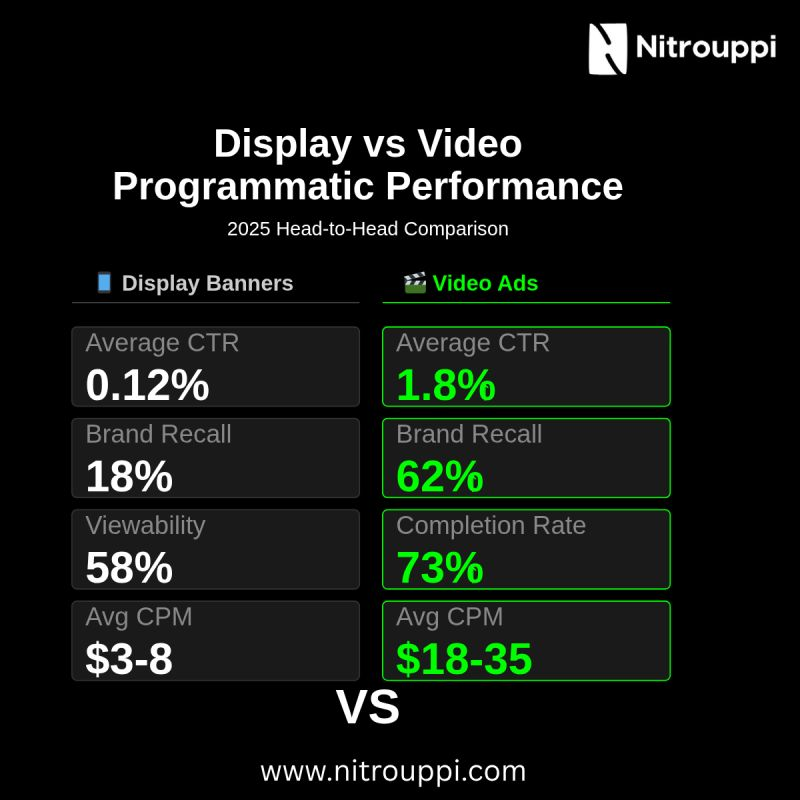
Start with the raw click data. Standard display banners average a 0.46% CTR industry-wide, while video display formats run 73% higher than that according to Digital Applied. Industry-wide Owlclaw data from 2025-2026 lands in a similar place: rich media and video units deliver up to 4x the click-through rate of standard display, according to aggregated Google and IAB benchmark figures.
Crypto-specific data tells the same story with sharper edges. Across 200+ publishers on HypeLab’s crypto ad network, static display banners average a 0.08%-0.25% CTR, while video in rewarded placements reaches 0.40%-0.80%. And wallet-aware campaigns convert two to four times better than demographic targeting alone. Cost-per-lead data from a controlled A/B test of Cardinal Digital Marketing tells an even more direct story: $2.75 per lead for video versus $14.22 for static image ads run in the same campaign, an 80% reduction.
None of this makes static banners outdated. They still perform well for brand recognition and repeat-exposure frequency. But on the metrics that decide whether a crypto campaign hits its target, like CTR and CPL, the gap is wide enough that it stops being a design preference and starts being a budget decision.
Attention mechanics: why motion beats static
Banner blindness is a documented, measurable behavior rather than a marketing buzzword. Eye-tracking research from the NN Group on web advertising consistently finds that users who are focused on page content simply stop registering banner-shaped elements, whether or not those banners are well designed. The brain learns the shape of an ad and files it under “ignore” before any message gets through.
Motion breaks that filter, and there’s a biological reason for it. Human vision runs on two separate processing routes: a fast one built to detect motion and movement and a slower one that handles color, detail, and fine text. Vision scientists call the fast route the magnocellular pathway. It evolved to detect movement in the environment before the brain has fully understood what is moving. This is useful for finding a predator in the grass and also for drawing attention to a moving banner. A static creative has only the slow route to work with. It has to be consciously scanned to register at all, which is exactly the step banner blindness skips.
The gap between video and static isn’t really about production polish. A rough, low-budget video banner will often out-click a beautifully designed static one, because the deciding factor is movement. Movement alone doesn’t guarantee results. A video that plays out slowly or buries its message past the first few seconds gives banner blindness time to reassert itself.
Where in-banner video pulls its weight
Video display ads don’t help every campaign equally. Four situations show up again and again in in-banner video ad examples across Bitmedia’s crypto and iGaming advertisers:
| Use case | Static banner | Video banner |
| Token launches | A countdown graphic or a price screenshot reads as if it were announced. | A price ticker or particle animation in motion reads as something happening right now. |
| Exchange and wallet UX demos | A logo or a still screenshot only tells the viewer the product exists. | Showing the deposit or staking flow in motion lets the viewer see it actually working before they’ve clicked anything. |
| Retargeting | The same static image repeated to a visitor gets easier to tune out with every exposure. | In banner videos, re-engage past visitors with fresh visual angles and updated value messaging. |
| Time-sensitive offers | A headline can state the deadline, but it can’t make the viewer feel it. | Pacing and motion carry the deadline pressure itself rather than a statement of it. |
If a campaign just wants to raise brand awareness through a large banner, switching to video won’t have as much of an effect. Static or animated HTML5 may still be the cheaper option.
Video and static aren’t rivals
The strongest framing is a funnel argument. When it comes to building brand recognition across a wide placement network, static and animated banner video ads are easy to run a lot of times and don’t cost much to make. Video banners sit above that layer: fewer impressions, but a far higher rate of turning attention into a click. Campaigns that run both tend to outperform those that run either format alone, because each format is doing the job. It’s actually best to use it this way instead of stretching it to cover the whole funnel.
The cost question
A common concern among advertisers is production overhead. However, on Bitmedia, video creatives run on the same placement inventory and CPM pricing models as standard display inventory.
When you make a 15-second MP4 creative, you only pay for it once. And if you make a good one, it can run across a network for weeks, while a static image gets old after a few days of showing it over and over again. At an 80% cost-per-lead reduction, production costs become negligible compared to the performance gain.
Video won’t be the right choice for every placement in every campaign. But for the moments that need attention fast, such as a launch or a deadline, it’s a format worth budgeting for.

Related Posts