

Paid traffic is any visitor you buy. You pay an ad platform, publisher, or creator to put your message in front of a chosen audience, and some of those people click through to your site, app, or offer. That is traffic acquisition at its simplest: you rent attention instead of waiting to earn it.
Organic traffic comes from rankings, social posts, email lists, and referrals, so it costs time and content rather than media spend. Paid is faster, since a campaign can go live within hours, and easier to control. It also stops when the budget does.
Why paid traffic matters
Dentsu’s 2026 forecast puts global ad spend at $1.06 trillion, up 5.0%, with digital taking 69%. WARC’s October forecast is higher at $1.34 trillion, with social up 21.3% to $394.6 billion. Alphabet, Amazon, and Meta are expected to hold 59.7% of spend outside China, which is one reason advertisers look past the big three.
The job determines the channel. Online stores optimize for purchases and finance companies for lead quality, while brand advertisers care about reach and recall, a different goal that needs different metrics.
The main paid traffic sources at a glance
Paid traffic sources split along two lines. The first is intent: whether the person was looking for something when the ad appeared. The second is the buying route, meaning a self-serve dashboard, a managed deal, or a direct arrangement with a publisher.
How each paid traffic source works
Paid search
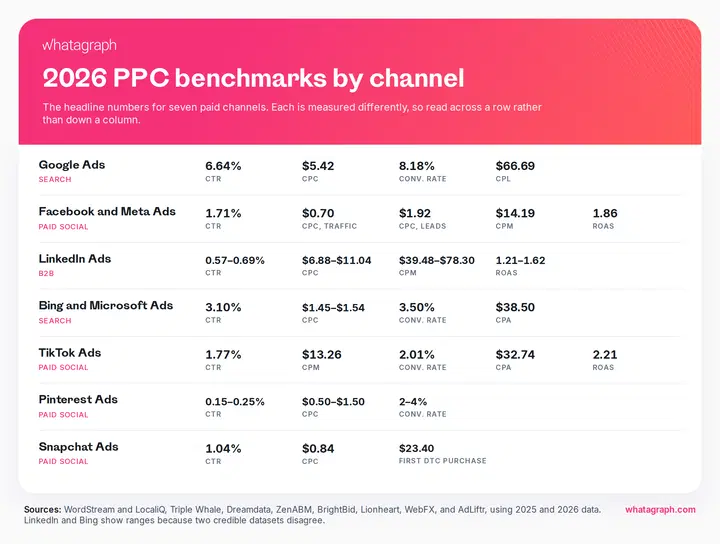
Paid search traffic comes from people typing a query, your ad appears above the organic results, and you pay per click. WordStream data shows Google’s 2026 averages are a 6.64% CTR, $5.42 CPC, 8.18% conversion rate, and $66.69 cost per lead, though legal runs near $9.87 a click and arts and entertainment near $1.63. It is strong for buyers who are already looking and weak for new categories nobody searches yet.
Microsoft advertising
It sells Bing and partner placements and imports Google campaigns easily. Whatagraph roundup lists average CPCs of $1.45 to $1.54 and a 3.50% conversion rate, with lower volume. It works as a cheaper second layer for brands that already know their keywords.
Shopping and Performance Max
Shopping shows product images and prices for buying searches, and the product feed decides how well it performs. Performance Max hands bidding and placement across Google’s inventory to automation, which saves work but blends the results. Add negative keywords on any search platform.
Paid social
Ads reach people who weren’t searching, so the creative has to earn the click. Targeting runs on interests, job titles, and lookalikes, with costs from about $0.25 a click on X to $6.88 to $11.04 on LinkedIn. Meta is the default for e-commerce and app installs; LinkedIn suits B2B because it targets by job title. TikTok skews younger and rewards entertainment-first creative.
Display and programmatic
Banners in standard sizes like 300×250 and 728×90 are bought through networks or automated auctions, usually per thousand impressions. CTRs sit well under 1%, so display earns its keep through reach and retargeting. Fraudlogix flagged 20.64% of 105.7 billion impressions as invalid. Programmatic buying goes through a demand-side platform that bids on impressions one at a time, in an automated auction that finishes before the page loads.
Native ads
Native ads are recommended-reading widgets inside articles, run by Taboola, Outbrain, MGID, and others. MGID’s August 2026 cost guide gives broad industry benchmarks of $0.20 to $0.50 a click and a CTR of 0.30% to 0.60%. They suit content promotion better than direct checkout offers. Native ads should be clearly labeled as sponsored; the FTC’s guide for businesses explains why.
Push notifications
Notifications go to opted-in subscribers and are billed per click, around $0.01 in the US and $0.003 in India, according to Evadav’s May 2026 rate sheet. Deposits are small, typically $50 to $250. Fresh subscribers respond best. In-page push shows a notification-style ad inside the page and needs no prior subscription, while classic web push reaches only people who opted in.
Pop and pop-under ads
A pop ad opens a full page or new tab after a user action such as a click, and a pop-under opens behind the current window. Pricing is per thousand impressions, and the floors are among the lowest in programmatic buying. Evadav’s May 2026 figures show average pop-under CPMs of $0.85 in the US and $0.29 in Germany. They fit mass-appeal offers in crypto, iGaming, finance, and utilities and work best when followed by banner or native retargeting. They are a poor fit for high-ticket decisions.
Video ads
YouTube works as both a discovery feed and a search engine, and connected TV is among the fastest-growing segments. Video shows a product working and builds awareness. Because many viewers never click, results often show up later as branded searches or direct visits.
In-app and mobile networks
In-app ads run inside games and utility apps as banners, interstitials, rewarded videos, and playables, usually billed per install or per thousand impressions. Cheap installs can hide poor retention, so judge them by post-install activity.
Influencer marketing
Creators charge a flat fee per post, and you buy their audience’s trust. Influencer Marketing Hub’s 2026 benchmark, as summarized by Neal Schaffer, estimates spending reached $32.55 billion in 2025, yet it is still only 1.98% of global ad spend. Use trackable links, because measurement is the weak spot.
Affiliate marketing
You pay a partner only for a sale, lead, or deposit, and media buyers earn the gap between payout and traffic cost. The advertiser pays only for results, though attribution disputes and fraud are common.
Newsletters and direct deals
Sponsors reach people who opted in, usually for a flat fee per issue. Ask for open rates and past click history first. The reach is small, and the audiences closely match the topic.
Mainstream platforms and specialized networks
Google, Meta, TikTok, and LinkedIn offer huge audiences and deep first-party data, with strict approval rules. Specialized networks trade targeting depth for access, looser policies in regulated verticals, and low CPMs. Push and pop networks such as RichAds, HilltopAds, and Adsterra sit here, and so does Bitmedia, a self-serve network that started in crypto. Bitmedia sells image, HTML5, in-app, Telegram, and pop formats under CPM, CPC, and Smart Bid pricing, with targeting by geography, device, and wallet behavior. Its site now lists six verticals: Web3 and crypto, finance and fintech, SaaS and AI, gaming and iGaming, mobile utility, and earnings.
If your ads break Facebook’s or Google’s policies, you are out of luck. A common pattern is to use mainstream platforms for what they approve and a specialized network for the rest.
Best paid traffic sources by vertical
No two verticals buy traffic the same way. Policy limits decide a lot of it: a supplement brand and a software company may both want Meta, but only one is likely to stay approved. Cost per customer decides the rest.
Advertising pricing models
Every paid deal rests on one question: what event triggers the bill? The earlier the trigger is in the funnel, the more risk the advertiser carries.
The models convert into each other, which makes comparison easier. A $10 CPM with a 1% CTR means 10 clicks per thousand impressions, so each click costs $1.00. In the same way, a $5.42 CPC at an 8.18% conversion rate works out to about $66 per lead, close to the $66.69 average reported in the 2026 search benchmarks. A pricier click that converts better can be the cheaper lead.
Traffic quality and invalid traffic
Judge a source by conversion rate, engagement, bounce rate, cost per acquisition, and ROAS, then by what happens weeks later: activation, repeat orders, and refunds. ROAS needs a margin check. Break-even ROAS is 1 divided by your gross margin, so a product with a 40% margin must return $2.50 per $1 of spend just to break even. Published ROAS figures vary widely. SaleHoo reports a median ecommerce ROAS of 1.86 on Meta in 2025, while Whatagraph lists 1.21 to 1.62 for LinkedIn and 2.21 for TikTok. A 1.86 is a loss for the 40% margin example and a win for a software business with a 90% margin.
Invalid traffic muddies all of this. Lunio’s 2026 report found 8.51% of paid clicks invalid across 2.7 billion clicks, about $63 billion a year, with TikTok highest at 24.2%. Spider AF says sophisticated bots made up 64.4% of automated invalid traffic by June 2026, and a Lunio survey found 75.6% of marketers lose more than 5% of their performance budget. These are vendor figures, so read them for scale. Watch for clicks without engagement and spikes from one placement, block bad sources, and judge by post-click results.
How to choose a paid traffic source
Start with the goal. Demand capture points to search, a new product to social, video or creators, B2B to LinkedIn, restricted offers to specialized networks, and cheap tests to push, pop or native. Then check policy, geography, budget and audience habits. Prices swing by country, so keep countries separate.
Most advertisers outgrow one channel. Take Ridge, which grew past $100 million largely on Facebook ads and now spreads spend across Meta, Google, and others. Give each channel a job, such as creating demand on social and capturing it on search, then retarget visitors who left. Tag every link with consistent UTMs, and define conversions by revenue or qualified leads. Dark traffic can distort channel data.
Tracking and attribution
Attribution needs one more step. A customer might first see a video ad, return through organic search a week later, and buy after a retargeting click. Last-click reporting credits only the final visit, so compare platform numbers with CRM or revenue data.
Data-driven attribution spreads credit across the touchpoints in a path. A practical split: use each platform’s own model to compare campaigns inside that platform, and use orders or qualified leads in your CRM as the check on what actually happened. Platform totals often differ from CRM totals, partly because several platforms can claim credit for the same sale. To reconcile them, tag every link with UTMs, pass a click or order ID into the CRM, and compare platform and CRM counts by campaign every week. Server-side tracking closes some of the gap. Instead of relying on a browser pixel that ad blockers and cookie limits can block, your server sends the conversion directly, as with Meta’s Conversions API. Run both with a shared event ID so each conversion is counted once.
Testing and common mistakes
Test one offer, one country, and one device first. Check quality a few weeks later. Try creative organically first and pay only for what beats your baseline.
Define success in numbers first: the metric (cost per lead, cost per acquisition, or ROAS against your break-even), the target, and how many conversions you need before judging. Budget follows from that. Multiply the cost per conversion you expect by the conversions you want per test; at a $40 cost per purchase, 30 conversions needs about $1,200. Meta’s help documentation points to roughly 50 optimization events per ad set within a week of its last significant edit for delivery to settle, though many buyers now treat that as a guide rather than a gate. A test has enough data when you have the conversions you planned for. Results hold across several days instead of one lucky spike, and early quality signals such as bounce rate and refunds agree with the conversion count. If they don’t, extend the test instead of guessing.
Common mistakes include buying “10,000 visits” packages, optimizing for clicks, running Meta without a cost cap, skipping negative keywords, and judging a test too early. A sensible split puts most budget on proven sources and a smaller share on experiments.
Emerging trends in paid traffic acquisition
Five shifts are changing how paid traffic is bought.
- AI-powered campaign optimization: Google’s Performance Max and Meta’s Advantage+ choose placements and audiences automatically and can test creative variations on their own. That saves setup time, but the platform optimizes toward whatever conversion you report, so weak tracking sends spend in the wrong direction.
- Automated media buying: A single demand-side platform can now buy a news site, a mobile game, and a connected TV app in the same auction system, so inventory that once needed separate deals sits in one dashboard.
- Privacy-first advertising: Safari and Firefox block third-party cookies, and Apple’s App Tracking Transparency prompt limits app tracking, so platforms see less of each user’s journey. Advertisers respond with first-party data, consent tools, and server-side conversion tracking.
- Retail and commerce media: Retailers such as Amazon and Walmart sell ads against their shopper data, which lets brands reach people close to the point of purchase.
- Growth of digital video: Short-form video, streaming television, and creator partnerships are expanding the ways businesses communicate with audiences. The IAB’s 2025 revenue report highlights the strong growth of video advertising in the US market.

Related Posts