





Banner performance still has its place, but attention online is harder to earn than it used to be. CTRs that looked healthy a year ago now sit flatter, even when the creative and targeting are strong. That’s less a sign that banners have stopped working and more a sign that advertisers need another way to reach users who scroll past a static placement without a second look.
That’s why we added Pop Ads to Bitmedia, a format that performs better in a market where static placements struggle to get noticed.
Why the market requires this format now
Display advertising is experiencing a visibility problem, and it didn’t happen overnight. Users started to ignore ad slots, a phenomenon known as “banner blindness.” NN Group’s banner blindness research points to the same pattern: users scan past anything shaped like a banner without registering what’s in it, regardless of how the creative looks. Industry reporting from Business of Apps puts banner and ad blindness as high as 86% among online consumers.
At the same time, CPMs for competitive crypto betting and finance traffic keep climbing. Advertisers are paying more for placements that convert less, which narrows margins on both sides of a campaign. Acquisition cost goes up while the format itself does less work to earn attention.
Optimized creatives don’t fully solve this. A well-designed banner still competes with a page layout the user has learned to ignore. The problem sits with the placement, not the message inside it.
Pop ads exist as a direct response to that shift. Attention has become the scarcest resource in digital marketing. Instead of hoping a passive placement gets noticed, a format that guarantees a viewport moment solves that scarcity.
How pop ads actually work
A pop ad is a full-page or new-tab ad that opens in response to a user action, rather than sitting embedded in a page the way a banner does.
The trigger depends on the setup. It might fire on a click anywhere on the page, on a specific interaction like a button press, or on a navigation event such as loading a new page. You can now choose exactly which of these triggers activates your pop ad on Bitmedia, so the format matches the flow of the site it runs on.
The core distinction between pop ads and banners is how each one is seen. A banner sits in a fixed spot and waits. A pop-up or a pop-under that opens behind the active window is event-driven: it appears because something happened, not because a user happened to look in the right direction.
That difference has a direct effect on delivery. Because the ad occupies a viewport moment, impression completion rates tend to run higher. The user doesn’t have to notice the ad among other page elements. It’s already in front of them.
But none of that justifies using pop ads instead of banners. That makes them a different tool for a different job, one built around guaranteed visibility instead of passive placement.
Pop ads vs. Banner ads: What’s the difference?
The two formats serve different purposes, and the differences show up clearly once you compare them side by side. A banner is passive by design. People often don’t see it because of common banner blindness. It just sits there in the page layout and waits for someone to look at it. A pop-up or pop-under doesn’t wait. It opens because the user did something, which means it occupies the viewport at the exact moment attention is available. That’s the whole mechanical difference between the two formats, and everything else follows from it.
Visibility is where the ad shows up first. A banner’s exposure is capped by its placement. If a user skips that part of the page, they never see the ad at all. A pop ad doesn’t have that ceiling. Full-page or new-tab delivery means the ad gets in front of the user regardless of where their attention was a moment earlier.
That visibility gap is also what drives the difference in CTR. Industry data puts pop-ad click-through rates at roughly 6 times those of standard banners. But the reason is that more of the audience actually sees the offer in the first place. Forced visibility ensures a glance rather than a click. A pop ad running a weak offer will still underperform a banner running a strong one. What changes is the starting point. With pop ads, the rest of a campaign’s performance rests on offer quality and targeting.
That distinction, in turn, shapes what each format is actually best suited for. Banners still play a key role in building brand presence and retargeting. You don’t need to force a moment of attention to remind a past visitor that a brand exists, and a lighter touch usually works better there. Pop ads earn their spot when the goal is an immediate action: a sportsbook promo tied to a live match or a fast-moving crypto offer where the user needs to act now rather than remember the brand later.
And because the two formats work differently, optimizing them looks different, too. Managing banner campaigns means testing where on the page they work best and swapping out creative before it gets old. Pop-up campaigns are managed around trigger logic, frequency capping, and how quickly a user can act on what’s in front of them. Running a pop-ads campaign with a banner mindset tends to underperform because the trigger that actually moves results is different.
| Feature | Banner ads | Pop ads |
| Display | Embedded within the webpage | Open after a user interaction in a new window or tab |
| Attention | Passive exposure | Event-driven exposure |
| Visibility | Depends on page placement | Full-page visibility |
| User experience | Easy to overlook due to banner blindness | Designed to capture attention at a specific moment |
| CTR | Generally lower | Often higher, depending on targeting and offer |
| Best for | Brand awareness and retargeting | Direct response and promotional campaigns |
| Optimization | Creative, placement, and refresh rate | Triggers, frequency, targeting, and landing page |
| Primary goal | Build long-term brand visibility | Drive immediate engagement or conversions |
Get started with pop ads on Bitmedia
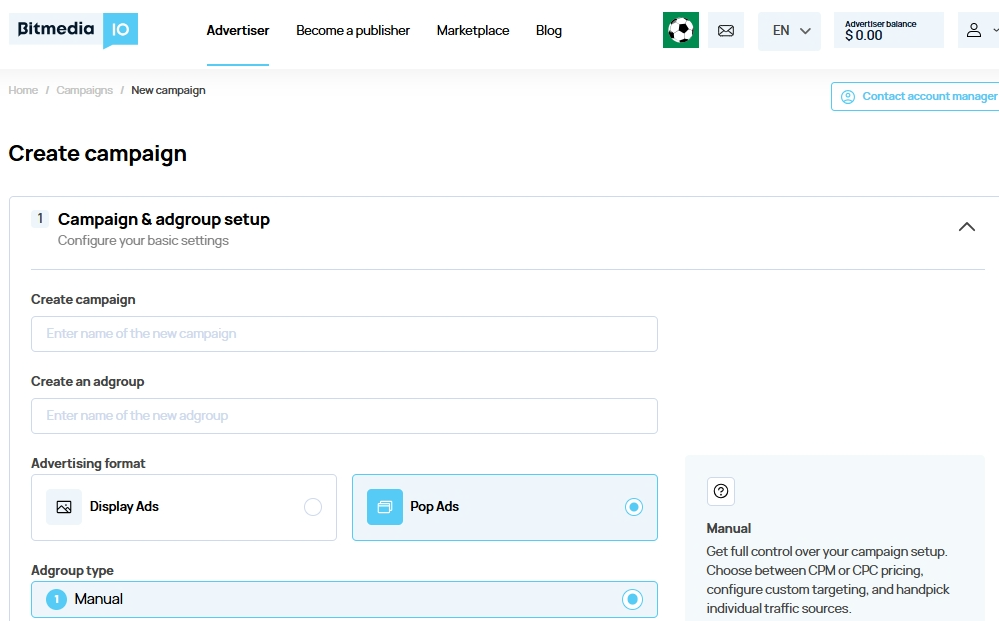
You can now launch pop ads directly from the Bitmedia dashboard. The most practical way to evaluate the format is alongside a campaign that’s already running.
A few starting points:
- Launch a small test budget parallel to an existing banner campaign, using the same offer, so results are directly comparable.
- Segment traffic by vertical and geo before scaling up. Pop traffic performs differently across regions, and early segmentation optimizes faster.
- Watch frequency and trigger settings closely in the first few days. These control both delivery volume and user experience, and small adjustments here move performance more than creative changes do early on.
Pop ads won’t outperform banners in every scenario, and they’re not meant to. They give advertisers a second lever for reaching users that static placements no longer reach effectively. Testing a small slice of budget against a live campaign is the fastest way to find out where that lever fits in your funnel.
Launch Your Campaign!
Related Posts