





Ask ten media buyers what they think of pop ads, and you’ll get ten different answers. Some swear pop-under traffic is the cheapest, most reliable volume they’ve ever bought. Others tried it once, watched CPL climb, and never touched the format again.
Both of them are right, and both of them are missing half the picture.
Pop-under ads fail for two common reasons. Advertisers run them like a banner campaign and expect banner-style engagement. Or they skip the landing page work that popunder traffic actually depends on. This guide breaks down where pop-unders are effective and where they fall short. And it shows how to structure a campaign on Bitmedia so the format works for you instead of against you.
Pros – What pop-unders do well
- Zero banner blindness: A pop-under loads behind the active browser tab, so the user isn’t interrupted mid-scroll. When they eventually close their main window, your landing page is already there, fully loaded, with nothing else competing for their eyes. That single mechanic is why pop-unders sidestep the banner blindness problem that plagues most display formats. There’s no competing content on the page because there is no page. Just your offer.
- High-volume cost efficiency: Pop-up and pop-under ads typically run on a CPM basis with some of the lowest floor prices in programmatic advertising. It means you can put real volume behind an offer without real budget risk. That matters if you’re validating a new vertical or a new GEO before committing spend elsewhere.
- No creative bottleneck: Unlike banner or native campaigns, pop-unders don’t require a set of image assets to get started. Your landing page is the ad. That collapses production time and lets you test five landing page variants in the time it would take to design one banner set.
- Full-page real estate: A pop-under opens an entire browser window instead of a 300×250 box. That gives you room for a real value proposition and a CTA that doesn’t get lost in a sidebar. Julia Larionova, Head of Marketing at PropellerAds, put it plainly when comparing pop formats earlier this year:
“Classic pop-ups are mostly a legacy format now – browsers block them too often, and users close them instantly. That’s why most affiliates work with Popunder (OnClick) traffic instead. It gives the same reach without interrupting the browsing session, which usually leads to more consistent engagement and faster campaign stabilization once the funnel starts converting.”
- Resilience against ad blockers: Users report that autoplay videos and banner ads are the most disruptive types of online content, so many blocking tools are designed to block them. Pop-unders, precisely because they don’t interrupt the page, tend to slip past a portion of that filtering, which keeps reach more stable than it is for display.
Cons – Where pop-unders fall short
The format has real drawbacks worth understanding before committing a budget.
- Delayed visibility hurts time-sensitive offers: A user might not close their main tab for twenty minutes or two hours. If your campaign depends on urgency, such as a flash promo or a same-day event, that lag can work against you.
- Cold traffic: Pop-under traffic is inherently low-intent. Nobody was seeking your offer. The pop-under ad appeared while they were engaged in another activity. That’s fine for broad-appeal verticals but a poor fit for anything that requires a considered, high-ticket decision in one exposure.
- Vulnerability to browser restrictions and ad-blockers: Modern browsers (like Chrome, Safari, and Firefox) continually update their security protocols to suppress aggressive popups and forced windows. If an ad network doesn’t constantly update its delivery technology to cleanly bypass these filters, your ads will simply be blocked before they load. Research from GWI data, summarized by Backlinko, puts global ad blocker usage at roughly 30% of internet users. And mobile blocking, in particular, has continued to climb. Pop-unders are simply less exposed to ad blockers than banners, which is a different claim.
- Frequency mistakes are costly: Because pop-unders are cheap and easy to scale, it’s tempting to overserve. Show the same user a pop-under three times in an hour, and you’ll generate irritation rather than conversions, along with a spike in bounce rate that drags your overall stats down.
- Potential for high bounce rates: If your landing page loads slowly, or if the offer lacks immediate hook appeal, users will click the “X” within one second of discovering the window. You must accept that a significant percentage of traffic will bounce instantly, and your funnel must be optimized to convert the percentage that stays.
| The advantages (Pros) | The trade-offs (Cons) |
| Guaranteed views: Bypasses banner blindness by occupying a full, dedicated window. | Zero initial intent: Users are completely cold and did not ask to see your offer. |
| Highly scalable: Delivers massive traffic volumes at a fraction of search/social costs. | Delayed exposure: The user may not notice the ad until hours after it actually loads. |
| No ad creative needed: Eliminates the need to design banners; the URL is the ad. | High initial bounce: Relies heavily on immediate page speed to prevent instant closure. |
| Unrestricted space: Perfect for comprehensive landing pages and long-form copy. | Tech-subservient: Requires advanced network delivery to avoid browser pop-blockers. |
How to run pop-unders right on Bitmedia
If you choose to move forward, success is about rigid parameters and data-driven optimization. The setup on Bitmedia comes down to six decisions. Get them right, and the format performs. If you miss any one, your CPL will reflect it.
Set a frequency cap before you launch. One to two impressions per user per 24 hours is a reasonable starting point for most verticals. You can loosen the cap once you see how your specific audience responds, but starting tight protects both your budget and your brand.
Build a pre-lander instead of only a landing page. A pre-lander is a page that warms up cold pop-traffic before it hits your main offer page. It gives them some background information and captures their interest. The pre-lander page gets rid of people who were never going to convert anyway. For iGaming and Web3 offers specifically, this step tends to matter more than the offer page itself.
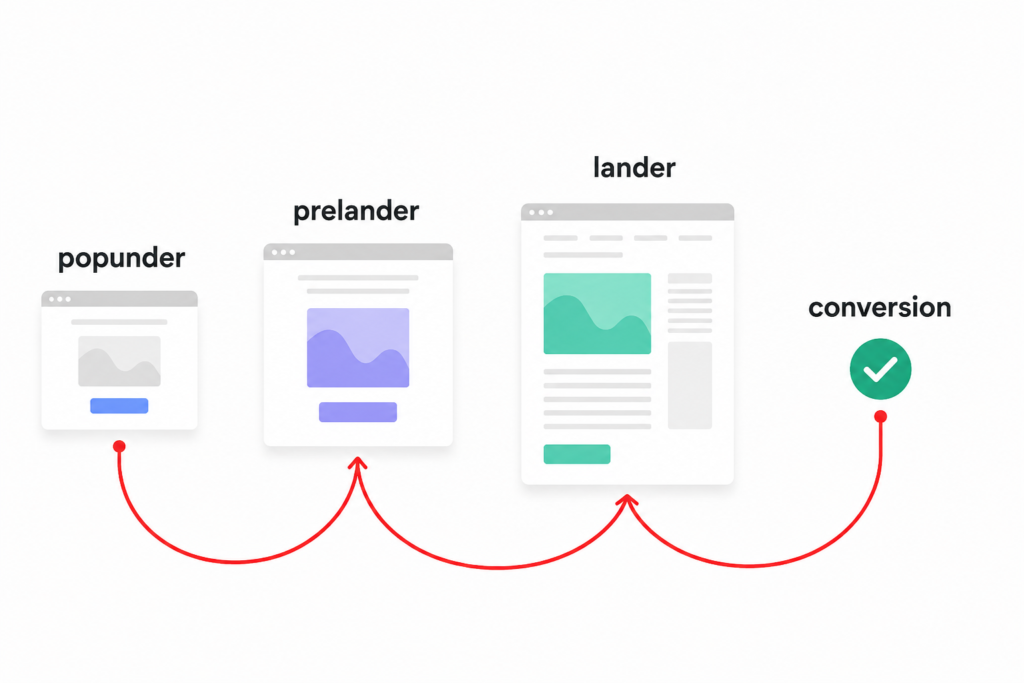
Test multiple angles, even without banners. Without image assets, you still have multiple testing levers: headline, value proposition, CTA copy, page load speed, and pre-lander structure. Run several landing page variants against the same traffic. Let the data tell you which headline and CTA structure actually converts.
Segment verticals and GEOs. Popunder ads work best when combined with broad, mass-appeal verticals like crypto, iGaming, finance, utilities, and major lead-generation funnels. Do not bundle multiple countries or mixed desktop/mobile traffic into a single campaign. Group your campaigns tightly by specific geographic regions (GEOs) and device types. Mobile users interact with tabs completely differently from desktop users. Separating them ensures you can bid accurately based on performance data.
Treat pop-unders as one channel in a funnel. Combine popunder ads with retargeting through banners or native placements once a user has already been exposed. The pop-under drives reach, and the follow-up format drives persuasion.
Start small and scale only what proves itself. Launch with a modest daily budget across a couple of GEOs. Watch CPL and conversion rate for at least a few thousand impressions and then scale the winners. Resist the urge to go broad on day one.
Pop-unders are effective or not?
Pop-unders perform or fail based entirely on setup decisions, and the format itself is neutral. They’re a tool that rewards discipline and punishes shortcuts. Skip the frequency caps and pre-landers, and you’ll get the same frustrating experience that made some advertisers swear off the format. Build the funnel properly, and you’ll have one of the most cost-effective ways to put a landing page in front of real, engaged users at scale.
Bitmedia gives you the controls to do this right, such as frequency management, GEO and device segmentation, and campaign-level testing tools built for exactly this kind of cycle.
Ready to test it for yourself? Launch a pop-under campaign on Bitmedia, or contact your Account Manager to plan your targeting and pre-lander strategy before you spend a dollar.
Launch Your Campaign!
Related Posts