







Finance advertising is expensive. Anyone who has run campaigns in the finance vertical knows that traffic costs are high, audiences are cautious, and a single conversion can take days or weeks to close. That is why conversion rate optimization (CRO) matters here more than in almost any other vertical.
Wasted traffic is expensive in any vertical. In finance, where the average CPA on search hits $81.93, it is especially painful. Bringing in users is just the first step. Turning them into customers is where campaigns succeed or fail.
Finance also comes with its own set of challenges. Regulations limit what you can say and how. Users are skeptical, especially online. And the products themselves – trading accounts, investment platforms – require real consideration before anyone commits.
So how do you improve performance here? Let us get into it.
Understanding the finance conversion funnel
Before you optimize anything, you need to understand how finance users actually behave in the funnel.
The typical funnel looks like this: awareness → consideration → conversion. In most verticals, this journey is fairly quick. In finance, it is not. Users tend to research carefully. They compare multiple options and revisit your site several times before taking action.
At the awareness stage, a user might click your ad after seeing it on a crypto site or reading a content piece. They are curious, but not ready. At the consideration stage, they start comparing rates, reading reviews, and checking whether you are legitimate. This stage is where most finance advertisers lose people and where trust signals become critical.
By the time a user reaches the conversion stage (filling out a form, opening an account), they need to feel confident in your product and your security.
This longer cycle means you need more patience. Retargeting is essential.
Factors that influence conversions
Several factors can determine the success of a finance campaign:
- Trust and regulatory signals: Licenses, compliance badges, and privacy documents reduce skepticism fast.
- User experience: Confusing forms and slow pages are direct conversion killers.
- Fee transparency: Hidden costs are among the top reasons users abandon financial applications.
- Content clarity: Financial products need plain-language explanations. Jargon pushes people away.
- Mobile performance: The majority of web traffic is mobile, but desktop users still convert at higher rates in finance. You need to serve both audiences well.
Proven strategies to increase conversion rates
A leaky financial funnel needs intentional, data-backed changes to become efficient.
Build trust before you ask for anything
In finance advertising, trust is the currency. Users will not hand over personal or financial information to a brand they do not trust.
Start by making your compliance clear. Display your regulatory affiliations and security certifications prominently, not buried in a footer. Real customer reviews help too. Case studies that show actual outcomes carry more weight than generic testimonials.
If you are running financial ads in the crypto or investment space, this step is especially important. The audience has seen scams. Anything that signals legitimacy early in the funnel reduces friction downstream.
Reduce friction on landing pages
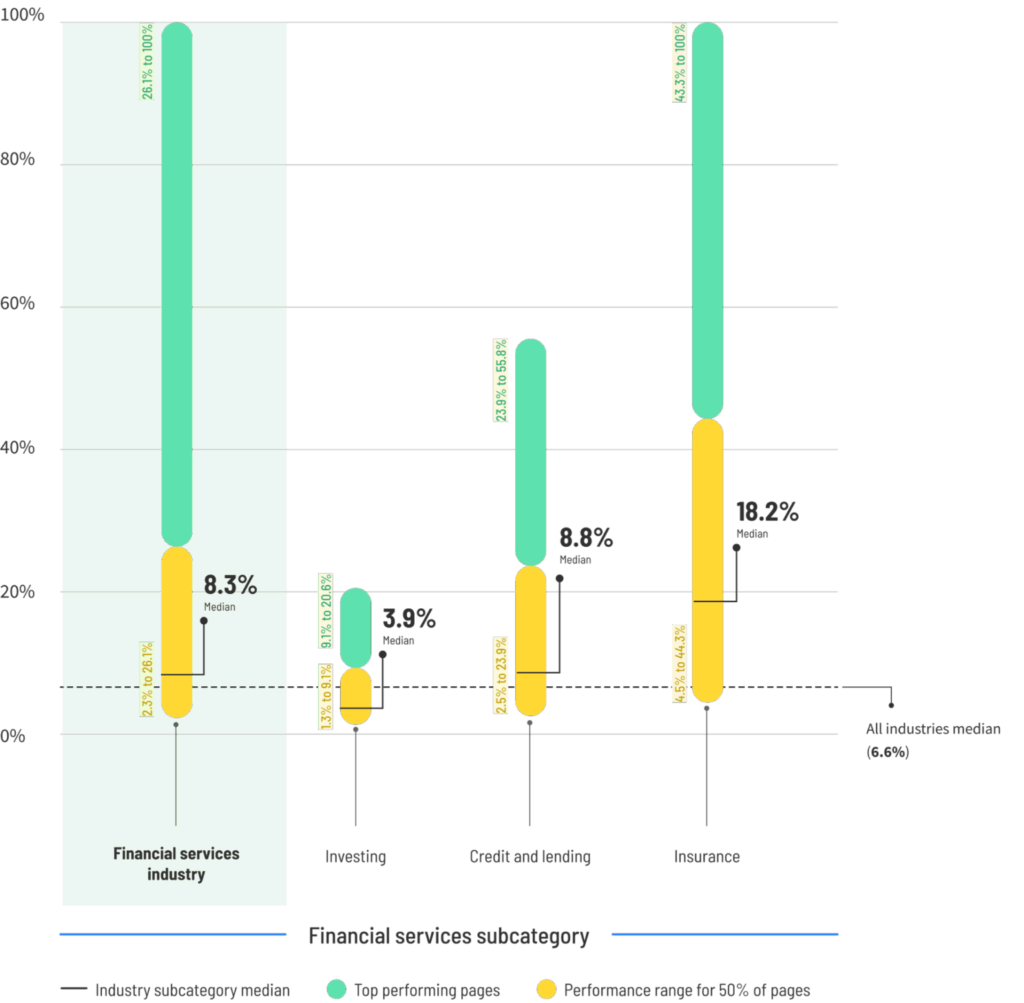
This stage is where many finance marketers miss out on potential revenue. Your landing page is where the conversion either happens or does not, and small friction points cause real drop-off.
Unbounce analyzed over 57 million conversions and found that financial services landing pages convert at a median of 8.3%, higher than the 6.6% all-industry median. The gap between median and top-performing pages is significant, though. Top performers hit higher.
What separates them? Simplicity. Fewer form fields. Clear single calls to action. Progress bars that show users how far along they are. Multi-step forms that break a long process into smaller, less intimidating steps.
To improve landing page conversion, every element on the page should serve one goal: getting the user to take the next step.
Fix your page speed
This is not a nice-to-have. A one-second delay in page load time can reduce conversions by 7%. On mobile, the impact is even larger. And 53% of mobile users will leave a page that takes more than three seconds to load.
Finance users are high-intent, but they are not patient. Compress your images, minimize JavaScript, and aim for a load time under two seconds, especially on mobile.
Use retargeting strategically
Because the finance conversion cycle is long, most users will not convert on the first visit. What matters is whether you bring them back.
Use retargeting to serve different messages at different stages. Someone who left a landing page before filling out a form needs a different message than someone who abandoned mid-application. Segment your audiences and tailor the creative accordingly.
Personalize where possible
Generic finance ads produce generic results. When an offer reflects a user’s actual situation, such as their likely rate or investment profile, engagement goes up. Generic offers do not convert as well as relevant ones.
Even simple personalization, such as dynamic location-based content or product-specific landing pages, is more effective than generic approaches.
The role of creatives and ad formats
Ad format is part of the message rather than a delivery mechanism. The wrong format in a finance campaign can undermine even strong copy and targeting.
In financial advertising, credibility is visual. Your creative needs to look trustworthy. That means clean design, clear messaging, and no promises that are overly optimistic (which also helps you stay compliant). Eric Cook, digital strategist and financial services marketing specialist, made a sharp point about this topic in a 2025 FinTech Weekly interview:
“Advertising does not always need to be focused on the “sale” and can be used to build awareness for educational events or promote content that helps to address issues and solve problems. Being genuine in your copy and ad design can go a long way.”
Emotional triggers work in finance ads, but they need to be grounded. Fear of missing out, desire for financial security, and aspiration are real motivators for financial audiences. Use them honestly.
Bitmedia offers four ad formats built for crypto and finance advertisers. Text ads work well when the message does not need visual support and when ad fatigue is a concern. Image ads lead with visuals, which historically generate stronger awareness in display advertising. Responsive ads adapt to the look and feel of the publisher’s website, making them feel less intrusive and earning more trust from skeptical finance audiences. And HTML5 ads let you pack the most into a single banner, such as video, animation, slides, and layered messaging. That makes them well-suited for complex financial products that need more than a static image to explain the value.
Test multiple formats within the same campaign. What works in awareness often differs from what drives conversion. A bold display banner might generate clicks, while text closes the deal.
Launch Your Campaign!Data and analytics: Measuring what works
You cannot optimize what you do not measure. Finance campaigns in particular need strict tracking because the conversion cycle is long and multi-touch.
Key metrics to monitor:
- Click-Through Rate (CTR): Measures ad relevance and creative performance.
- Conversion Rate (CR): The percentage of visitors who complete the desired action.
- Cost Per Acquisition (CPA): The total marketing spend required to secure one converting user.
- Lifetime Value (LTV): The total revenue generated by a user over their entire relationship with your brand.
Set up proper conversion tracking at every meaningful action and intermediate step, like form starts and calculator uses. This helps you identify exactly where users drop off and where to focus optimization efforts.
For finance advertisers in the crypto space, the distinction between on-chain and off-chain analytics also matters. Both data types complement each other in campaign measurement.
Run A/B tests constantly. Test headlines, CTAs, form structures, and page layouts. Small changes can produce meaningful results in high-CPA verticals.
Common mistakes that hurt conversion rates
A few things consistently damage performance in finance campaigns:
- Misleading ads: If your ad promises one thing and the landing page delivers another, users leave immediately, and your reputation suffers. Message match between ad and page is non-negotiable.
- Slow or poorly optimized pages: A laggy website compromises trust. According to research published by Portent, a site that loads in 1 second has a conversion rate 3x higher than a site that takes 5 seconds to load.
- Weak or absent trust signals: No reviews and visible compliance information. Users in finance are already cautious, so give them reasons to stay.
- Ignoring mobile users: Even if desktop converts better in finance, the majority of initial traffic arrives on mobile. A broken mobile experience means most users never make it to desktop retargeting.
- Over-complicated forms: Asking for too much too soon is a conversion killer. Collect only what you need, when you need it.
How to stay competitive in finance advertising
Increasing conversion rates in finance marketing is about eliminating friction at every stage while building enough trust that users feel confident taking action.
Build credibility early, optimize landing pages, speed up your site, retarget persistently, and track everything. What makes these strategies difficult is the consistency required to execute them in a regulated, high-stakes environment.
Finance advertisers who scale are the ones who keep testing and put user experience first.

Related Posts