






Crypto advertising budgets are not small, and the stakes for wasting them are high. Coinbase alone spent $99 million on marketing in a single quarter of 2025. Across the broader ecosystem, the crypto advertising market grew from approximately $50.95 billion in 2024 to over $63 billion in 2025. Yet a significant portion of that spend never reaches a real human being. It turns into bots and mismatched audiences, and campaigns end up with numbers that look good and results that don’t.
Low-quality traffic has always been a problem in digital marketing. But in Web3, where every campaign targets a niche, high-intent audience, and conversion events carry outsized value, the damage compounds fast. Estimates from Blockchain Ads suggest that 15-25% of clicks across crypto ad networks are fake or invalid, with some formats and regions pushing above 30% of impressions. By the time a team spots the problem in their analytics, the budget is already gone.
What counts as low-quality traffic in Web3 marketing?
Low-quality web traffic is any traffic that does not represent a genuine, in-market user capable of completing a meaningful action.
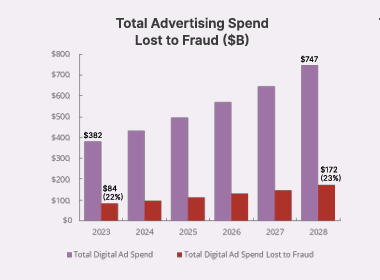
Bot traffic is the most obvious culprit. Automated scripts generate impressions and simulate clicks at scale. Bots, automated scripts mimicking human behavior, account for 38-42% of all web traffic, with bad bots hitting 32% according to Imperva’s reports. According to 2023 Juniper Research data, ad fraud will cost advertisers $172 billion globally by 2028, and crypto verticals attract disproportionate bot activity because CPMs are higher and oversight is thinner.
Click farms are the human equivalent. Low-wage workers click through ads manually. The traffic looks clean to basic fraud filters, but it just never converts.
Accidental and incentivized clicks are a placement problem. Ads that overlap content on mobile, interstitials that load automatically, or reward-based units that pay users to engage all produce technically human traffic with no real intent behind it.
Audience mismatch is the less commonly discussed form of low-quality traffic. A Web3 project running banners on a generic finance site may attract thousands of clicks from retail stock investors who had no idea they were looking at a crypto product. High volume, zero signal. This is also why placement environment matters: in-app and website traffic behave very differently in terms of user intent and conversion likelihood.
The real cost of poor traffic quality
Low-quality traffic triggers a chain reaction across metrics and the algorithmic infrastructure that powers every future campaign.
Inflated metrics that hide the truth
The first casualty of low-quality traffic is accurate data. When bots flood a campaign, click-through rates climb, and session counts spike even though nothing real is happening. Standard analytics tools, including Google Analytics, are not built to detect sophisticated bot traffic. A non-human session can look identical to a real one at the surface level: correct browser headers, a plausible session duration, standard screen resolution, and nothing obviously wrong.
Wasted budget and higher acquisition costs
Every click from a bot or a mismatched user transfers budget away from real potential users. In Web3, every real wallet-connected user carries significant value to a protocol. When half a campaign’s traffic is invalid, the effective cost per real user doubles while the dashboard still shows the original conversion count. The damage stays hidden until the budget is gone. Globally, ad fraud drained over $100 billion in 2026. Web3 campaigns suffer worse; estimates peg 23% of open-web spend as lost to low-quality inventory, climbing to 70-80% in hype-fueled airdrops.
Distorted retargeting and algorithm poisoning
Low-quality traffic does not just waste current spend; it poisons future campaigns. When programmatic platforms learn from polluted conversion data, they optimize toward the wrong signals. Lookalike audiences built on fake user profiles will find more fake users. Retargeting pools fill with bots. The algorithmic damage compounds over time. Each campaign that follows inherits the damage from the one before.
How to identify low-quality traffic
Spotting poor-quality web traffic requires looking past headline numbers. Understanding how to identify fake users and bots in Web3 advertising is the first step toward protecting your budget from both automated and human-assisted fraud.
Abnormally high CTR with low conversion rates: Display banners in crypto contexts average between 0.08% and 0.25%, native ads hit 0.20%-0.65%, and video reaches 0.40%-0.80% CTR in rewarded formats. If a placement delivers 2-4% CTR but produces near-zero wallet connections, that is a strong fraud signal. As Dr. Augustine Fou, one of the world’s leading independent ad fraud researchers, puts it:
“So any variable that is too high, like click-through rates (CTRs) that are too high, should immediately raise red flags. Anything that is too low, like 1% bounce rates, should again raise suspicions and be investigated further.”
Near-zero time on site: Real users need time to read and engage. Bot sessions typically last 0-5 seconds, while legitimate traffic on a crypto landing page should average well above 30 seconds.
Geographic concentration inconsistencies: Geographic concentration inconsistencies. A campaign targeting Western Europe that suddenly draws significant traffic from unrelated regions or data center IP ranges warrants immediate investigation.
How Web3 advertisers can improve traffic quality
Fixing a traffic quality problem requires tightening several levers at once: who you target, where you run ads, how you verify delivery, and how often you actually look at the data. A Web3 project with 500 genuine wallet holders acquired through well-targeted campaigns is in a far stronger position than one with 10,000 ghost users who will never interact with the product. Blockchain products only work with real users. Whether the product involves staking or on-chain governance, headcount means nothing if the wallets are empty. High web traffic volume with low engagement costs more in both budget and team time.
Use fraud detection tools. Platforms like HUMAN Security, DoubleVerify, and Integral Ad Science offer real-time invalid traffic (IVT) detection. For crypto-specific placements, networks that build fraud detection natively rather than bolting it on offer better protection by design.
Work with verified crypto ad networks. General programmatic networks apply the same fraud filters to crypto placements as to mainstream consumer products. The threat model is different. Crypto campaigns attract more sophisticated fraud because revenue per click is higher. Working with networks like Bitmedia that specialize in Web3 audiences and apply crypto-specific bot filtering is a baseline requirement for accurate campaign data.
Analyze web traffic regularly, not just at campaign end. Many teams only audit traffic after a campaign concludes. Setting up mid-flight reviews to analyze web traffic, looking at session quality, conversion path drop-offs, and geographic distribution, allows teams to cut underperforming placements before they drain the full budget.
Key takeaways for Web3 success
Low-quality traffic is one of the primary reasons crypto campaigns underperform. When bots and click farms distort website traffic volume, they waste budget in the present and corrupt the data that informs every future campaign decision.
The methods to detect low-quality traffic exist, verification tools are available, and specialized crypto ad networks have built filtering into their infrastructure. The advertisers who treat traffic quality as a strategic priority rather than an afterthought will consistently outperform those chasing volume metrics.
In Web3, where every real user represents a potential long-term protocol participant, 500 genuine users will always outperform 5,000 fraudulent sessions in ROI, and in every metric that actually matters.

Related Posts