





Between 2020 and early 2026, the Web3 gaming market attracted between $12 billion and $15 billion in venture capital, token proceeds, and NFT revenue. Advertising budgets scaled faster than development teams could ship product. Influencers promoted play-to-earn games to millions. And then it all fell apart fast.
According to a comprehensive analysis by crypto market-maker Caladan, 93% of Web3 gaming projects are now effectively dead. Gaming tokens have declined an average of 95% from their 2022 peaks. Quarterly VC (Venture capital) inflows that once peaked at $1.6 billion have since dried up to roughly $18 million, with a 99% drop.
The question every crypto advertiser and Web3 founder should be asking isn’t “why did the games fail?” It’s “how did so many well-funded campaigns produce so little lasting value?” These projects failed at the product, campaign, targeting, and strategy levels. And the mistakes are instructive.
The rise and fall of Web3 gaming campaigns

The Caladan report shows that GameFi’s share of total Web3 project investment hit 62.5% in 2022, when sector funding peaked at roughly $4-5.56 billion. Axie Infinity reached 2.8 million daily active users. The Sandbox raised $93 million from SoftBank. Play-to-earn games were everywhere in ad feeds, Discord servers, creator content, and influencer channels.
The play-to-earn model was marketed aggressively: token rewards to acquire users, airdrop campaigns to generate buzz, guild structures to onboard players massively, and influencer deals to drive speculation. User numbers looked extraordinary on paper, and advertisers ran with the narrative.
Then the fatal flaw surfaced. Play-to-earn tokenomics required a constant inflow of new buyers to sustain rewards for existing players. When inflows slowed, Axie’s reward token SLP cratered, and the 2.8 million daily users shrank to around 99,000. Hamster Kombat, the Telegram tap-to-earn game that drew 300 million registered users, lost 96% of its audience within six months of its HMSTR token airdrop. The Sandbox, despite nearly $100 million in funding, never sustained more than 4,500 daily on-chain users.
Even the most established names couldn’t survive it. Yield Guild Games (YGG) is down 99.6% from its all-time high. Projects raised on hype. They marketed on hype. When the hype ran out, there was nothing underneath to retain anyone.
Where Web3 gaming marketing went wrong
Misaligned incentives
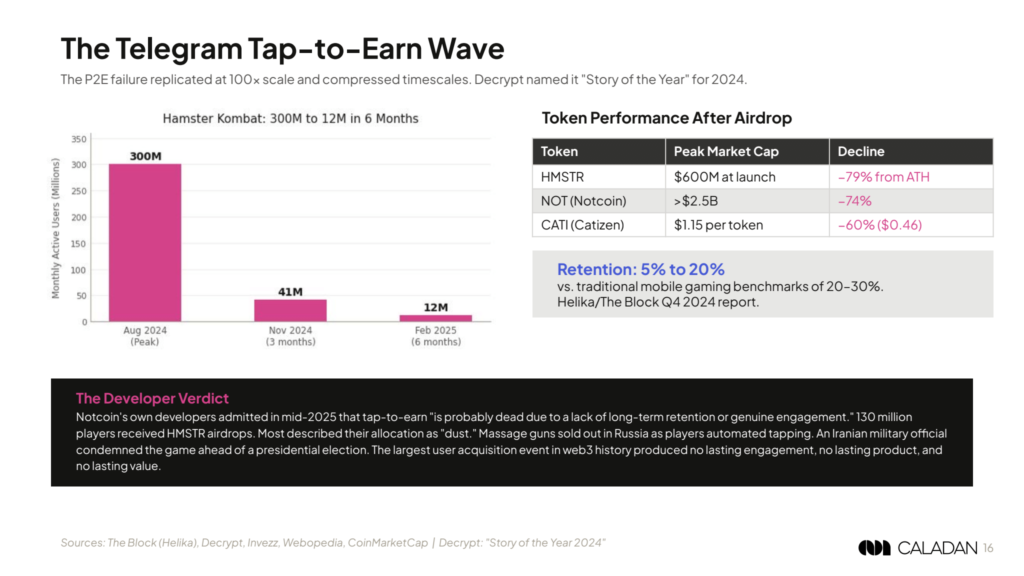
The most fundamental failure was mistaking financial motivation for real engagement. Campaigns attracted people who wanted to earn, not people who wanted to play. When Hamster Kombat airdropped its HMSTR token, it immediately dropped 80% as users liquidated their allocations. Those 300 million “users” were airdrop hunters, so they completed the minimum interactions to qualify, collected their reward, and left. That’s a one-time transaction dressed up in engagement metrics rather than a user base.
Any advertiser measuring success in clicks or wallet connections without tracking downstream retention was flying blind.
Over-reliance on hype cycles
GameFi campaigns leaned heavily on influencer deals, coordinated launches, and social media amplification. These tactics generate traffic spikes. But without a sustainable funnel behind them, those spikes translate into nothing. Traffic quality, not traffic volume, is what determines long-term ROI. Daily active wallets across the sector slid from 7 million in January 2025 to 4.66 million by Q3, a 33% decline despite ongoing promotional spend.
The influencer machine also created a credibility trap. When tokens declined, the same audiences that had followed creators into GameFi turned against them. Trust, once lost, rarely recovers within a project’s funding runway.
Poor audience targeting
GameFi campaigns were largely directed at “crypto opportunists” – DeFi and NFT participants looking for the next profitable play. Those audiences were reached efficiently. The problem is they have no loyalty to a game; they have loyalty to returns. Actual gamers who might have become long-term players were almost entirely ignored.
The distinction between broad crypto audience targeting and niche gamer targeting was rarely made in GameFi strategy. ChainPlay’s analysis of over 3,200 GameFi projects found that 316 new projects launched per year on average, while 262 disappeared, most unable to retain users beyond a few months. That’s an audience mismatch rate more than a product failure rate.
Weak product-market fit
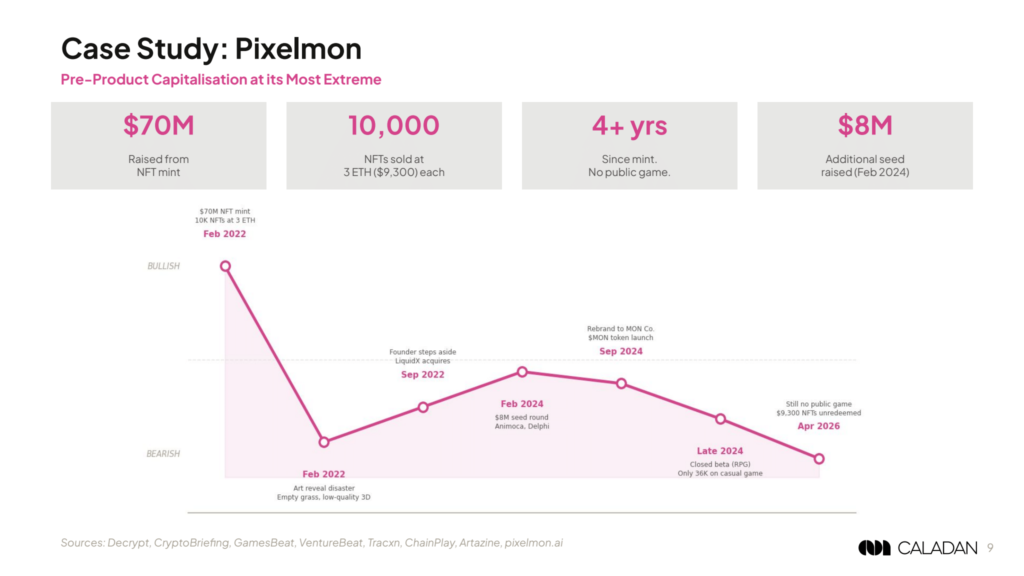
Marketing budgets were scaled before teams validated whether their games were worth playing. This sequencing error is not unique to Web3, and it happens in traditional gaming too, but the availability of token-based fundraising made it catastrophically easy to over-capitalize early-stage, unproven concepts.
Pixelmon raised approximately $70 million in NFT sales in 2022, completed an $8 million seed round in 2024, launched a token, and never shipped a final product. Wilder World attracted over $60 million, peaked at 4,500 daily active users, and its token is down 96%.
When campaigns scale before product-market fit is confirmed, you’re not building a user base, you’re burning capital to discover the product wasn’t ready.
Lack of trust and transparency
The Web3 gaming market was damaged by how projects failed rather than by failures. Rug pulls, opaque tokenomics, token inflation, and unclear team structures compounded the trust problem. Ember Sword raised $203 million, sold land NFTs for years on the promise of a fantasy world, and never delivered a playable game, leaving its community feeling systematically misled. The $625 million Ronin bridge hack in 2022 created sector-wide reputational damage that no ad budget could repair. By the time users had been burned by two or three projects, influencer promotion alone couldn’t move them.
What advertisers can learn from Web3 gaming failures
The collapse of the Web3 gaming market is, at its core, a series of correctable mistakes. The campaigns were doomed by structural problems in how they were targeted and measured. Here’s what that means for advertisers working in the space today.
Acquisition metrics are not retention metrics. If your campaign KPIs are wallet connections, token sales, clicks, or installs, you are measuring the beginning of a funnel without any visibility into whether the funnel works. Tracking on-chain user behavior – return sessions, transaction frequency, time-in-game – gives you a materially more accurate picture of whether your campaign is driving real engagement or temporary speculation.
Incentive design shapes audience quality. When you build a campaign around financial rewards, you attract financially motivated users. That’s fine if your product is a financial product. If it’s a game, you’ve recruited the wrong audience. Consider what your campaign’s call-to-action says about who you’re trying to attract, and whether those are the users your product can actually retain. For better frameworks on acquiring the right users in Web3 games and crypto exchanges, the incentive structure deserves as much attention as the creative.
Transparency is a performance lever. Campaigns that led with audit results and clear tokenomics documentation outperformed those that led with price speculation and influencer hype. Because transparent projects gave users rational reasons to stay beyond the initial token drop.
The shift toward sustainable Web3 marketing
The projects still running today share something their failed counterparts didn’t: they built the game first. Gunzilla Games’ Off the Grid became the first major Web3 title on Steam by prioritizing the gaming experience over the token economy. The blockchain infrastructure exists in the background rather than the central marketing hook.
Play-to-earn is giving way to “fun-first” models where the token economy supports the game rather than defining it. Hype-driven spend is being replaced by performance marketing with actual retention benchmarks. Smarter advertisers now track lifetime value together with impressions. Retention at Day 7 and Day 30 is important, just like Day 1 installs. The path to sustainable Web3 adoption runs through genuine gaming audiences, people who game first and speculate second, if at all.
Practical strategies for advertisers
Test before you scale. Run small, controlled tests across audience segments before committing the full budget. What works for a competitive gamer won’t work for a DeFi power user.
Use contextual targeting over broad crypto traffic. Ads on crypto news sites reach speculators. Ads in gaming communities and Discord servers reach players. Know which audience your product actually needs, this is core to effective user acquisition for Web3 games.
Track on-chain and off-chain behavior together. Off-chain data shows clicks and installs. On-chain data shows whether users are returning, transacting, engaging, and participating in the game economy. Both are necessary; neither is sufficient alone.
Optimize creatives also for education besides conversion. User confusion is a cyclical factor. Campaigns that explain the token economy, the roadmap, and why the gameplay is worth the time build informed audiences that don’t exit the moment sentiment shifts.
Build trust signals before running campaigns. Smart contract audits and transparent tokenomics are campaign resources. Campaigns built on verifiable proof outperformed those riding influencer hype every time. Skepticism is the default now, give audiences evidence-based reasons to override it.
Launch Web3 CampaignGameFi failed, your next campaign doesn’t have to
The collapse of Web3 gaming was a marketing failure: misaligned incentives, speculative audience targeting, hype-dependent creative, and campaigns that scaled before the product was ready. The numbers tell it plainly: $12 to $15 billion committed, 93% of projects dead, tokens down 95%, VC inflows down 99%.
The Web3 gaming trends that are actually gaining traction look different: better games with honest messaging, and metrics centered on retention over reach. The advertisers who learn from these Gamefi marketing failures and apply those lessons now will be positioned to outperform when the next wave of Web3 growth arrives. Those who repeat the old playbook will simply contribute to the next round of post-mortems.

Related Posts