







Choosing an ad network usually starts with a simple question: where can you get more traffic, or more revenue, outside the platforms you already use?
The practical answer is more complicated.
A publisher may be rejected by Google AdSense because of site quality, content category, or policy restrictions. Another may be accepted but earn too little because its audience is concentrated in lower-value geographies. An advertiser can face the opposite problem: Google and Meta may offer scale but place gambling, financial, crypto, health, or other restricted categories behind additional reviews, certifications, or outright prohibitions.
The wider market continues to grow. The IAB/PwC Internet Advertising Revenue Report put U.S. internet advertising revenue at $294.6 billion in 2025, up 13.9% year over year.
The problem with many “best ad networks” lists is that they stop at names and general descriptions. Traffic thresholds, revenue shares, payment schedules, minimum deposits, bid requirements, and category restrictions are often missing, even though those are the details that determine whether a network is usable.
This guide compares 19 top ad networks for both sides of the market. It covers publisher eligibility, advertiser entry costs, revenue shares where published, payout terms, category acceptance, traffic quality, and the level of control you have after joining. It also covers what to do when AdSense is not an option and how specialist networks work in crypto, Web3, iGaming, gaming, and finance.
Quick picks
TL;DR
For Publishers:
- Bitmedia: Best for finance, gaming, and Web3 sites.
- Google AdSense: Ideal for beginners with no traffic thresholds.
- Mediavine: Suited for established, revenue-qualified content publishers.
- Raptive: Designed for premium sites with 25,000+ monthly pageviews.
- Media.net: A strong alternative for contextual ad monetization.
- Publift: Best for larger publishers needing managed optimization.
- Adsterra: Great for small sites using performance formats.
- PropellerAds/Monetag: Suited for global reach via performance ads.
For Advertisers:
- Bitmedia: Best for targeting financial, gaming, and Web3 audiences.
- Google Ads: Ideal for capturing search intent and broad display reach.
- PropellerAds: Suited for performance campaigns targeting global users.
- Adsterra: Good for high-volume campaigns in restricted-adjacent niches.
- Adcash: An option for self-serve global advertising campaigns.
- ROIads: Built for performance campaigns using push and pop formats.
- Taboola and Teads: Top choices for native ads and content distribution.
- MGID: Suited for native advertising with mid-market budgets.
What an ad network actually does
An ad network connects two sides of the advertising market.
Publishers have inventory: banner positions, native placements, interstitial opportunities, or other spaces where advertisements can appear. Advertisers have campaigns: creatives, budgets, targeting requirements, and pricing models.
The network aggregates publisher inventory, matches it with advertiser demand, delivers ads, tracks impressions and clicks, and handles payment flows between the parties. That basic role is the reason ad networks remain relevant even as programmatic exchanges, supply-side platforms, and direct deals have become more sophisticated.
Ad network vs. ad exchange vs. SSP
These terms are often used interchangeably, but they describe different layers of the market.
An ad network packages publisher inventory and sells it to advertisers. It may provide a curated inventory pool, specific audience packages, campaign management, targeting, and reporting.
An ad exchange is closer to an open marketplace. Buyers and sellers can transact through real-time auctions, with multiple demand sources competing for available impressions.
An SSP, or supply-side platform, is technology built primarily for publishers. It helps them manage and sell inventory across multiple buyers, exchanges, and demand partners.
A network can use exchange and SSP technology underneath its product, but the commercial experience for the advertiser or publisher can still be quite different. For crypto publishers, real-time bidding (RTB) offers another way to sell available ad inventory through competing demand sources.
Managed vs. self-serve
A self-serve network gives you direct access to the dashboard. You create campaigns or placements, set targeting, manage bids, and monitor results yourself.
A managed network puts more of that work in the hands of an account or yield-management team. The trade-off is usually less control, different commercial terms, or a higher traffic threshold.
Neither model automatically produces better economics. A small publisher with little ad-operations experience may value managed optimisation. An advertiser running dozens of GEO-specific tests may prefer to control bids, budgets, and exclusions directly.
Horizontal vs. audience-led networks
A horizontal network tries to cover a broad range of categories and audiences.
An audience-led network starts with a defined type of user and sells access to that audience across different verticals.
Bitmedia’s current positioning fits the second model. Its homepage describes high-intent audiences across Web3 and crypto, finance and fintech, SaaS and AI tools, gaming and iGaming, mobile utility, and earnings.
That matters because the same financially active or high-intent audience can be relevant to several categories. A fintech advertiser and a Web3 advertiser may have different products, but both can value an audience interested in financial technology. An iGaming operator and a gaming studio may similarly compete for overlapping users without needing identical inventory.
Premium content networks vs. performance networks
Premium publisher networks focus on established content sites and demand from advertisers seeking particular audiences. Performance networks offer broader traffic options and formats designed for acquisition campaigns. A lifestyle site protecting its reader experience will usually need a different setup from a publisher monetising international performance traffic.
Mediavine, Raptive, Ezoic, and higher-end programmatic platforms are generally built around publishers with established content, strong user experience, and demand from premium advertisers. Their business model depends heavily on protecting publisher quality and monetising valuable impressions efficiently.
Adsterra, PropellerAds/Monetag, AdMaven, and PopAds are more associated with performance-oriented formats and broader traffic acceptance. They can make sense for publishers or advertisers that need volume, but the formats can carry a larger user experience or placement-management trade-off.
How we evaluated these networks
A comparison is only useful when every network is measured against the same practical questions. We used six criteria.
- Eligibility. How much traffic does a publisher need? Is there a minimum advertiser deposit? Is approval automatic, manual, or selective?
- Economics. Where disclosed, this includes revenue share, pricing model, bid floors, and realistic RPM or CPM information.
- Payout terms. This includes payment methods, currencies where relevant, minimum withdrawals, holding periods, and settlement speed.
- Category acceptance. Can the network serve crypto, gambling, iGaming, finance, supplements, or other restricted categories, and under what conditions?
- Traffic quality. What fraud controls are used? How broad is the publisher network? Is there enough genuine demand for the traffic type being monetised?
- Control and lock-in. Can publishers and advertisers operate campaigns independently? Are there exclusivity requirements? How easy is it to run another network alongside the first one?
Bitmedia is our own ad network. Its March 2026 repositioning expanded the platform from Web3-only advertising to a multi-vertical model built around high-intent audiences. CEO Tanya Petrusenko summarised the approach as “Audience is the product.” Bitmedia appears in both sections because it serves publishers and advertisers. It is evaluated using the same criteria as the other networks, including a section on who may not be a good fit.
We excluded mobile-app SDK networks such as AppLovin and Unity Ads, as well as pure ad servers and SSPs. The purpose here is to compare networks that publishers and advertisers can realistically evaluate as network relationships.
| Network | Audience | Min. traffic (publishers) | Revenue share | Min. payout / rails | Best for |
|---|---|---|---|---|---|
| Bitmedia | Both | None published; manual approval | Not published | Not published | Finance, gaming, iGaming and Web3 sites and campaigns |
| Google AdSense | Publishers | None | 68% (display) | $100, bank/wire, Net-21 | Starting out; broad general content |
| Mediavine | Publishers | $5,000/yr | 75%+ | Net-65 | Large lifestyle and food publishers |
| Mediavine Journey | Publishers | 1,000 Tier 1 sessions/mo | Not published | Net-65 | Mid-tier lifestyle publishers |
| Raptive | Publishers | 25,000 pageviews/mo | 75% | Net-45 | Premium content, niche-selective |
| Ezoic | Publishers | 250,000 users/mo (raised 2026) | Not published | Net-30 | Testing and layout optimisation |
| Media.net | Publishers | None published | Not published | $100 | Contextual AdSense alternative |
| Publift | Publishers | 500k pageviews or $2k/mo revenue | Not published | Not published | Managed monetisation |
| Amazon Publisher Services | Publishers | None published | Not published | Not published | Extra demand layer alongside others |
| Adsterra | Both | None | 75–80% | $5, Net-15, twice monthly | Small sites; performance formats |
| PropellerAds / Monetag | Both | None published | Not published | From $5, weekly available | Global volume, push and pop formats |
| Adcash | Both | None | 70–80% dynamic | Not published | CPA-focused global buying |
| Taboola | Both | 500,000 pageviews/mo | Not published | $100 | Native content distribution |
| Outbrain (now Teads) | Both | Editorial review | Not published | Not published | Premium publisher native |
| MGID | Both | ~3,000–5,000 daily uniques | Not published | $100; $1,000 bank transfer | Native at mid-market budgets |
| Sovrn | Publishers | None | Not published | $25; $50 wire | Low-threshold display demand |
| AdMaven | Both | ~2,500 daily visitors | Dynamic | Bitcoin, PayPal, wire | Pop and high-volume formats |
| PopAds | Both | None | Advertiser bid minus fees | Not published | Popunder traffic at scale |
| ROIads | Advertisers | None published | None published | None published | Performance campaigns |
Last checked: October 12, 2026. Payment thresholds and eligibility can vary by country, payment method, program, or account, so publishers should verify the exact terms offered to their account before switching.
Best ad networks for publishers
Publishers need a different evaluation framework from advertisers.
The central question is whether your site qualifies, whether the audience is attractive to the network’s demand, whether the formats fit your readers, and whether the resulting revenue arrives on workable terms.
1. Bitmedia – Best for finance, gaming, and Web3 publishers
A finance, gaming, iGaming, or Web3 site can have valuable traffic that a general-purpose network treats like any other pageview.
An audience-led network approaches the inventory differently because advertisers are actively looking for the audience itself.
Bitmedia currently lists more than 1.5 billion monthly impressions, more than 1.5 million monthly clicks, 800+ active publishers, and 7000+ advertisers. Its current positioning spans six areas: Web3 and crypto, finance and fintech, SaaS and AI tools, gaming and iGaming, mobile utility, and earnings.
For publishers, the important part is demand diversity. A site that attracts a financially active audience may be relevant to multiple advertiser categories. The network can therefore fill the same inventory slot from multiple advertiser categories.
Bitmedia supports both CPC and CPM monetisation. Publishers can also apply for a CPM floor, which sets a minimum cost-per-thousand-impression price below which qualifying advertisers will not buy that inventory.
Earnings from clicks sit in a pending balance for seven days while traffic quality is checked, then move to the main balance. The minimum withdrawal is 0.01 BTC, per Bitmedia’s publisher page.
Approval is manual. The network does not publish a minimum traffic number, but it does publish quality requirements covering genuine traffic, original and useful content, ongoing updates, navigation, traffic sources, and ad placement. Incentivised clicks, bots, paid-to-click traffic, click exchanges, spam traffic, redirects, pop-ups, pop-unders, and harmful modifications to ad code are among the prohibited practices. A site with only a couple of recently written articles may not pass review.
Bitmedia uses a four-step traffic verification process to assess publisher traffic quality. Fraudulent clicks are charged back to the publisher, so traffic quality is directly tied to publisher earnings.
There is no published revenue-share figure or standard public payout threshold in the sources reviewed for this comparison. Publishers should confirm commercial and settlement terms directly. Bitmedia is also not designed for every content category; approval is based on traffic quality, content quality, and compliance.
2. Google AdSense – Best for getting started
AdSense remains the easiest reference point for a publisher starting from scratch because Google does not impose a general traffic minimum.
Its standard display revenue share works out to about 68% of advertiser spend when the advertiser buys through Google Ads, although Google’s current documentation explains the underlying share as 80% after the advertiser-side platform fee.
The standard U.S.-dollar payment threshold is $100. AdSense payments are issued on a monthly cycle, generally between the 21st and 26th after the previous month’s earnings are finalised. Typical RPM is commonly cited at $2 to $6 depending on niche and country.
That combination makes AdSense straightforward to understand: no traffic threshold, established demand, standard payment rules, and broad category coverage.
The limitations become more visible as a site grows.
AdSense has extensive publisher policies, and restricted categories can become difficult or impossible to monetise through the platform. A publisher can also lose access to advertising revenue if its site or traffic violates policy.
For general content sites that qualify, it remains a straightforward starting point. For restricted or highly specialised publishers, eligibility can matter more than the network’s scale.
AdSense restricts or rejects large categories outright. A policy strike can remove a site’s whole revenue with little recourse. Gambling, financial promotions, crypto, and several health categories are where publishers hit the wall.
3. Mediavine – Best for established content publishers
Mediavine has changed its eligibility structure, so older advice that simply says “50,000 sessions” is incomplete for 2026.
Its current requirements say publishers applying to Mediavine should generate at least $5,000 in annual ad revenue, publish original audience-first content, maintain clean and human traffic, and be in good standing with Google AdSense and AdExchange.
For new sites launched from January 1, 2026, Mediavine’s official program starts at a 75% publisher revenue share, with higher shares for qualifying revenue tiers. Payment is Net-65.
Journey by Mediavine is designed for smaller publishers. The current requirement is at least 1,000 sessions from Tier 1 countries in a 30-day period, alongside content-quality and traffic-integrity requirements.
The attraction of Mediavine is its premium publisher infrastructure and strong advertiser demand. Its suitability depends heavily on the site’s category and audience rather than simply its traffic count.
The standards are strictly applied, and Net-65 means slow cash flow. Non-lifestyle niches perform materially worse.
4. Raptive – Best for premium content publishers

Raptive lowered its publisher traffic requirement to 25,000 monthly pageviews, making it more accessible than its older high-traffic positioning suggested.
Raptive states that publishers receive 75% of advertising revenue, with payments on a Net-45 schedule. Payment methods include direct deposit, eCheck/local bank transfer, PayPal, paper check, and wire transfer, depending on eligibility and location.
The network remains selective about the sites it accepts. Meeting the traffic bar does not automatically make a publisher a fit.
The traffic condition is easy to miss: sites between 25,000 and 99,999 pageviews need 50% of traffic from the US, UK, Canada, New Zealand, and Australia, and larger sites need 40%.
Acceptance is discretionary. Applicants outside Raptive’s favoured content categories are routinely declined even when they meet the traffic bar, and a site with a global audience may fail the geography test.
5. Media.net – Best contextual AdSense alternative

Media.net sells contextual demand from the Yahoo and Bing network. The payout threshold is $100, and no traffic minimum is published. It is the usual answer to “what do I run alongside AdSense”. The core proposition is contextual relevance: advertisements are matched to page content and user intent rather than relying exclusively on the broad behavioural targeting associated with larger platforms.
Performance skews heavily towards US and UK traffic and text-heavy pages. Revenue share is not published.
6. Ezoic and Publift – Best managed optimisation partners
Ezoic and Publift sit in a different category from single-network setups. They are optimisation and managed-monetisation partners.
Ezoic changed the market for smaller publishers in February 2026 by raising its standard eligibility threshold to 250,000 monthly users. Existing sites that were already using Ezoic before February 18, 2026 were grandfathered, while newer smaller publishers can apply to the Incubator programme, where only a limited number of sites are selected each month.

Publift is positioned further up the traffic ladder. It says it typically partners with publishers earning more than $2,000 per month in advertising revenue, while 500,000 monthly pageviews is a strong signal that a site has enough scale for its managed optimisation model.
Both services are best suited to publishers who already have meaningful traffic and want an optimisation partner.
Both are now mid-to-large publisher products. Ezoic’s testing layer can hurt Core Web Vitals if left unmanaged, so watch your page speed after turning it on.
7. Adsterra – Best for small sites with no traffic threshold
Adsterra is attractive to publishers who need accessibility more than premium editorial positioning.
The network says it works with tens of thousands of publishers and supports formats including display, popunders, push-style formats, interstitials, and its own Social Bar product. Its current publisher materials also emphasise broad traffic acceptance.
Publisher revenue share is around 75-80%, and the minimum payout is $5, although exact payment conditions vary by method and account. Payment is Net-15, twice a month. The minimum payout depends on the method: $5 for Paxum and WebMoney, $100 for crypto, $1,000 for wire, and a PayPal threshold that sources put at $25 or $100.
This low entry barrier explains why performance-oriented networks appear frequently in publisher roundups.
The format mix leans towards popunders, push, and interstitials. These monetise well but cost user experience. A content site building for long-term SEO should weigh that before turning them on.
8. PropellerAds / Monetag and Amazon Publisher Services
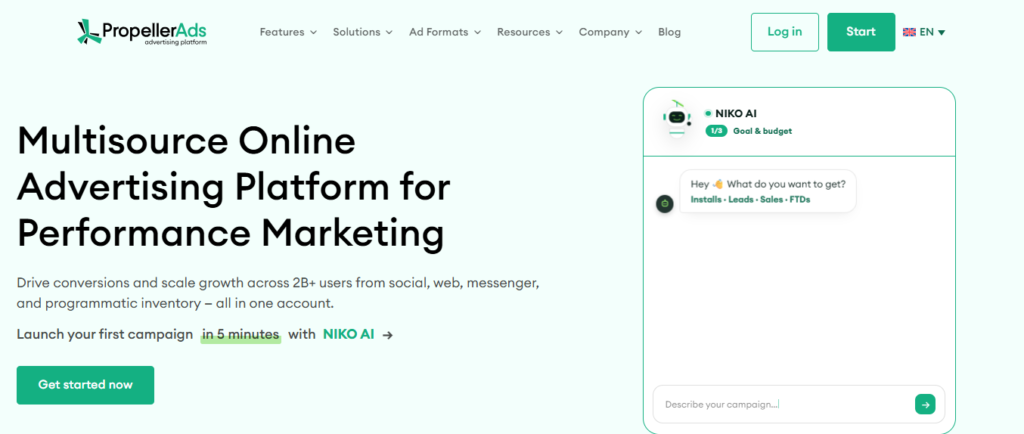
PropellerAds and Monetag are useful for publishers who prioritise international volume and performance formats. Payouts start at $5, with weekly options available.
Monetag currently offers multiple payment methods, including PayPal, Skrill, Webmoney, Payoneer, wire/online banking, Revolut, and cryptocurrency, with minimums that vary significantly by payment method. For example, PayPal starts at $5, while wire, online banking, and Revolut can require $500, and cryptocurrency starts at $100.
Its standard publisher schedule is twice a month, with a four-day hold, while weekly payments are available to qualifying Priority-program publishers.
Amazon Publisher Services is different. It is primarily a demand layer that publishers integrate into a broader programmatic setup. It is most useful alongside existing infrastructure rather than as a simple replacement for AdSense.
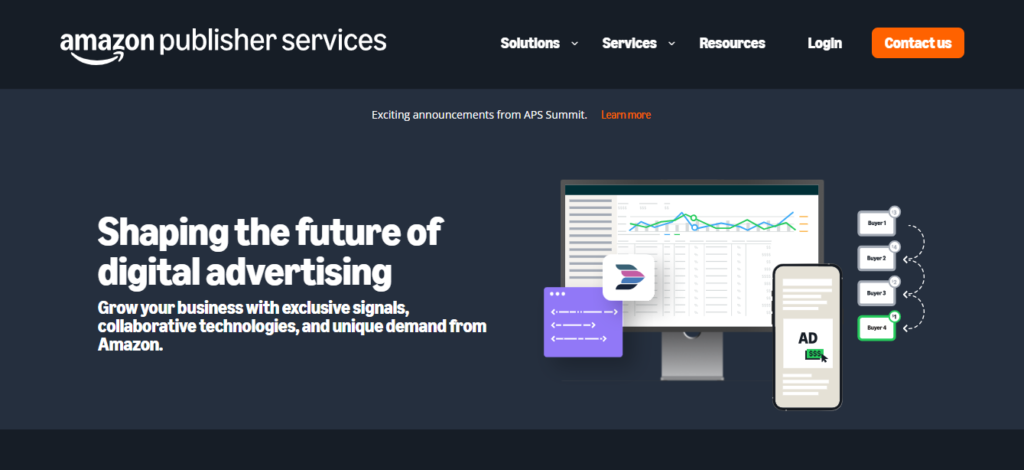
Performance-focused networks provide substantial automation, but publishers still need to monitor placement, formats, traffic quality, and underperforming inventory. Amazon Publisher Services requires a more advanced integration, including APS header bidding and demand-partner setup, so it is better suited to publishers with more technical resources.
What to do when AdSense will not take your site
An AdSense rejection can mean two very different things.
The first is site quality.
Thin content, poor navigation, copied material, unclear site structure, or low-quality traffic can cause a site to fail review. Those issues are fixable. Improving the site can also make it eligible for other networks.
The second is category restriction.
If the site’s core business is gambling, certain financial products, crypto services, CBD, supplements, or another restricted area, better design and more articles will not necessarily change the underlying policy. Those publishers should focus on demand sources rather than trying to force a general network to accept an unsuitable category. The routes for category-restricted publishers:
Audience-led and vertical networks
A specialist network already has advertisers looking for a specific audience. A crypto publisher may find more relevant demand from a crypto or Web3 network. A finance site may benefit from a network whose advertisers already buy financial audiences. The advantage is audience fit.
Performance networks
Networks such as Adsterra, PropellerAds/Monetag, and PopAds can be more permissive with categories and traffic profiles. They also introduce a practical trade-off: formats that monetise difficult traffic often create more user friction.
Direct sales and sponsorships
Direct deals remove the network’s content-policy layer from the transaction. A publisher sells inventory directly to an advertiser, negotiates the price, and determines the placement. The potential rate can be attractive, especially for a tightly defined audience, but the publisher now has to source advertisers, negotiate contracts, invoice on delivery, and run the campaign.
Affiliate revenue
Affiliate marketing can complement display revenue, especially where advertisers value leads, deposits, registrations, or sales more than impressions.
It should be treated as another revenue line instead of an automatic replacement for advertising.
The same restriction issue appears on the advertiser side. LinkedIn’s current advertising policy prohibits gambling and sweepstakes advertising. X forbids gambling globally by default and opens markets one at a time. Google permits many gambling campaigns only after certification and requires advertisers to hold the relevant local licences for targeted regions. Its gambling policy was updated in September 2026, expanding certification requirements across categories under the gambling-and-games policy. Anyone advertising crypto after the Google ad ban lift still has to clear that market by market, and projects that miss out buy from networks instead.
Casino operators whose ads are banned on Meta still need first-time depositors, and a network that accepts the category is where many of them end up buying. This helps explain why specialist networks exist. When mainstream platforms restrict a category, the demand does not disappear. It moves toward channels whose inventory and compliance model can accommodate that audience.
Best ad networks for advertisers
Advertisers should reverse the publisher decision tree.
Instead of asking which network has the most impressions, start with the audience, then confirm category acceptance, then examine the economics of a real test.
1. Bitmedia – Best for Fintech, iGaming, Gaming, and Web3 advertisers
Bitmedia’s main advertiser proposition is its audience.
The current platform positions itself around high-intent audiences across finance and fintech, Web3 and crypto, gaming, sports betting and iGaming, SaaS and AI tools, mobile utility, and earnings. Bitmedia reports more than 1.5 billion monthly impressions, 1.5 million monthly clicks, 800+ publishers, and 7000+ advertisers.
The platform supports CPC and CPM campaigns and allows advertisers to manage GEO, language, device, operating system, frequency capping, display time, VPN/data-center targeting, and audience options. Its advertiser dashboard also offers conversion tracking, including registrations and deposits. Formats include text, image, HTML5, playable and responsive ads, with image ads in 18 IAB sizes.
For Web3 campaigns, wallet-level and on-chain audience targeting is one distinctive capability within the broader network proposition. The important point is that Web3 is no longer the whole proposition: the same platform now sells access to several high-value audiences.
Bitmedia also supports iGaming as part of its broader advertising inventory, while traditional platforms such as LinkedIn prohibit gambling and Google requires certification for qualifying gambling campaigns. One iGaming account saw first-time depositors rise 1,174% in a year on Bitmedia.
The platform offers CPC, CPM, and smart bidding options. The minimum deposit is $300 by card or crypto equivalent, with BTC transactions exempt. Minimum bids are $0.25 CPC and $0.30 CPM. Ready-made source packages start at $100 a day, and banners are normally approved within hours (up to 24 on weekends).
Audience quality still depends on campaign targeting and placement selection. A high network-wide impression figure does not tell you how much relevant inventory exists for one GEO, vertical, or offer. Start with a controlled test and evaluate conversion quality, not raw clicks.
2. Google Ads and the Google Display Network
Google remains the benchmark for search intent and broad advertising scale.
Search gives advertisers access to users actively looking for a product or service, while Display expands reach across the wider Google advertising ecosystem.
The constraint is category compliance.
Gambling advertisers need Google certification and must meet location-specific licensing requirements. Financial services and other regulated categories can also require verification or certification depending on the market.
Certification requirements can materially change which GEOs and products you can advertise. Build policy checks into campaign planning before creative production.
3. PropellerAds – Best for global performance reach
PropellerAds is a self-serve network with very large volume, covering 195+ GEOs. It sells push, popunder, and interstitial formats and is permissive on restricted verticals.
Its historical publisher payment structure illustrates the model clearly: minimum withdrawals start at $5 for some e-wallets, with higher thresholds for bank wires, and weekly payments depend on eligibility and verified traffic. The deposit is $100 for most payment methods, and wire transfers start higher.
Traffic quality varies sharply by source and needs active blacklisting. The network suits direct response and is a poor fit for brand campaigns.
4. Adsterra – Best for volume across restricted-adjacent verticals
Adsterra provides access to 45K+ direct publishers in 248 geographies. It offers multiple formats, including Popunders, Social Bars, In-Page Push, and Smartlinks. The deposit is $100 with cards, PayPal, or Paxum, $200 with digital wallets, and $1,000 by wire.
Its published advertiser materials list verticals, including VPN, utility, antivirus, iGaming, e-commerce, and Addons.
Adsterra is relevant for advertisers looking for categories that can be awkward to run through mainstream social platforms.
It carries the same quality-management burden as PropellerAds. Budget a testing period spent excluding placements instead of optimising creative.
5. Adcash – Best for CPA-focused global buying

Adcash is designed around global self-serve buying across 195+ countries with CPA Target bidding.
Its advertiser proposition is particularly relevant to teams testing multiple GEOs and acquisition strategies at the same time.
The network’s exact minimum deposit is not consistently published publicly, which is notable given how often comparison guides overlook advertiser entry cost. Pricing and minimums need to be confirmed before funding an account.
6. Taboola and Outbrain (now Teads) – Best for native content distribution
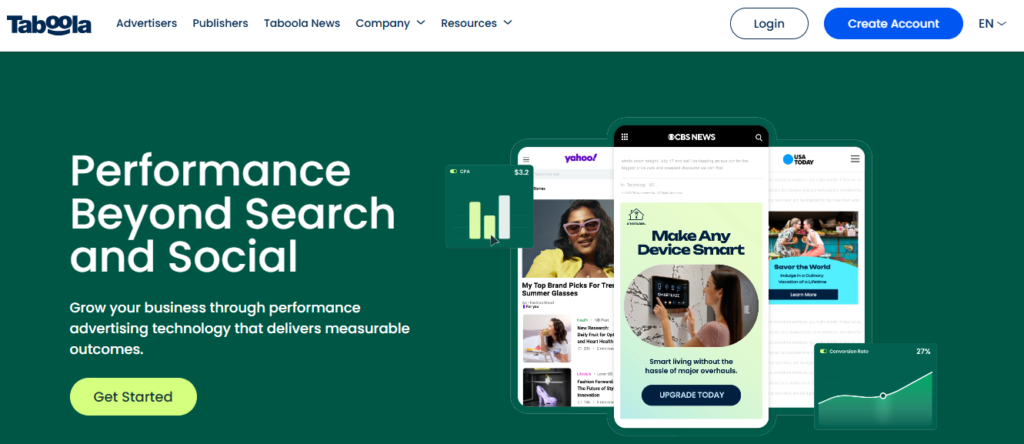
Both put ads in premium publisher content feeds at CPMs well below social. Outbrain was combined with Teads in 2025, and the combined company completed its corporate renaming to Teads in June 2025. Teads says it works with 10,000+ publishers and 20,000+ advertisers.
Taboola and Teads are suited to advertisers distributing articles, reports, research, branded content, or other content-led landing pages across premium publisher environments.
Taboola’s own blog says you can begin at $10 a day and recommends $50. Teads pricing is largely sales-led, so ask for current minimums.
Native advertising rewards useful content. A hard-sell landing page can underperform even with good placement because the creative-to-page transition feels mismatched. Publisher exclusions are also an important part of optimisation.
7. MGID – Best for native at mid-market budgets
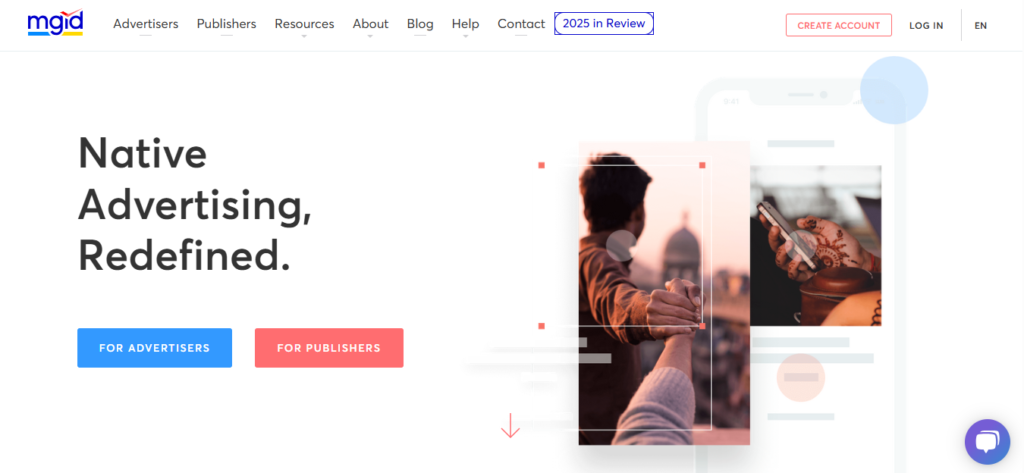
MGID provides native placements across international inventory and operates primarily on a CPC model.
Its current advertiser pricing information states that the minimum deposit is $100, with a $50 minimum campaign budget. It recommends around $650 or more as a starting deposit for advertisers that need enough data to run a meaningful test.
Expect the same site-exclusion work as the other native networks. A $100 deposit is not clearly cheaper to start with than Taboola’s $10 a day.
8. ROIads – Best for performance campaigns across multiple formats

ROIads is a performance-focused advertising network for affiliates and media buyers who want to acquire traffic across multiple GEOs and verticals. It offers push notifications, popunder ads, in-page push, and Direct Click, with particular emphasis on iGaming, betting, dating, finance, utilities, and other performance-oriented categories.
ROIads lists worldwide traffic and supports campaigns across more than 150 GEOs. Its formats serve different purposes: push ads use CPC pricing, while pop ads use CPM pricing. The homepage advertises starting rates of $0.003 CPC and $0.50 CPM, although actual costs depend on the campaign and targeting settings.
AI bidding and CPA Goal help automate campaign optimisation, while micro bidding lets advertisers adjust bids at the publisher or sub-source level. Advertisers can also use whitelists and blacklists to control where their traffic comes from.
The minimum deposit is $250. Deposits of $500 or more qualify advertisers for additional support from a personal account manager. The support covers campaign setup, traffic-source selection, and creative decisions. Wire transfers require a $500 minimum initial payment under the published terms.
Networks built for specific verticals
Specialist networks exist because the general advertising market struggles with targeting.
A general platform may know that a user is in a certain country or interested in a broad category. A specialist network knows that the user is reading crypto market analysis, using a blockchain application, following a betting site, or engaging with a specific financial audience.
That difference can be valuable when the audience itself is the scarce asset.
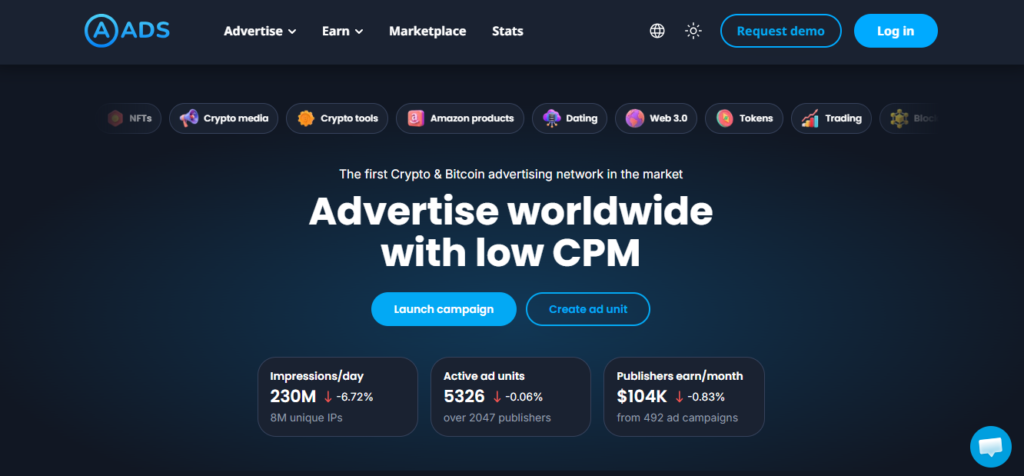
AADS has operated since 2011 and is widely considered the oldest crypto ad network. It currently reports more than 231 million impressions per day, 93,000 clicks per day, 2,041 active publishers, and 141 active advertisers.
Coinzilla focuses on finance and cryptocurrency advertising, with a network of major crypto and finance websites, self-serve campaign tools, retargeting, and audience targeting. Its current site reports more than 20,000 Web3 campaigns and more than 1 billion impressions in its Web3 advertising product.

Cointraffic describes itself as a crypto advertising network with 700+ vetted websites and 1 billion+ monthly impressions. It offers banners, native formats, popunders and press releases, with CPM bidding and managed support.
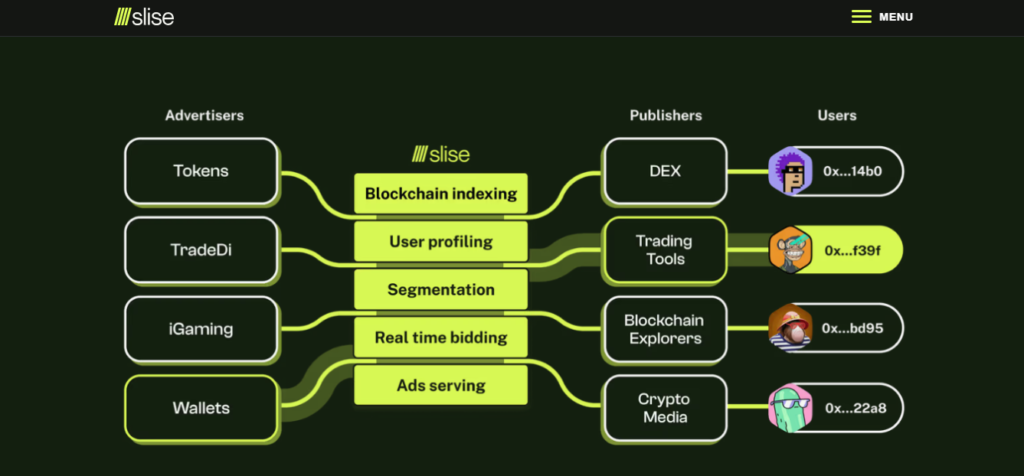
Slise focuses on Web3 users and on-chain targeting. Its offering includes wallet-based audience segments and access to a curated network of decentralised applications.
When choosing a crypto ad network among them, compare:
- Audience targeting depth. A network with wallet-level or behavioural segmentation may offer a fundamentally different audience product from a network that simply owns placements on specialist websites.
- Vertical coverage. A network serving several related advertiser categories can create more demand competition for the same inventory. A tightly specialised network may offer deeper context.
- Publisher composition. Ask how many publishers participate, what kinds of properties they operate, and whether the traffic actually comes from the specialist audience being advertised.
- Fraud controls. High-value verticals attract high-value fraud. Ask how invalid traffic is detected and what happens financially when it is identified.
- Payment rails. Check currencies, minimums, payout schedules, settlement methods, and any fees before agreeing to the relationship.
- Compliance. Gambling, financial promotion, and other regulated categories can change significantly by jurisdiction. A network should be able to explain how it handles restricted markets.
How to choose the right ad network
The right network depends first on eligibility and audience fit, then on economics.
For publishers
- Check eligibility first. Traffic thresholds and category restrictions eliminate networks before revenue share becomes relevant.
- Match the network to your audience, not just your traffic volume. A 20,000-visit finance site and a 20,000-visit recipe site can have very different monetisation opportunities because advertisers value their audiences differently.
- Check that you can actually get paid. Confirm the payment method available in your country, the minimum threshold, currency, hold period, and expected settlement time.
- Measure the user-experience cost. A higher CPM does not help if aggressive ad formats reduce returning users, session length, organic visibility, or page performance.
- Test before committing. Run two suitable networks in parallel when contracts allow it. Compare RPM, fill rate, viewability, user experience, and payment reliability. Check exclusivity clauses before implementation.
For advertisers
- Define the audience before choosing the network. “More impressions” is not a useful objective if most impressions come from users who cannot become customers.
- Confirm category acceptance before producing creative. This is particularly important for gambling, finance, crypto, and regulated products.
- Calculate the real cost of a test. Minimum deposit, daily budget, minimum bid, and the expected number of impressions or clicks all influence whether the test can produce enough information.
- Ask about fraud controls. Learn how invalid traffic is identified, whether traffic is filtered before purchase, and how disputed traffic affects billing.
- Budget for placement exclusions. On broad inventory networks, exclusions are part of campaign management. A period of testing and blacklisting is normal.
FAQ
What is the best ad network in 2026?
There is no single network that fits every publisher or advertiser. The practical choice depends on eligibility, audience, category, pricing model, payment terms, and the type of inventory you need. A general publisher with little traffic may prioritise a network with no threshold, while a high-volume finance publisher may need specialised demand. Advertisers face the same distinction: search intent, native content, performance traffic, or specialist audiences require different network models.
Which ad network pays publishers the most?
A published revenue-share percentage does not tell you which network will generate the most money for a specific site. Total publisher revenue depends on RPM, fill rate, GEO, device, advertiser demand, viewability, ad formats, and traffic quality. Premium managed networks (Mediavine, Raptive) typically deliver the highest RPMs on brand-safe lifestyle and food traffic because of demand-side concentration. Publishers in finance, gaming, and Web3 often earn more from audience-led networks, where advertisers pay specifically for that audience. Compare revenue share, floors, and payout terms together, since a high rate with slow payment is worth less.
What are the best AdSense alternatives?
Media.net is great for contextual ads, while Adsterra and PropellerAds offer low-barrier-to-entry performance formats. If you focus on finance, gaming, or Web3, Bitmedia is tailored specifically for those verticals. Once you reach higher traffic thresholds, you can step up to premium managed networks like Mediavine or Raptive. Keep in mind that these networks often work best when run in parallel rather than as a total replacement. The suitable alternative depends on why you want to leave or cannot use AdSense.
Which ad networks accept gambling and iGaming?
Bitmedia supports iGaming as an ad category, so an operator can buy without a certification programme. Performance networks such as Adsterra, PropellerAds, ROIads and Adcash also sell traffic to gambling offers under their own content rules. Mainstream platforms are stricter: Google requires certification and a local licence per region, LinkedIn bans gambling outright, and X requires pre-approval in each country where gambling is allowed. Always check each network’s current policy for your target markets.
Which ad networks accept crypto and Web3 websites?
Bitmedia and crypto-specific networks such as AADS, Coinzilla, Cointraffic, and Slise work with crypto and Web3 sites and projects. Google lets exchanges and wallets advertise only when they are certified, licensed, and targeting approved locations. Performance networks with permissive content rules also take crypto offers. Check the current content policies and the exact advertiser demand available for your GEO.
Can you run more than one ad network on the same site?
Often, yes, provided each network’s terms allow it and the implementation does not create auction, placement, policy, or user-experience conflicts. Running two networks during a controlled test can help a publisher compare real RPM, fill rate, viewability, and page performance. However, some managed programmes, direct deals, or contracts may include restrictions. Check exclusivity and placement terms before adding another network.
What is the difference between an ad network and an ad exchange?
A network packages inventory from many publishers and sells it to advertisers, usually at set or negotiated prices, and handles delivery, measurement, and payment. An ad exchange is an open marketplace where buyers bid for individual impressions in real time, usually through demand-side and supply-side platforms. Networks give you less control and less work. Exchanges give you more control and require technical setup. Many networks now also buy from exchanges.
Which ad networks have no minimum traffic requirement?
Google AdSense and Media.net are top choices for clean contextual display ads on new blogs. For faster approval and flexible formats like popunders or push notifications, low-threshold networks such as Adsterra, Monetag, and Adcash welcome small sites immediately. Crypto and privacy-focused publications can use AADS, which requires no traffic baseline. Bitmedia also does not publish a numeric traffic minimum, but it manually reviews publishers for content quality, genuine traffic, prohibited traffic sources, and site behaviour.
How much does it cost to start advertising on an ad network?
Entry costs range from $100 to $300 for most performance networks: PropellerAds, Adsterra, Adcash (self-serve), and MGID start at $100, ROIads at $250, and Bitmedia at $300. Taboola can start at $10 a day. A deposit only opens the account, though. MGID recommends at least $650 for a test, and open-inventory networks need extra budget for excluding poor placements. Plan a test budget several times the minimum.
Do ad networks slow down your website?
They can. Every additional ad script, auction, creative, and tracking request can affect page loading, layout stability, and overall performance. The risk depends on the network, implementation, number of demand partners, ad formats, and optimisation setup. Publishers should monitor Core Web Vitals, page speed, layout shift, and mobile performance after installation. A network that produces more revenue per session can still be a poor fit if the implementation creates enough friction to reduce organic traffic or returning users.
Conclusion
The network you choose needs to pass three practical tests: it must accept your category, value the audience you have, and provide payment terms that work for your business.
Traffic volume and impression counts are useful indicators, but they do not answer those questions.
Publishers can apply to Bitmedia, and advertisers can start a campaign from $300.

Related Posts