





If you’re running banner or display campaigns right now, you already know the feeling. The dashboard looks fine. Impressions are healthy. CTR hasn’t collapsed. And yet your CPA keeps drifting upward, quarter over quarter, without a clear reason to optimize away.
Execution problems are uncommon in that case. It’s a media mix problem that almost every account, regardless of vertical, experiences. One format is asked to do a job it wasn’t made for. Before adding anything new, it’s worth checking whether there’s a real gap in your mix and whether Pop Ads is the format that actually closes it.
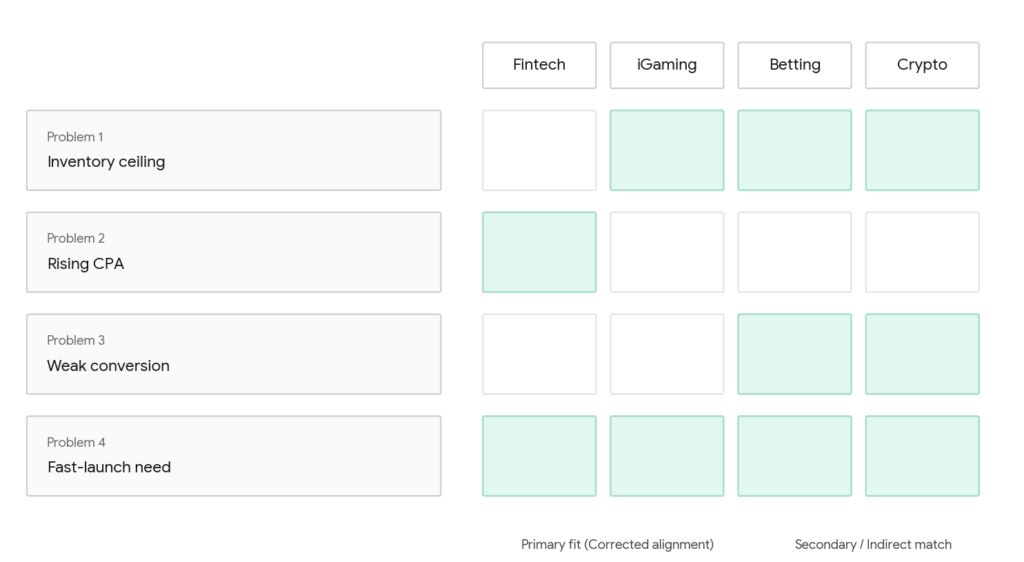
The four strategy problems Pop Ads is built to solve
Problem 1: You’ve hit a banner inventory ceiling
Display inventory on any given publisher network is limited. When you’re bidding competitively for the top slots in a Tier 1 market, more budget doesn’t buy you more reach. Instead, it raises the cost of the existing reach. Pop Ads sits on a separate inventory layer entirely. When a user interacts with a publisher page, the redirect fires, opening your destination URL in a separate window. Adding Pop Ads extends your reach. It doesn’t compete with your existing banner spend for the same impressions.
This is most noticeable in iGaming, betting, and crypto, where there is a lot of competition for Tier 1 display inventory, and CPMs are no longer a useful tool for growth.
Problem 2: Your CPA is rising but conversion rate isn’t
When CPMs climb without a matching lift in conversion rate, that’s usually a saturation signal. You’re paying more to reach the same people rather than new people. Pop Ads introduces your offer at a different moment and through a different touchpoint. That changes the conversion dynamic even when the underlying audience overlaps with your display campaigns. Instead of relying on a user noticing a 300×250 image on a busy page and choosing to leave what they were reading, Pop Ads places your offer front and center.
Neobanks and fintech brands feel this highly. Financial-services CAC has risen 40-60% since 2023, according to Data Ally’s fintech marketing benchmarks. Compliance costs and shrinking attribution accuracy are the main drivers. If your CAC curve looks like that and your conversion rate has stayed flat, the problem is that banners are the only lever you’re pulling.
Problem 3: You’re getting impressions but not conversions
This issue is a format mismatch problem rather than a targeting issue. Banner viewers are passive by design. They are in the middle of something else and are glancing over your ad. Pop traffic is different: the redirect fires while users actively engage with publisher content. It puts your offer in front of someone in an active browsing state rather than a passive one. For direct-response offers, that moment tends to align better with conversion intent than a banner impression does.
Sports betting brands with strong brand recognition but soft display conversion see this most clearly. Most bettors already know the brand. What’s missing is a touchpoint that reaches them at the moment they’re deciding where to place a bet, rather than mid-scroll on unrelated content. That’s a timing problem, and it’s precisely the kind of gap Pop Ads is positioned to close.
Problem 4: You need volume fast without a creative build
Creative production is often the biggest bottleneck in agile performance marketing. Building, testing, translating, and resizing dozens of banner variations for a fast-moving market launch or short-term event can take weeks you don’t have. Pop Ads needs one destination URL. That removes the production cycle from your launch timeline entirely. It matters most when the campaign window is short: an event-driven betting promotion, a market-condition crypto campaign, or a neobank regional launch tied to a specific date. When time is the constraint, format simplicity is a strategic advantage.
Vertical-specific strategy
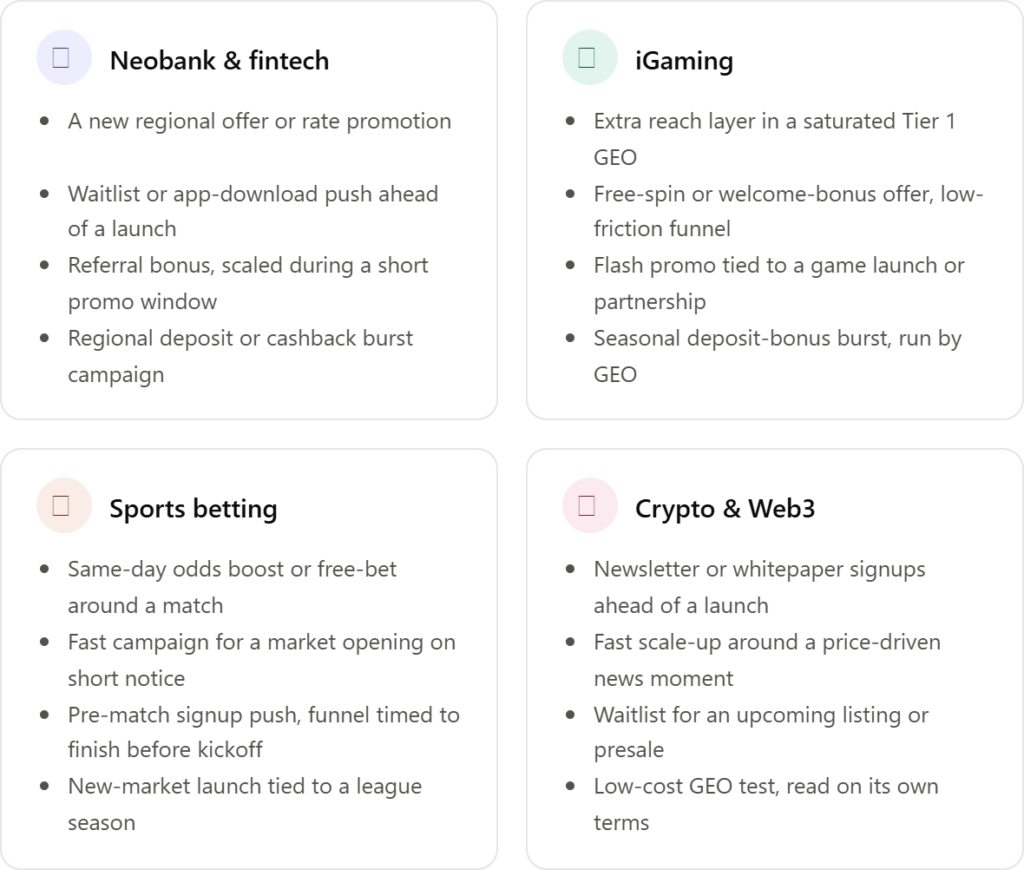
Neobank & Fintech
The core challenge here is trust and CAC discipline. Fintech acquisition costs are structurally higher than most verticals because of compliance, KYC, and onboarding drop-off. All sit on top of raw media spend, and every wasted impression compounds that cost. Pop Ads functions as an awareness accelerator and high-volume top-of-funnel filter. It introduces the offer cleanly, and a content-rich pre-lander bridges the trust gap before qualified users reach the registration page. In practice, that means using it in situations like these:
- A new regional offer or rate promotion
- Low-friction top-of-funnel actions like waitlist signups or app downloads, run ahead of a product launch
- A limited-time referral bonus or sign-up incentive, scaled during a short promotional window
- A regional deposit or cashback promotion, run as a burst campaign in specific GEOs without a longer creative build
iGaming
The iGaming sector suffers from high player acquisition costs (CAC) and extreme banner fatigue. Advertising in the iGaming industry is very competitive. In Tier 1 markets, banner CPMs buy less extra reach every quarter. Pop Ads gives iGaming advertisers a second inventory layer without touching the display budget that’s already working. Pop Ads acts as a direct line to immediate gameplay intent. Where that tends to show up:
- A saturated Tier 1 GEO where banner inventory is already maxed out, extended with a second reach layer
- A free-spin or welcome-bonus offer, scaled through a short, low-friction signup funnel
- A flash promotion tied to a game launch or provider partnership announcement
- A seasonal deposit-bonus push, run as a GEO-targeted burst campaign around a fixed calendar date
Sports betting
Betting brands often carry strong organic brand recognition, but that display isn’t converting efficiently. A challenge for sports betting in advertising is balancing strict regulatory compliance with high customer acquisition costs. Most bettors already know the brand well before they see another banner. A passive banner impression in a mature, retention-focused market doesn’t move a bettor who already knows you. Pop Ads work here because they insert your offer at a moment of active engagement instead of passive scrolling. A few situations where it earns its place in the mix:
- A same-day odds boost or free-bet promotion around a major match or tournament
- A fast, event-driven campaign for a market that opens on short notice, with no creative production cycle to wait on
- A pre-match signup push in the run-up to a fixture, timed so the funnel completes before kickoff
- A new-market launch tied to a specific league season or regulatory go-live date
Crypto exchanges and Web3
Crypto is the vertical where Pop Ads’ limits deserve the most honest treatment. Trust is the primary barrier to conversion in this category, and a cold pop redirect straight to a wallet-connect flow will underperform. Crypto-native display inventory typically runs $2-10 CPM, so the format itself isn’t expensive. But the trust gap means the pre-lander step matters more here than in any other vertical. That trade-off works best for:
- Newsletter or whitepaper signups for a new token or protocol, run ahead of a wider launch push
- Traffic scaled quickly around a price-driven news moment, when speed matters more than deep targeting
- A waitlist for an upcoming exchange listing or presale, built before the trust-heavy conversion steps begin
- A new market’s appetite for an offer, tested at low cost across a few GEOs before scaling banner budget into it
How to add Pop Ads to your existing strategy – The three-step approach
Success with Pop Ads depends on how you integrate them into your funnel architecture.
Step 1 – Don’t replace. Add.
The most common mistake advertisers make is cutting the banner budget to fund a pop test. That’s backwards. Banners build the brand familiarity that makes pop traffic convert better. The two formats reinforce each other more than either performs alone. Start with an incremental budget addition, rather than a reallocation of what’s already working.
Step 2 – Build the pre-lander before you launch
Pop traffic arrives quickly and directly. It needs a bridge to establish context. The pre-lander is the mechanism that turns cold pop traffic into a qualified prospect before the user ever sees your offer page. A pre-lander acts as a qualification filter. It educates the user and prompts an initial low-friction click before sending them to the main conversion funnel. Every vertical in this article needs one. The specific content varies by vertical, but the requirement doesn’t.
Step 3 – Read the data at the right time
Pop Ads deliver impressions instantly and at high volume, which tempts marketers to judge performance and cut campaigns after 6 to 12 hours. Doing so usually leads to inaccurate conclusions. Give the funnel 72 hours before you make any optimization call. Conversion cycles across all four verticals span multiple days, and decisions made before that window closes tend to produce false conclusions. Once you’ve cleared 72 hours, GEO is almost always the first lever to pull. Identify which markets are actually delivering qualified users, and concentrate your budget there before touching anything else.
If your mix has one of these four gaps, it’s worth a conversation with your Bitmedia Account Manager before you build a single creative. Bring your current CPA trend, and we’ll tell you honestly whether Pop Ads closes the gap or whether the problem sits somewhere else in your funnel.

Related Posts