

You have almost certainly clicked a native ad without registering it. A “Recommended for you” tile under a news story counts, and so do the promoted product at the top of Amazon search results. Both are paid placements built to look like the page around them.
Ten real campaigns show what native advertising looks like in practice. Nine worked, and one was pulled about 11 hours after it went up.
What is native advertising?
Native advertising is paid content that matches the look and function of the place where it appears. A banner announces itself with its colors and a reserved slot. A native ad borrows the format of its host: a feature article on a publisher’s site or a post in a social feed.
Blending in is different from hiding. Regulators expect a clear label such as “Ad,” and the ad still has to earn the click by being worth reading.
Native ads are often confused with two other formats. Content marketing is material a brand publishes on its channels, like a company blog. Display advertising, banners included, usually interrupts the page. Native advertising pays to put content on someone else’s channel and tries to sit inside the page instead of on top of it.
Types of native ads
Guides slice native formats in slightly different ways. Four types cover most of what a beginner will run into.
Native advertising examples that worked
The campaigns below come from publishers’ case studies, award entries, and trade press.
Netflix and The Wall Street Journal: “Cocainenomics”
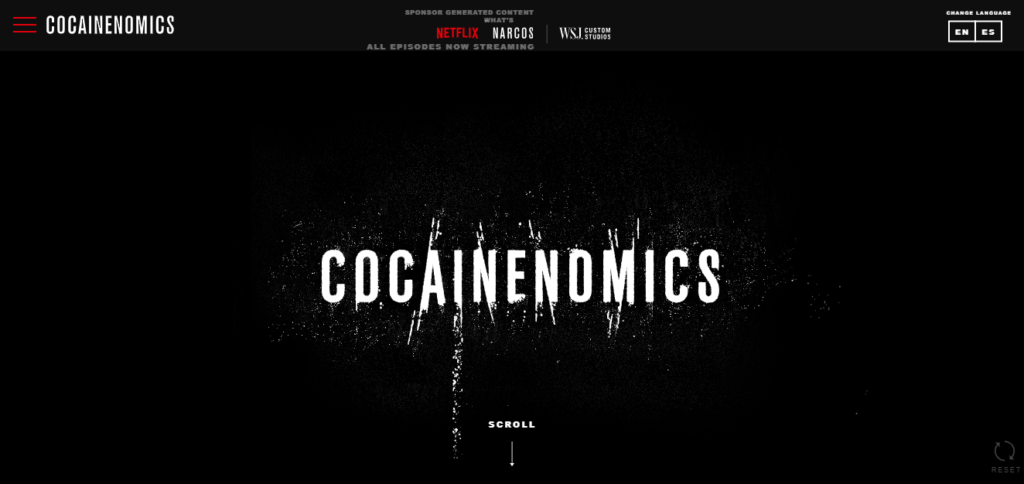
In 2015 Netflix wanted viewers to care about Narcos, its series on Pablo Escobar. It teamed up with WSJ Custom Studios, the Journal’s in-house branded content team, to build an interactive feature in six sections on how the Medellín cartel ran as a business. Readers got video interviews with DEA agents and a ten-question quiz to test themselves.
Allbirds and The New York Times: Paid Post
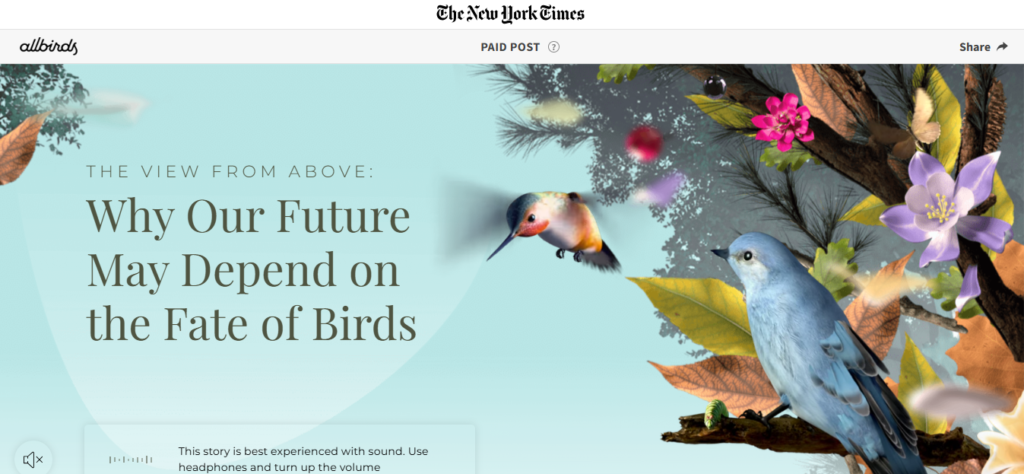
Most shoppers saw Allbirds as a sneaker brand, and the company wanted them to see its sustainability work. Together with the Audubon Society, it hired the Times’ T Brand Studio to make a piece on five climate-vulnerable birds. The Times calls its native ads Paid Posts. This one carried a “Paid Post” label and used graphics and sound in the style of the paper’s long-form features.
Dacia and Seznam: “The Road to Joy Is Simple”

For the Duster in the Czech Republic, Dacia ran a native article of day-trip routes near cities such as Prague and Brno, published through Seznam Brand Studio. A mud-covered Duster parked outside a Prague Prada store added a stunt for social sharing. According to the Native Advertising Institute, the article became the most-read automotive piece of the year in the country, with over 770,000 views and no paid promotion. Searches for “Dacia Duster 2024” rose 123%, and test-drive interest doubled.
Fortune and Accenture: a B2B case
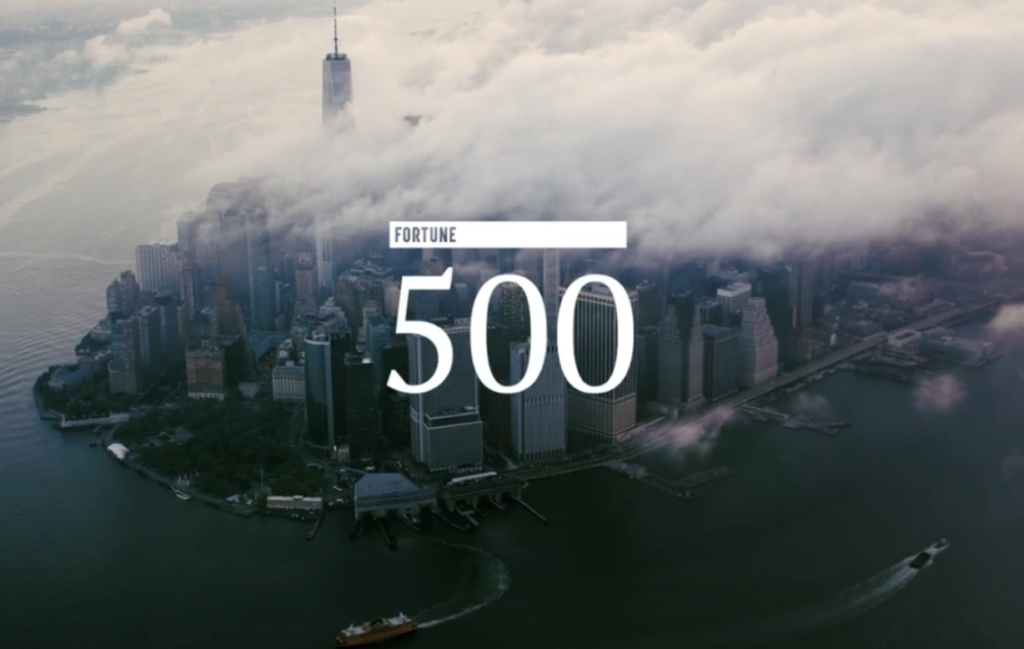
Native works for B2B too. Fortune Brand Studio made a ten-minute documentary-style film with Accenture, “Reinventing the Fortune 500,” tied to the list’s 70th anniversary. The same Native Advertising Institute write-up reports 4.1 million impressions, more than 18,000 landing page views, and an average scroll depth of 92.9%. Viewers came from 2,200 business domains, and 42% held management roles, including 7% in the C-suite.
Amazon Ads and Insider Studios: “An Advertising Tail”
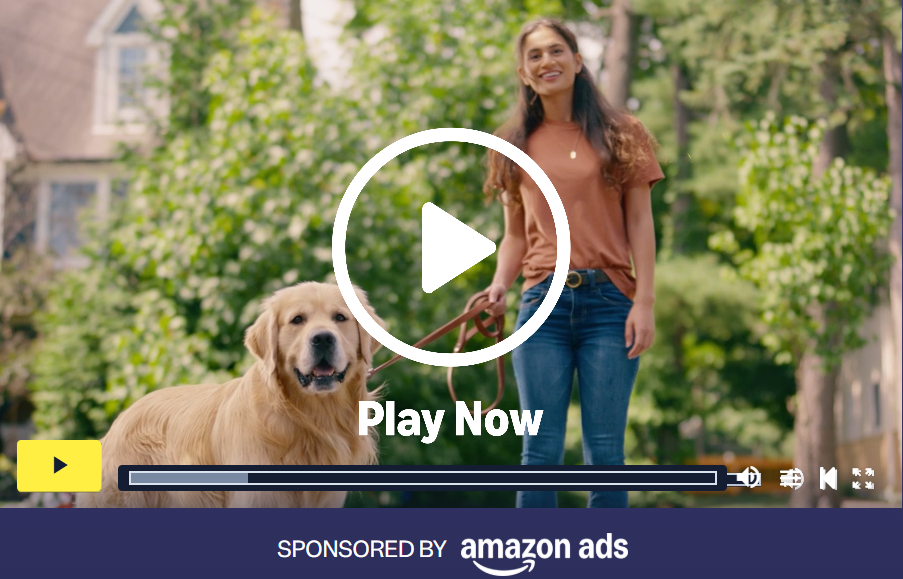
A golden retriever named Tucker starred in Amazon Ads’ pitch to marketers because nearly half of Business Insider’s senior marketing readers owned a dog, according to the publisher’s own audience data. Insider Studios built an interactive video around him, and viewers picked story paths and clicked hotspots that revealed Amazon Ads tools.
Per the same Native Advertising Institute source, the page drew over 165,000 views at an average watch time of three minutes. Brand awareness rose 23 points, favorability 12, and recommendation intent 17.
Michelin on Outbrain: a recommendation widget
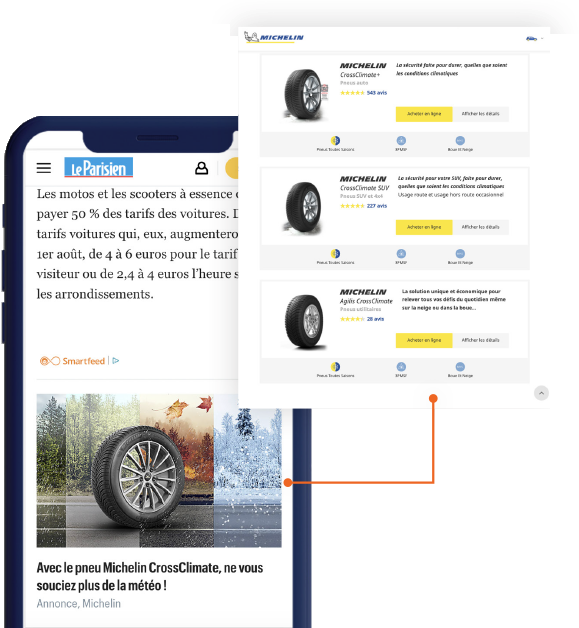
For its winter tire range, Michelin used Outbrain’s automated bidding to chase visits of more than 30 seconds at a maximum of €1.50 per visitor and aimed to send readers to tire content and nearby retailers. Outbrain says the campaign outperformed comparable social media campaigns, though that is the vendor’s own claim.
HSBC on MGID: credit card leads in Indonesia
MGID’s case study for HSBC in Indonesia reports 74,883 clicks at an average cost per click of $0.06. HSBC wanted leads for its Visa Platinum and Platinum Cashback cards. MGID, the native network that ran the campaign, delivered native-format messages aimed at young adults and families. The case study also reports a 1.5% conversion rate and an effective cost per acquisition of $4. The page gives no campaign dates, and the numbers are the network’s own.
A US home lender on Yahoo and Taboola
One of America’s largest home lenders had been buying Yahoo’s own inventory through a demand-side platform. It then tried Yahoo’s native workflow, powered by Taboola, with ads running on Yahoo properties such as mail, sports, finance, and news. Taboola reports 289% more leads and a 24% lower cost per lead than the lender’s previous native campaigns. The footnote credits Yahoo internal data, and the page names no campaign dates.
1xBet on Blockchain-Ads: sports betting in Africa
In an affiliate-run campaign across Nigeria, Kenya, Ghana, and South Africa, native became the main format after it beat display on cost per registration in all four markets. The creative led with a localized football angle covering CAF tournaments and regional leagues, and by the third phase that angle carried acquisition. Blockchain-Ads reports 20,043 players at a $48 CPA and 3.4x return on ad spend from $960,000. The page does not split results by format and says its figures are not typical results.
The one that backfired: The Atlantic and the Church of Scientology
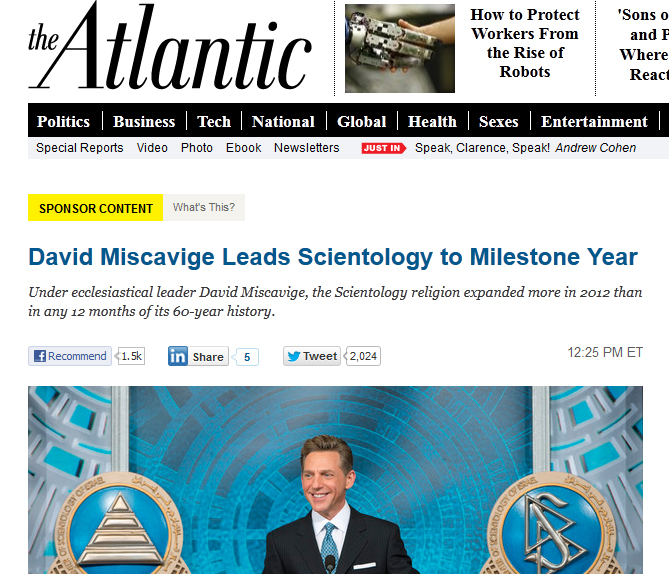
About 11 hours after it went up, The Atlantic took down a piece headlined “Davworth reading on its owns Scientology to Milestone Year,” which it had labeled “Sponsor Content” in January 2013. Journalists and readers had criticized it, also questioned how the magazine moderated comments on the page. AJR’s Rem Rieder noted that the only hint it was not an Atlantic story was a small “sponsor content” box above the headline.
Two weeks later The Atlantic introduced new rules, including a line stating the article was written by or on behalf of the sponsor and not by its editorial staff. A label cannot rescue a sponsor that clashes with the host.
What the best native advertising examples have in common
- Value comes first. Readers get a feature or a documentary-style series, and the brand rides along.
- The audience was studied. Insider Studios built around dog owners because its audience data pointed there. The Fortune film spoke to executives, and 42% of its viewers held management roles.
- The format matches the host. A scrolling story on a news site or a documentary series on a publisher’s video site looks like it belongs.
- One goal, one measure. Michelin chased 30-second visits. Fortune tracked scroll depth. Neither stopped at the click.
Labeling: what the FTC expects
In the US, the Federal Trade Commission published its enforcement policy statement on deceptively formatted ads in December 2015, and the rule is that an ad has to be recognizable as an ad. Its business guide says terms like “Ad,” “Advertisement,” “Paid Advertisement,” and “Sponsored Advertising Content” work. “Promoted” is ambiguous, and “Sponsored by” or “Presented by” can leave readers thinking the sponsor paid for content someone else wrote.
Placement matters as much as wording. The FTC wants the label in front of or above the headline and before the promotional message in a video. A logo alone is generally not enough. Rules differ by country, so check the ones where your ad will run. In the UK, the Advertising Standards Authority’s CAP Code says advertorials must be made clear as marketing communications. IAB Europe publishes guidance on how EU rules apply to native formats, and the ICC Code, the basis of most self-regulatory systems around the world, says marketing communications should not be disguised as news or editorial matter. The campaigns above ran in the Czech Republic, France, Indonesia, and several African countries, each with its own rules. Labels in the wild vary: Netflix’s page says “Sponsor Generated Content,” and The Atlantic used “Sponsor Content,” and neither is among the terms the FTC guide names as effective.
Common mistakes
An ad that is only a pitch is the usual failure. A reader who clicks expecting an article and lands on a sales page feels tricked, and the Atlantic story shows how fast that goes public. Headlines that promise more than the page delivers has the same effect, with high bounce rates as the price.
Sending clicks to a generic homepage wastes the work done on the creative. Judging the campaign by clicks alone is the other trap, since a click says little about whether anyone read anything.
Another mistake is skipping the rules conversation with the publisher. The Atlantic added its authorship line and new sponsor rules two weeks after the Scientology page came down, after journalists questioned how its comments were moderated. Agree on who writes the piece and how it is labeled before launch.
How to run your first native campaign
- Pick one goal and one measure. Decide what success means before you launch, then track against it. Michelin set 30-second visits as its target, and Fortune reported scroll depth.
- Choose a host that suits your audience. Pick a publication whose subject and readers fit your brand, and write in its voice.
- Give readers value first. Make the piece useful or entertaining on its own, and avoid a sales-heavy pitch.
- Label it plainly. Use a term the FTC names, such as “Ad” or “Advertisement.”
- Track it yourself. Implement trackable calls to action alongside the publisher’s reporting, and adjust over time. Click-through rate (CTR) is clicks divided by impressions. Also check the time on the page and conversions.
Frequently asked questions
Where can I find native ads?
You can find native ads under articles on news sites in blocks labeled “Recommended for you,” inside social media and app feeds, at the top of search results and Amazon results, and in some email newsletters.
How much does it cost to start a native ad campaign?
Bitmedia’s minimum deposit is $300 by card, and bids start at $0.25 per click or $0.30 per 1,000 impressions. A higher bid gives the ad better visibility, so treat those numbers as the entry point, not the budget that will fill the campaign.
How is native advertising different from display advertising?
Display ads use standard banner sizes and sit in reserved slots, so they interrupt the page. Native ads copy the format of the content around them.

Related Posts