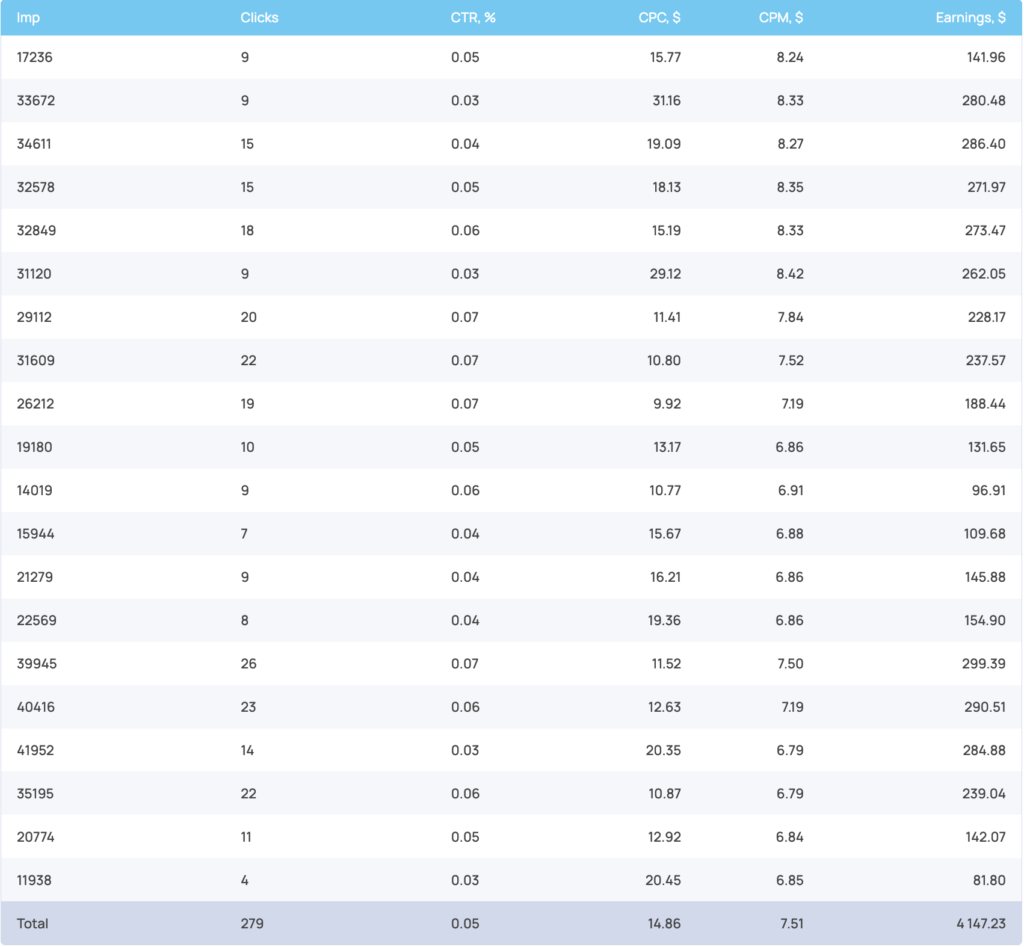
CoinGecko, the world’s largest independent cryptocurrency data aggregator, switched on Bitmedia’s header bidding on October 30, 2026. In the first 20 reporting periods, its 300×250 header bidding ad unit earned $4,147.23 from 552,210 impressions, an average CPM of $7.51. This case study shows the numbers, how header bidding works for crypto publishers and what other publishers can take from it.
CASE STUDY OVERVIEW
PUBLISHER
CoinGecko
INDUSTRY
Crypto data and price tracking
SOLUTION
Bitmedia header bidding (Prebid.js)
AD UNIT
300×250 banner
PLACEMENT
Bitcoin page
LIVE SINCE
October 30, 2026
PREVIOUS SETUP
Direct sales and waterfall
GOAL
Higher yield and fill from crypto traffic
Key results of the header bidding integration
Key results
$4,147.23
total earnings from the header bidding ad unit
552,210
impressions served
$7.51
average CPM, earnings per 1,000 impressions
279
clicks
0.05%
average click-through rate
$14.86
average earnings per click (CPC)
How the revenue adds up
552,210
impressions
×
$7.51
average CPM
÷
1,000
CPM unit
≈
$4,147
earnings
About CoinGecko
CoinGecko was founded in 2014. It tracks prices, trading volume, market capitalization and community data for thousands of crypto assets and exchanges, and offers an API and a mobile app. Its coin pages, such as the Bitcoin page, are where crypto users check prices and market data, so the audience is closely tied to the crypto market.
Independent data aggregatorPrices, volume, market capAPI and mobile app
Before header bidding, CoinGecko relied on a standard direct setup and basic waterfall monetization. Even with a massive volume of crypto traffic, fill rates and average yields stayed flat, because part of the inventory was not competing in a real-time auction.
In a waterfall, each ad request goes down a priority list one demand source at a time, and the impression is sold to the first source that fills it, not to the one that would pay the most. Header bidding replaces that line with a single auction where every source bids at once.
Before: direct + waterfall
1Direct campaigns
↓ only if the slot is not filled
2First demand source
↓ only if the slot is not filled
3Next demand source
↓ only if the slot is not filled
4Remnant demand
One source at a time. Part of the inventory never faces competition.
The solution: Bitmedia header bidding for CoinGecko
Bitmedia opened CoinGecko’s ad slots to simultaneous bidding from multiple advertisers. Instead of passing each impression down a waterfall, header bidding sends the request to several demand sources at once and serves the highest bid. Bitmedia’s header bidding runs on Prebid.js with a Bitmedia adapter.
300×250
ad unit size (medium rectangle)
Prebid.js
with the Bitmedia adapter
Oct 30
header bidding live from the start
Bitcoin page
example placement on CoinGecko
HOW EACH IMPRESSION IS SOLD
1
Page loads
A JavaScript wrapper in the page header starts the auction.
2
Requests go out
Demand partners receive page and user details at the same time.
3
Advertisers bid
Bids are placed in real time, so price follows demand.
4
Highest bid wins
The winning bid is passed on to the ad server.
5
Ad displays
The 300×250 creative renders in the placement.
You can see the placement live on CoinGecko’s Bitcoin page, where the 300×250 unit sits in the left column next to the community sentiment poll, above the Bitcoin Markets table.
After running the test phase, Bitmedia’s team saw a solid boost across the board. Ad revenue grew compared with the old setup, average CPM and fill rates went up, and overall monetization efficiency improved without slowing page load times.
One detail matters when reading the numbers: header bidding was active on this ad unit from the very first day, so there is no like-for-like before-and-after comparison for this specific setup. The results below show absolute performance.
Results: header bidding revenue and CPM
Over the first 20 reporting periods, the 300×250 header bidding ad unit earned $4,147.23 on 552,210 impressions. Earnings per period averaged $207.36, and 13 of the 20 periods earned $150 or more.
Volume moved a lot between periods, from 11,938 to 41,952
Above average
Below average
Average 27,610
What it shows: the peak of $299.39 came in period #15, one of the three highest-volume periods. Periods #15 to #17 each served more than 39,900 impressions and each earned over $284.
CPM stayed in a narrow band
CPM is what the publisher earns per 1,000 impressions, so it is the cleanest read on how strongly advertisers bid for the inventory. Across all 20 periods it never fell below $6.79 or rose above $8.42, around an average of $7.51.
CPM by reporting period ($)
Earnings per 1,000 impressions
CPM
Highest
Lowest
Average $7.51
CPC VS. CPM VOLATILITY
CPC swung much more than CPM
Earnings per click moved from $9.92 to $31.16, more than three times apart, while CPM stayed within about 10% below and 12% above its average.
Earnings per click by reporting period ($)
Click counts were small, so CPC jumps around
CPC
Above $25
Average $14.86
What it shows: revenue followed impressions and CPM, not the number of clicks. Periods #2 and #6 earned $280.48 and $262.05 from just 9 clicks each. CPM was highest in the first six reported periods ($8.24 to $8.42) and settled between $6.79 and $7.84 afterwards.
Impressions drove the revenue
Plotting each period shows how closely earnings follow volume. The correlation between impressions and earnings is 0.97, against 0.68 between clicks and earnings (1.00 would be a perfect straight line). For a 300×250 unit sold on a header bidding auction, the lever is the number of impressions that reach the auction at a healthy CPM.
Earnings vs impressions
Each dot is one reporting period
Reporting period
Peak period
Trend line
Click-through rate
The average CTR was 0.05%, about one click per 2,000 impressions, with periods ranging from 0.03% to 0.07%. Earnings in this data follow impressions, so a low CTR did not stop the unit from earning.
CTR by reporting period, %
Clicks divided by impressions
At or above average
Below average
Average 0.05%
Why header bidding worked for CoinGecko
$7.51 CPM
Competition kept the price high
With several demand sources bidding for every impression, CPM never dropped below $6.79 in 20 reporting periods.
$6.79–$8.42
Pricing stayed stable
CPM varied by only about 10% below to 12% above its average, while CPC swung more than three times between $9.92 and $31.16.
r = 0.97
Volume drives revenue
Earnings track impressions closely. More inventory in the auction at a healthy CPM means more revenue.
8 of 20 periods
Consistent earnings
8 periods earned $250 or more, and the weakest period still brought in $81.80.
0.05% CTR
Clicks are not the lever
Two periods earned over $260 from only 9 clicks each, so impressions and CPM explain the revenue.
Live Oct 30
Header bidding from day one
The unit launched on header bidding, and the Bitmedia team saw no slowdown in page load times.
Conclusion
CoinGecko’s header bidding test shows what an open auction can do for a high-traffic crypto site. A 300×250 ad unit earned $4,147.23 from 552,210 impressions, with CPM holding between $6.79 and $8.42 and an average of $7.51. Revenue followed impressions rather than clicks, which makes inventory volume and bid competition the two things to optimize.
For publishers still on a waterfall, the takeaway is simple: let every demand source compete for every impression. Bitmedia’s real-time bidding and header bidding tools are built for exactly that on crypto and Web3 sites.
How to start with header bidding on Bitmedia
1
Join as a publisher
Create an account and submit your site for review.
2
Create a header bidding ad unit
In your dashboard, choose the Header Bidding format and your ad size.
3
Add the Prebid.js code
Configure the Bitmedia adapter with the code from your dashboard and go live.
GET STARTED
Ready to put your ad slots into a real auction?
Start monetizing your crypto or Web3 site with Bitmedia header bidding.