



From group stage to final: How to maximize your betting Ad ROI across the entire World Cup with Bitmedia.io


A 39-day tournament with 48 teams and 104 matches demands a different advertising approach at every stage. Each stage brings different audiences and betting behavior. Bettors’ plans change with the bracket. A user searching for odds during the group stage is a different prospect than the same user three weeks later, deciding which sportsbook gets their money on the final day. Sportsbooks that bet on the World Cup with a flat, “set it and forget it” budget miss out on conversions at every stage of the draw. This guide breaks the tournament into three phases. It explains where to shift sports-betting ad spend and how to protect ROI once the knockout rounds start.
Why World Cup betting requires a different advertising strategy
Most sportsbook advertising is planned around a media calendar: fixed budgets and creative. The World Cup breaks that model. Sportradar SVP of Marketing Services Nikolaus Beier put it plainly:
“When a nation scores, the energy is global, but most brands still advertise as if every minute of the match is the same. Those relying on strategies set months in advance may still show up during the World Cup, but they won’t truly be in play. And they’ll get knocked out early as they’ll struggle to adapt their creative, targeting, and messaging to the live emotional context unfolding on the pitch.”
That intent shift also changes who you’re targeting. Early in the tournament, casual fans and first-time bettors dominate the audience. By the knockout rounds, the pool narrows to people who already have an account and are deciding whether to keep betting with you. Crypto bettors are a valuable audience for World Cup betting, and fiat-first sportsbooks should respect them as such. Voluum also found that a significant portion of this year’s bettors are new to online betting entirely.
Group stage: Build data before scaling
The group stage runs the longest and produces the most matches, which makes it the cheapest phase to test in and the worst phase to overspend in. At this stage, broad markets such as match winner and over/under do the heaviest lifting. Both teams to score play a similar role, which lowers the barrier for users to place their first bet.
Voluum’s pre-tournament survey projected that roughly one in five people who acquired this summer would never have placed an online bet before. That’s close to half of the respondents who don’t normally follow soccer, and they still plan to wager during the tournament. This group needs simpler creative, and shorter funnels than the same performance angle you’d use for regulars.
Run A/B tests across different creative themes instead of a single 50/50 split. Update your assets every few days as the results come in. Keep your spending steady enough to get clear information on which betting traffic sources are actually turning clicks into deposits.
Operators looking to see which sources bring the best bettors should split-test early on across crypto websites, sports publishers, betting communities, and gaming sites. The group stage is the cheapest time to do this type of testing before real money is committed to the knockout rounds.
Knockout rounds: Scale winning campaigns
Once the knockout stage begins, draws are no longer possible in regulation, stakes rise, and so does user urgency. This is where the group-stage data pays off. Pause underperforming placements and push budget toward the creative variations and traffic sources that have already proved they convert.
It’s also the point where moment-based creative starts to outperform static banners. Sportradar says that getting ad messages related to live match events, like updating odds when a goal is scored, led to a 23% rise in purchase intent for one operator during the recent Champions League final. Applied to the World Cup, this means creative tied to a specific fixture or a player’s odds. It will consistently outperform generic “bet now” banners once the tournament reaches this stage.
Semifinals & final: Capture peak betting demand
Competition for attention peaks in the final week. CPMs and CPCs at this stage demand aggressive bidding strategies rather than capped daily budgets. Micro-betting markets such as next goal scorer capture the impulsive, in-play traffic that defines this stage. Ads should focus on live odds and in-play prompts, since acquisition messaging has already done its job by this point.
Mobile matters more here than at any other point. Voluum’s research shows at least 70% of all World Cup bets in the US are placed on mobile devices. This is mostly because games start during work hours and people are already on their phones. During this tournament, prediction market platforms like Kalshi and Polymarket have pulled attention away from traditional sportsbook apps. Sportsbooks that don’t actively retarget during the final stretch risk losing that attention to a competitor.
The semifinals and final are the tournament’s highest-betting-activity windows. This is when the reserve budget that was held back earlier finally gets spent. CPCs and purchase intent are higher at this stage, but anyone still watching by the semifinals has already decided to bet rather than browse odds. The narrowing, higher-commitment audience in the final week also justifies paying for premium inventory that wouldn’t have made sense at group-stage prices. And because scores and odds move by the minute, campaigns need faster optimization cycles than in earlier phases.
Retarget users before they choose another sportsbook
During the group stage or round of 16, anyone who clicked but didn’t deposit is a warm lead by the semifinals. It costs a lot less to retarget them than to get a new user from scratch. Time these campaigns around specific windows: 60-90 minutes before a major fixture and at halftime. Right after full-time work, too, when a result just created excitement or a fresh reason to chase a loss responsibly through a new offer.
In-page push and pop-under formats work well here because they can reach people on mobile browsers without the need to install an app. This approach matters because a lot of bettors watch games on a second screen. If users lose interest sooner, combine this strategy with simple, non-match-specific offers, such as loyalty tiers and standard deposit bonuses, since match-specific urgency becomes irrelevant once the occasion has passed.
How to allocate your World Cup betting budget
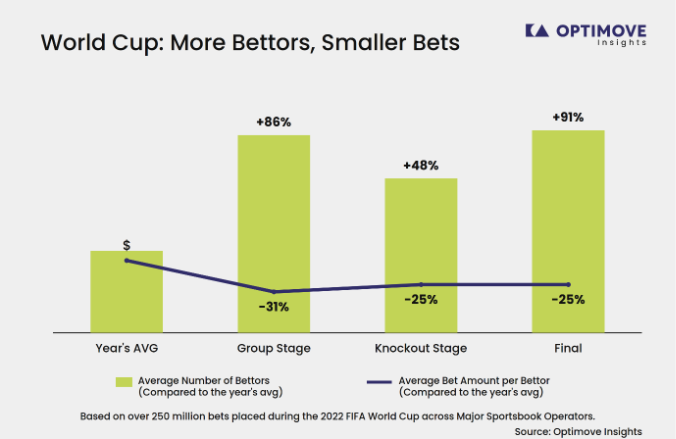
Advertising budgets don’t usually go up in a straight line. When the tournament starts, most operators collect performance data. Then, they move a bigger chunk of their acquisition budget to the knockout rounds, where people are more likely to bet and convert. According to Optimove’s analysis of 250 million World Cup bets, the group stage has the most bets, but the average bet value is lower. But later, the bettors are more committed.
| Tournament stage | Suggested budget share | Primary goal |
| Group stage | 35% | Audience discovery, A/B testing, data collection |
| Round of 32 & Round of 16 | 25% | Scale winning campaigns |
| Quarterfinals | 15% | Maximize high-intent acquisition |
| Semifinals | 10% | Retarget and increase frequency |
| Final week | 15% | Aggressive acquisition and retention |
Common mistakes that reduce World Cup betting ad ROI
Even with a big budget, campaigns can fail to meet ROI targets if strategy doesn’t change during the tournament. One of the most common mistakes is scaling too early, before you know which audiences and GEOs consistently convert during the group stage.
Another is to underestimate rising media costs. As the competition progresses and more brands compete for premium inventory, CPMs and CPCs typically increase. In this stage, reserve the budget for the knockout rounds.
Treating every bettor the same can also waste ad spend. Sportradar’s analysis of deposit origins before and during major football tournaments shows that 40% of deposits came from new customers, 36% from active customers, and 24% from infrequent bettors. Targeting and dividing your audience into groups is important because each group responds to different messages.
Using the same creatives until the final match can lead to ad fatigue. The World Cup can keep campaigns relevant and people engaged with refreshing visuals and messaging around national teams or limited-time offers.
How Bitmedia helps sportsbooks maximize World Cup ad ROI
Successful igaming advertising during the World Cup requires reaching high-intent audiences and adapting campaigns as betting demand shifts. Bitmedia assists with these efforts. Its network delivers over 1.5 billion monthly impressions across 550+ premium publishers. This gives sportsbooks access to interested crypto, finance, and gaming audiences around the world.
Advertisers can use GEO, device, language, and audience targeting to refine their online betting advertising campaigns. Then, optimize performance with real-time conversion tracking and budget pacing. The knockout rounds take the competition to the next level. These tools help marketers spot top-performing placements and shift spend fast instead of relying on broad, one-size-fits-all campaigns.

Related Posts