



From 804K Dota viewers to CS2’s $1.1M finale: Why September is a goldmine for gaming advertisers


September brings several major opportunities for advertisers targeting competitive PC gamers. The International 2026 is drawing a large Dota 2 audience in Shanghai, while BLAST Open Fall 2026 puts Counter-Strike 2 at the center of the schedule.
For gaming advertising, that concentration of major events creates a useful campaign window. TI 2026 provides the audience scale. The wider CS2 schedule keeps that audience active into September.
What TI 2026 tells advertisers about the Dota 2 audience
The International 2026 takes place in Shanghai from August 13-23. Sixteen teams are competing for the Aegis of Champions, with the playoffs at the SPD Bank Oriental Sports Center.
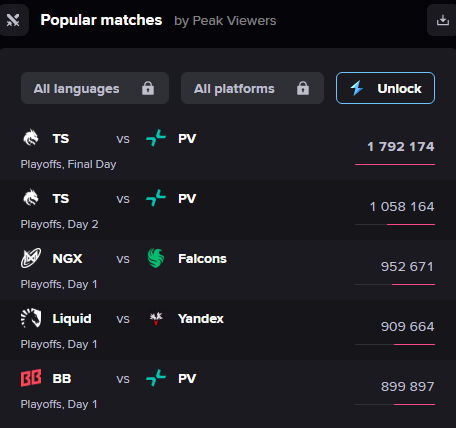
The tournament’s opening day reached a peak online audience of 804,800 viewers. TI 2026 finished with a 1.79 million peak audience, while the grand final between Team Spirit and PVISION produced the tournament’s highest viewership. Across the event, TI 2026 generated 64.35 million hours watched and averaged 588,564 viewers. That number is a baseline for a useful indication of the audience scale around a major Dota 2 tournament. The interest in this year’s event was already visible before the main stage.
According to Esports Charts’ report, The International 2026 regional qualifiers averaged 21.38% more live viewers than the 2025 edition, while total watch time increased by more than 8.4%. Europe accounted for more than 57% of the qualifiers’ total watch time.
What BLAST Open Fall 2026 means for CS2 advertisers
BLAST Open Fall 2026 is a major Counter-Strike 2 event on the September schedule. The tournament features 16 teams competing for a $1.1 million prize pool. The playoffs take place at Porto’s Super Bock Arena on September 4-6.
Evidence from last year strongly supports the audience potential of the BLAST Open format. BLAST Open Spring 2025 peaked at 851,728 concurrent viewers, with an average audience of 305,998. Esports Charts has recognized it as one of the most-watched non-major Counter-Strike events in the history of BLAST.
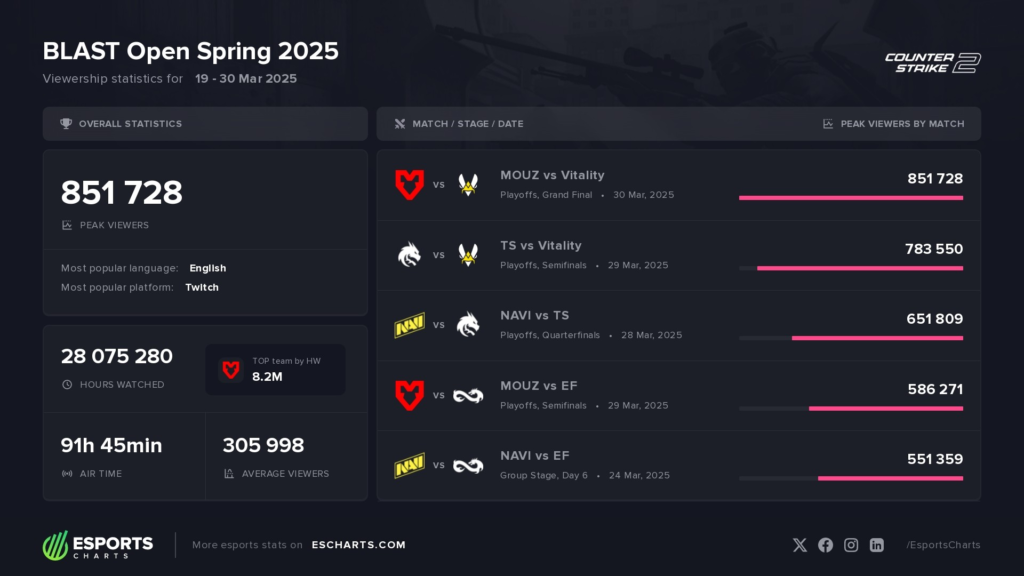
The fall edition also drew a significant audience. The BLAST Open Fall 2025 grand final peaked at over 700,000 viewers and racked up more than 17 million hours watched. Factor in the qualifiers, and the average audience sits around 200,000 concurrent viewers.
The 2025 results provide a useful reference for the plan against heading into the 2026 CS2 tournament. A major BLAST event can attract a large audience across the full competition, with the biggest spike often arriving during the decisive matches.
The tournament also takes place during a busy September for CS2. FISSURE Playground 3 runs from September 8–13, so attention around competitive Counter-Strike continues after BLAST Open Fall.
The audience overlap between Dota 2 and CS2
Dota 2 and Counter-Strike 2 have separate communities, yet both attract large audiences around competitive PC gaming.
Maincast Analytics published in July 2026 found that viewers aged 25-34 were the largest group for both games, while 75% of Dota 2 viewers and 78% of Counter-Strike 2 viewers were between 18 and 34.
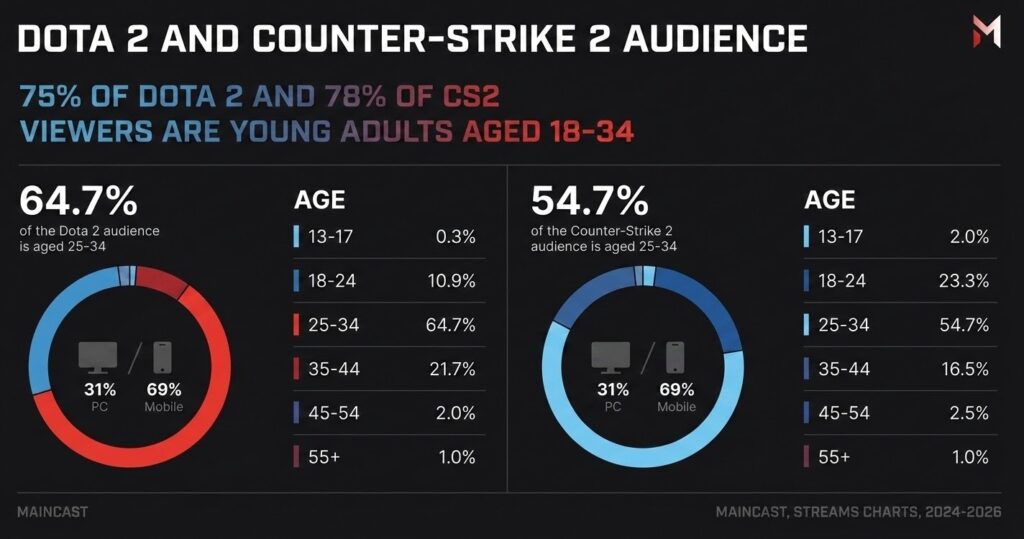
Although the two audiences are distinct communities, their demographic profile is close enough to support cross-event targeting tests.
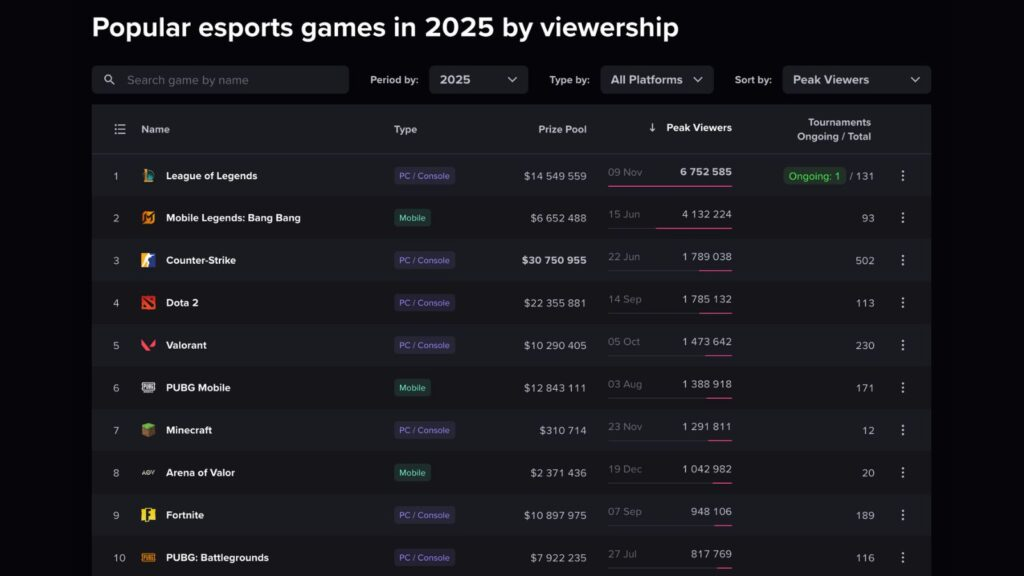
The two titles also rank among the largest competitive gaming ecosystems. In 2025, Counter-Strike and Dota 2 both peaked at around 1.8 million tournament viewers each.
BLAST Open Spring 2025 was broadcast on 92 different channels – official streams plus a long list of language-specific ones. That’s a lot of doors into the same audience. The important point is that tournament reach spreads across several viewing environments rather than concentrating in one stream.
Why gaming-focused targeting matters during esports events
Google Ads and Meta Ads offer extensive audience targeting, but their systems are designed to work across many industries and content environments. Google Display campaigns can use audience segments, topics, keywords, and placements. Meta allows advertisers to target interests, demographics, custom audiences, and other signals.
The difference for a gaming advertiser is the starting point. A general advertising platform can identify people who may be interested in gaming and then decide where the ad is most likely to perform. A gaming-focused platform starts with gaming inventory and builds the campaign around that environment.
That distinction becomes more relevant during a major esports tournament. Audience attention focuses on gaming content, but the users watching one event are not necessarily the same as those following another. Geography, language, device, and prior engagement with campaigns can all influence who is most relevant.
One approach that works: start with broad gaming audience targeting for acquisition, then build retargeting audiences from the people who’ve already engaged. General ad platforms still have a place for broad reach and demand capture. But for an esports-focused campaign, a network that deals only in gaming keeps the whole strategy closer to where competitive gamers actually are.
Gaming audience targeting with Bitmedia
Bitmedia provides advertisers with access to gaming-focused inventory and targeting options that they can adjust by geography, language, device, and operating system. Advertisers can also build audiences for retargeting, so they can come back to users who already interacted with a campaign.
The timing also fits the current esports calendar. An advertiser could launch in TI 2026’s final days, carry the campaign through BLAST Open Fall’s August 26 start, and keep targeting the users who engaged along the way.
Bitmedia’s current offer ends on August 31, 2026, with 5% off wallet top-ups and 63% off gaming audience targeting. That’s enough runway to carry one gaming-audience strategy across both Dota 2 and CS2 esports without rebuilding it.
Launch before August 31, and carry that same gaming audience strategy straight into BLAST Open Fall!
Launch Your Campaign!
Related Posts