





AMA stands for “Ask Me Anything,” a format built around direct questions for a person or team. A crypto AMA might feature a founder explaining a roadmap, a developer unpacking an upgrade, or an external expert challenging the team. It puts a project representative in direct conversation with the people following its work. The strongest sessions treat the audience as participants rather than a crowd waiting through a product pitch.
For crypto marketing, AMAs are especially relevant when a project needs to explain something complicated or earn confidence around a launch. Their results depend on the audience, platform, project maturity, promotion, and execution. Casra Azarmi, Campaign Manager at the KOLLAB, says:
“From our experience working with Web3 teams, AMAs are one of the most effective ways to build trust when done properly. As part of our crypto marketing services, we often use AMAs to help projects open up to their audience and create real conversations.”
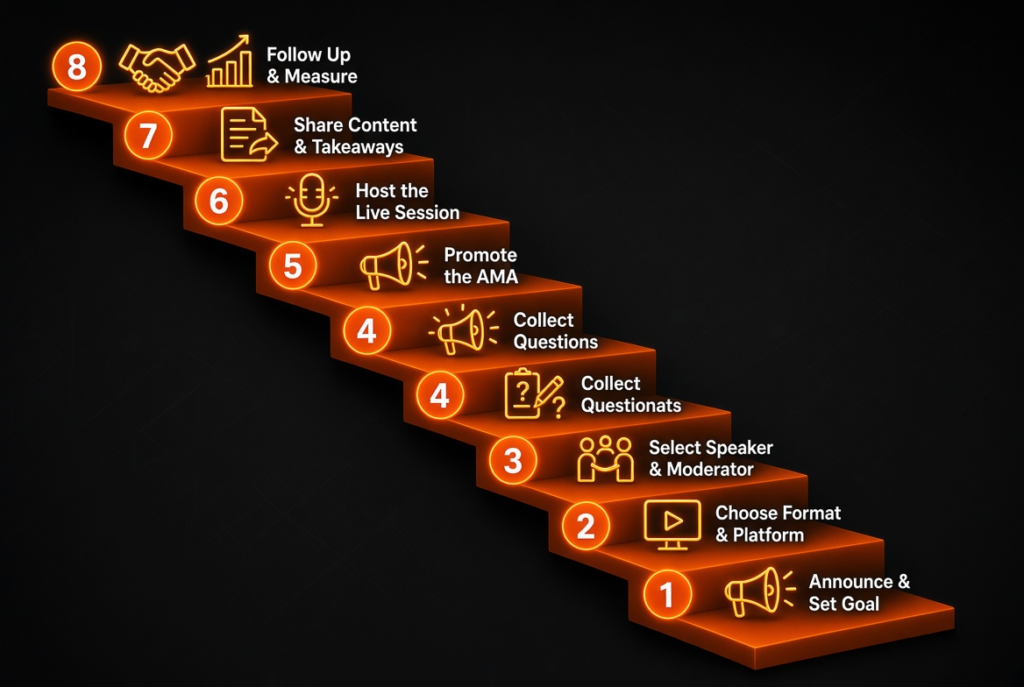
Why a clear crypto marketing goal comes before the AMA date
The first decision in a crypto marketing strategy should be what the AMA needs to change. For a broader Web3 marketing plan, that goal should connect to the next stage of the funnel.
For awareness, look at reach, live listeners, replay views, branded searches, and follower growth. Community-growth goals need new members, returning participants, submitted questions, and post-event activity tracked. A product-education AMA can send users to a feature page or documentation. A launch AMA can be tied to registrations and waitlists. Lead-generation campaigns need a clear conversion path and properly tracked traffic.
Teams that lock in one primary objective and one secondary signal tend to get clearer results. “Get more engagement” is too vague. “Drive qualified traffic to the testnet signup page from developers” gives the team a measurable target.
UTM parameters (source, medium, campaign, content) let Google Analytics show you exactly where traffic came from, whether it was a creator, a community partner, a paid placement, or one of your own channels.
The right AMA format for your audience
A live video interview suits topics where facial presence or demonstrations matter. Discord works well for communities already discussing the project in real time. Reddit can suit audiences that value detailed written answers and a public discussion record. Audio Spaces fit conversational topics when the audience is already active on the platform.
Audience behavior should determine the format. A polished YouTube stream only works if that is where your community already spends its time; otherwise, Discord or Telegram will usually perform better.
Binance provides examples of both live and written AMA formats. On June 24, 2025, Binance CEO Richard Teng held a live AMA on Binance Square that drew more than 100,000 listeners, according to Binance’s official recap. Binance also hosted its first VIP Community Written AMA on June 19, 2025. More than 500 members of its VIP Telegram channel could submit questions directly to Binance executives.
Ethereum Foundation’s research team provides another example of adapting the AMA format into a recurring community channel. Its February 2025 Reddit AMA was the team’s 13th, while an August 2025 session became its 14th. The recurring format gave Ethereum’s technical contributors a regular public forum for community questions.
Speaker and moderator choices that shape the crypto AMA
The speaker should be qualified to answer the questions you expect. Founders are suited to vision, priorities, and business decisions. Developers explain architecture, integrations, upgrades, and technical constraints. Executives handle products, operations, or partnerships. An external researcher or industry expert adds a perspective the internal team cannot provide.
The moderator has a separate role: brief the speaker, collect questions, remove duplicates, manage time, challenge vague answers, and keep the discussion moving. For a technical AMA, that can mean asking, “What changes for the user after this upgrade?” instead of moving straight to the next prepared question.
Better ask-me-anything questions before promotion
“Ask me anything” still needs direction. Create a question bank around the decisions users are actually making so the discussion has substance from the start. For a token launch, questions might cover utility, distribution, access, product readiness, or changes to the roadmap. Discussions regarding protocols can center on topics such as security assumptions, developer tools, integrations, governance, and recognized limitations.
Collect questions in advance. Better sources include recent support tickets and comments under the last few announcements, plus a public form where the community can submit its own questions ahead of time. They show what the audience actually cares about and give speakers time to prepare accurate answers. Keep difficult questions in the queue. An AMA built entirely from easy talking points can sound like a press release with a comment box.
Treating AMA promotion as a full campaign
Crypto project marketing can draw on owned channels, community partners, creators, newsletters, relevant publications, and paid media.
Start promotion early enough for people to see the event more than once. The message should explain the topic, identify who is answering questions, and show people where to submit theirs.
Influencers and community partners can extend reach when their audiences overlap with target users. Inviting a mid-size crypto influencer to co-host, or asking a few community moderators to seed early questions, gets the session in front of audiences who wouldn’t otherwise see the announcement. Give partners unique links to compare traffic and conversions. Paid crypto promotion works as a strong message while the event page stays focused on the conversation.
How to keep the live AMA a real conversation
A practical structure is opening context, focused discussion, audience questions, and a clear next action.
Keep answers specific. If a founder makes an adoption claim, point to the underlying data or explain what is being measured. When criticism comes up, address the issue before moving on. And if the team cannot disclose something, simply say so and explain what can still be shared.
Good moderation also creates clips. A strong answer about token utility or a difficult technical question gives the content team a ready-made short video.
Turning one AMA into ongoing content
Pull strong answers into short videos and social posts on X and TikTok. Recurring questions often make a solid FAQ, while a written recap with timestamps helps people who missed the live session. Extract technical explanations for a blog or documentation update. Give creators clips they can discuss with their audiences.
Doing this turns one AMA into content you can keep using long after the live session ends. It also gives people who missed it an easy way to catch up without having to sit through the whole recording.
Full-funnel metrics beyond attendance
Track the numbers that matter across the full funnel: registrations, peak viewers, average watch time (where available), questions submitted, and chat activity. After the session, look at replay views, follower growth, community joins, referral traffic, sign-ups, and conversions. AMA-referred users with other acquisition sources give a clearer picture of what the event actually contributed.
A simple setup is to give each promotion channel a separate UTM-tagged link. For example, give an influencer a link that looks like utm_source=creatorA&utm_medium=social, and hand a partner community something like utm_source=partnerB&utm_medium=referral. Google recommends consistent UTM naming so campaign data does not split across inconsistent source or campaign values.
Look beyond same-day conversions. For community growth, check whether new members remain active. To assess product education, look at feature-page visits and the actions that follow. A large audience with little downstream activity differs from a smaller audience that keeps returning and converts.
Common mistakes that limit crypto AMA results
Poor promotion can leave a strong speaker talking to an empty room. Over-scripted answers make AMA feel predetermined. Weak moderation lets one topic consume the session. An irrelevant guest can attract curiosity without bringing qualified users. A vague call to action makes it difficult to connect attention with acquisition.
Follow-up is another common gap. Publish the recording, answer unanswered questions, share the recap, and give attendees a reason to stay connected. Good ask me anything questions can also become prompts for future community discussions.

Related Posts