





For over 20 years, publishers and search engines had a simple deal: create good content and get traffic in return. That agreement is now breaking down.
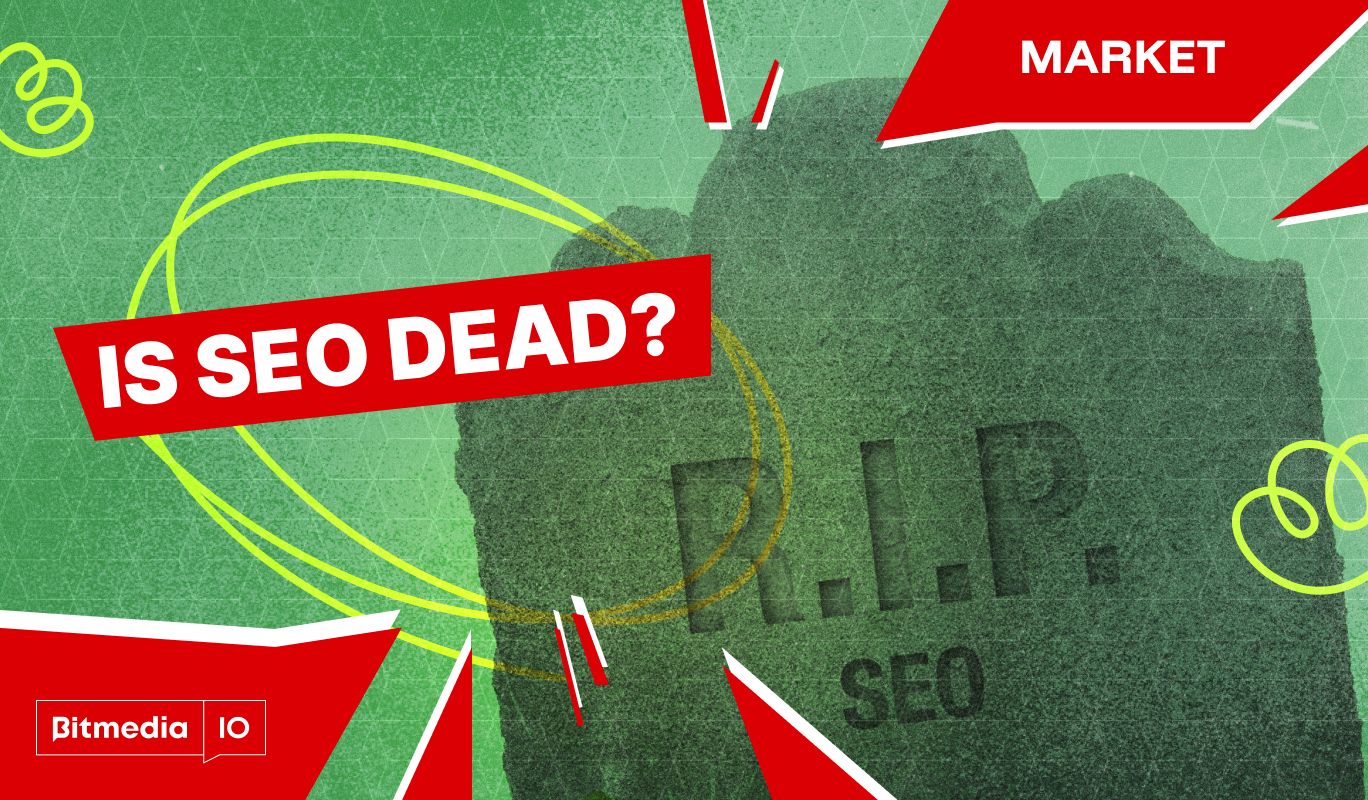
Google is updating its AI search features. Media companies and affiliate marketers are experiencing significant changes in their click-through traffic. The traditional search engine results page (SERP) used to be a simple list of blue links. Now, it has become an answer engine. So the real question is: Is organic traffic disappearing or just changing?
What changed in Google’s AI search update?
Google’s transition toward AI-powered search impacts the mechanics of data collection and user engagement. The key component of this transition is the rollout of AI Overviews (formerly SGE). It places a detailed, multi-source AI summary directly at the absolute top of the SERP.
This leads to the rise of zero-click searches, when a user gets their answer without visiting any external websites. At Google I/O 2026, Google announced that Gemini 3.5 Flash now powers Search. It comes with the biggest upgrade to the Google search box in over 25 years. For the first time, users no longer need to type short keywords. The search box now expands dynamically, letting people describe exactly what they need in plain, natural language, the way they’d ask a friend. It even suggests how to phrase your question before you finish typing. You can also search using images, files, videos, or open browser tabs, not just text.
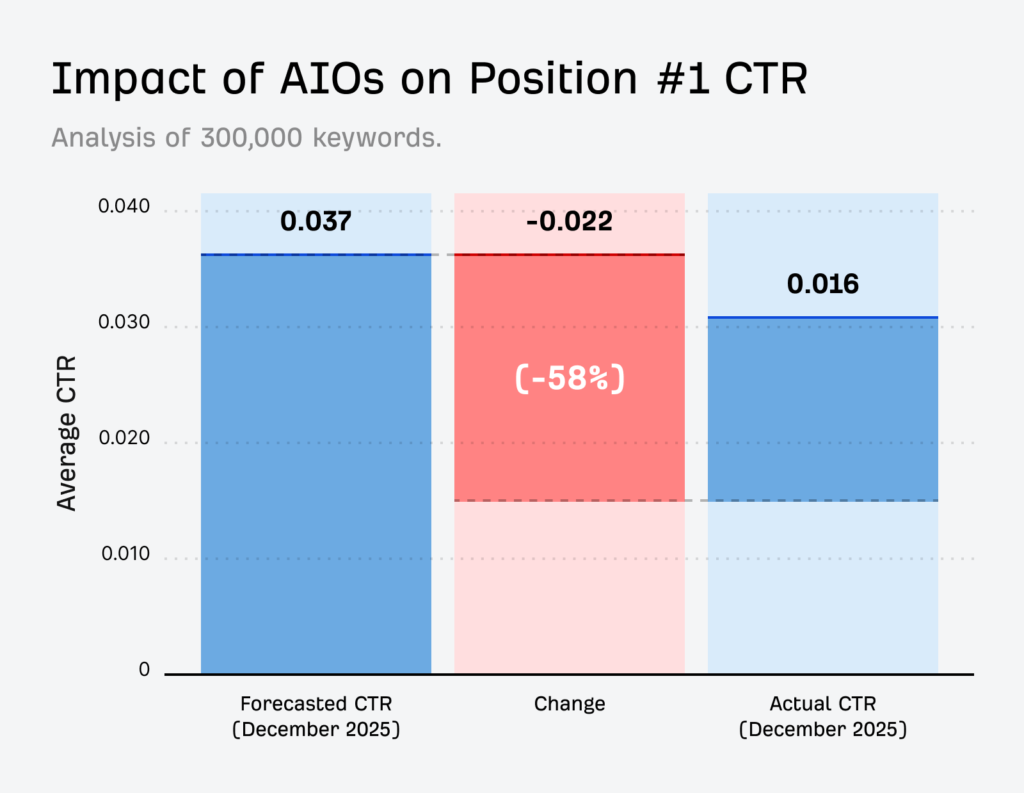
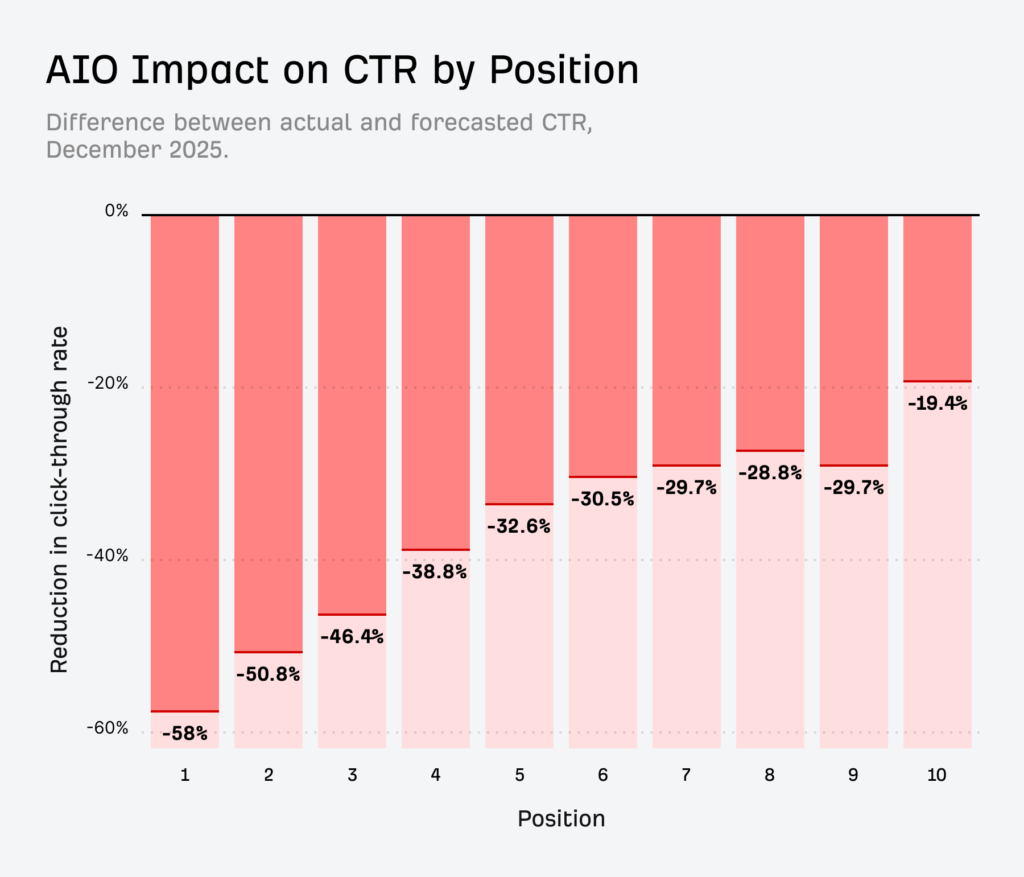
Since the AI answer sits at the very top of the page, most users never scroll down to the regular search results. Users are increasingly relying on summaries instead of clicking through to read full articles. According to Ahrefs, when an AI Overview appears, even the #1-ranked page gets 58% fewer clicks than before. Position two rankings saw click volumes drop by roughly half, while even tenth-place positions suffered declines of nearly 20%.
Is organic traffic really dying?
Labeling organic traffic as “dead” misinterprets the fundamental realignment taking place across the web. Organic visibility is experiencing traffic redistribution based on search intent. Addressing concerns over disappearing web traffic, Google’s Vice President and Head of Search, Liz Reid, explained that generative answers are filtering out lower-value actions without removing the open web:
“I think there’s this sort of myth that people want AI or the web… I actually think what we see is that people want AI on the web together.”
This shift unevenly distributes its impact across industries. Traffic is dropping sharpest for standard affiliate marketing sites, alongside general news outlets and broad informational hubs. If your site mostly answers basic questions, Google’s AI can now do that job. Your traffic will suffer for it.
However, certain content categories are showing strong resilience or even gaining traffic:
- Deep expertise: AI struggles to replicate real experience. If your content includes original data, case studies, technical breakdowns, or expert-level insight, it offers something AI simply can’t generate on its own. It still ranks well.
- Niche authority platforms: Platforms with a clear topical focus tend to rank better than broad generalist publishers. Specificity and depth of coverage help establish the kind of authority that both AI Overviews cite and human searchers trust.
- Branded content: When people search for a specific brand or service by name, they skip the AI summary and go straight to the source. Companies with strong recognition and direct audience relationships are partially safe from the worst effects.
The defining factor is intent-based search behavior. Complex queries that require detailed comparisons or real-world operations still require a click.
The real impact on SEO and publishers
The transition to AI overviews for SEO requires a fundamental change in how digital marketers measure success. For years, standard organic traffic research treated all click volumes equally. Today, publishers must differentiate between low-intent informational impressions and high-value transactional engagement.
Ranking for popular “what is” or “how to” keywords no longer drives the traffic it once did. With fewer organic spots left below the AI block, competition for them has gotten much tougher. This dynamic increases the strategic value of Google’s E-E-A-T (Experience, Expertise, Authoritativeness, and Trustworthiness) guidelines. To capture both human clicks and AI citations, content must demonstrate firsthand experience and verifiable expertise. Brands that appear in AI Overviews generate 35% more organic clicks and 91% more paid clicks than their non-cited competitors for the same queries. AI-referred traffic also converts at significantly higher rates. Semrush reports a 4.4x lift in conversion rates compared to standard organic search. Users who click through have already engaged with an AI summary and progressed further in their decision-making process.
In niches like Web3 and finance, the trade-off between traffic quality and traffic volume is clearer than ever. In Web3 advertising, low-quality traffic is a real problem. So clicks that don’t convert just inflate your numbers while killing your actual results. When it comes to traffic quality vs volume, AI search makes the answer clear: 1,000 visitors who are ready to buy will always outperform 100,000 casual readers that Google now answers before they ever reach your site. You need a strong filter for traffic quality to ensure that your analytical data reflects actual human interactions. Automated scripts frequently cause problems for ad networks.
How to adapt to AI-driven search
Surviving and growing in this updated landscape requires moving toward AI search optimization frameworks. Marketers can use several actionable strategies to stabilize and grow their organic footprints:
- Target informational details and long-tail intents: Pivot keyword strategies toward highly specific queries that require human perspective and troubleshooting.
- Optimize for conversational LLM citations: Structure content clearly in direct question-and-answer formats and bulleted lists. This makes it easier for Google’s AI to read, understand, and cite your pages as a trusted source inside its AI answers.
- Audit technical and structural health: Consistently run an organic traffic check via Google Search Console and specialized platforms. A reliable organic traffic checker shows you exactly which pages are losing clicks to AI features, so you know where to fix things first.
- Build direct-to-consumer and branded channels: Don’t rely solely on search. Build email lists, grow on social, start a podcast, and join communities so you have channels Google can’t take away. When users search for your specific brand name, your site remains the primary destination.
The future of organic search in the AI era
Organic search is going through a profound transformation. SEO isn’t dying. Google now answers simple questions on its own, but it still sends people to websites when they need more detail or are ready to buy.
The role of the search marketer is shifting to managing digital brand authority across the web. As Google gets smarter, generic and repetitive content will continue to lose visibility. There’s simply no room for it anymore.
Organic traffic is experiencing a structural shift driven by AI integration rather than dying. Media and Web3 sites that build real authority and put user experience first will keep growing. Focus on keywords that signal real buying or research intent. So you can still grow your organic traffic, even as AI continues to reshape how search works.

Related Posts