







The year 2025 is certainly important for the cryptocurrency and Web3 industries to become more professional. It was the year that the industry moved past the ups and downs of its early years and started to fit into the global financial and regulatory system. As we look back, 2025 will be remembered not for speculative frenzies but for the passage of important laws, significant network upgrades that addressed long-standing scalability issues, and a shift in marketing that prioritized honesty over hype.
For people who work in crypto marketing and business development, knowing what really happened, beyond the price charts, shows why this year was a real turning point toward mainstream adoption.
Major market and industry events in 2025
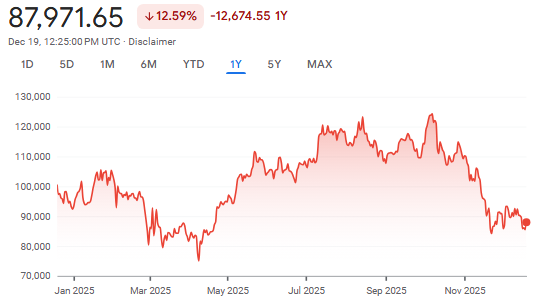
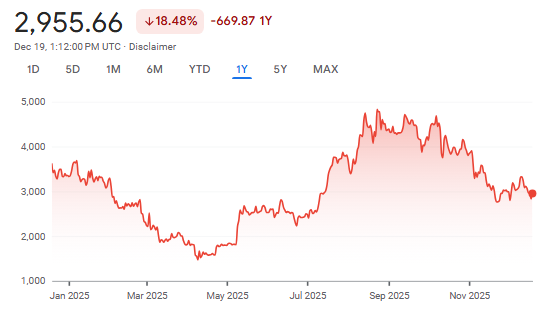
The crypto market in the second half of 2025 was anything but stable, but the main story was that institutions were buying more and more, and record amounts were coming in.
The story of Ethereum was more up and down. Ether’s low for 2025 is $1,380, reached in April. In July, the network saw record ETF inflows of $5.41 billion, the highest amount in a single month. This showed that institutions were interested in more than just Bitcoin. In August, ETH did better than Bitcoin and hit $4,950, its highest price of all the time. But the momentum didn’t last. Ethereum was trading close to $2,930 by the middle of December, down from its high of all the time. This was because people were becoming more cautious as the year came to an end.
October should be talked about separately because it broke a seven-year pattern. Bitcoin briefly reached an all-time high of more than $126,000 on October 6. Then, on October 10, Donald Trump said that there could be 100% tariffs on Chinese imports. This led to the largest single-day liquidation event in crypto history, with $19 billion in leveraged positions being wiped out in 24 hours. By the end of the month, Bitcoin was down 5.3% from $110,000. This was the first time since 2018 that it had a negative finish in October. Ethereum dropped 9.8% to trade near $3,850, which is a bigger drop.
Even though things were shaky, institutional flows kept going. Even with all the chaos in October, Bitcoin ETFs saw $3.4 billion in net inflows, and Ethereum ETFs saw $570 million in inflows. This ability to bounce back from geopolitical shocks showed that the idea of institutional adoption was real, not weak.
The larger crypto market grew up in other ways as well. In September 2025, the number of stablecoin transactions reached an all-time high, surpassing $4 trillion per year. By the second half of 2025, stablecoins made up 30% of all crypto volume on the blockchain. It wasn’t a guess, but the way things worked. The July announcement of “Robinhood Chain” on Arbitrum and the addition of Circle’s paymaster tools on Base (which lets users pay gas fees in USDC) are examples of how real-world use can take the place of theoretical promise.
Regulatory and policy developments are changing the industry
In 2025, the rules changed completely. Instead of focusing on enforcement, they moved toward operational frameworks that make the sector legitimate.
President Trump’s election victory in November 2016 showed that he was pro-crypto, but the real policy wins came before that. The GENIUS Act, which was signed into law on July 18, 2025, set up the first federal rules for stablecoins. These rules required that each stablecoin be backed by an asset worth one dollar and that audits be done every month. It meant that stablecoin issuers now had a clear way to do business legally, which led to the rise in the use of stablecoins and their integration into mainstream payment systems. These changes, along with the GENIUS Act, changed the way institutions could access and use crypto assets in a big way.
The European Union implemented MiCA (Markets in Crypto-Assets Regulation) in early 2025 and spent 2025 establishing technical standards. The ESMA set final data standards by November 28 to make sure that all EU crypto-asset participants have the same information. This brought together a regulatory approach that was broken up by country.
In December 2025, the United Kingdom brought crypto-assets under the Financial Services and Markets Act. This made it illegal for trading platforms and stablecoin issuers to do new things.
In August 2025, Hong Kong officially launched its stablecoin framework, which set a standard for the rest of the region. In 2025, Dubai updated its rulebook (Version 2.0), making it harder to distribute tokens and trade on margin.
This change in the rules made things harder for crypto marketers and communications professionals. Starting in April 2025, only MiCA-licensed companies will be able to run crypto ads on Google in the EU. The Digital Services Act made it illegal to use profiling-based ads to target kids. In the UK and other places, influencer marketing had to follow rules about what to tell people.
It wasn’t a wall of rules that made people use it; it was clear that it was useful. In 2025, hedge funds had 55% of their money in crypto assets, up from 47% in 2024. That rise came directly from institutions’ faith in the rules and regulations.
Technological innovations and launches
The real excitement for developers and long-term builders came from the network upgrades and infrastructure tools launched in 2025.
The biggest event was Ethereum’s Fusaka hard fork on December 3. PeerDAS (Peer Data Availability Sampling) was added in the upgrade. It cut down on the amount of data validators had to handle by up to 85%. It raised the block gas limit to 60 million units, with suggestions for it to go up to 150 million. The end result was that transaction costs on Layer 2 went down by 40%-60%. This meant that users who sent transactions on networks like Arbitrum and Optimism paid a lot less in fees. The upgrade was important because it fixed the real problem with Ethereum scaling, not just in theory but in the code that was already in place.
Layer 2 networks have grown a lot. In the middle of 2025, Base’s “Flashblocks” cut block times from 2 seconds to 200 milliseconds. This made it really competitive with centralized exchanges for applications that need speed. By November, Arbitrum One still held 51% of the total value locked in the Layer 2 segment. Layer 2 networks were handling more than 1.9 million transactions every day.
Web3 tools got better in more ways than just scaling. Zero-Knowledge proofs were built into decentralized identity tools like Zink and zCloak. This lets users check attributes without giving away personal information, which is very important for compliant DeFi and gaming. In late 2025, Fetch.ai and SingularityNET’s partnerships grew, and they launched autonomous on-chain agents that could trade data and services on decentralized marketplaces.
They were deployed tools that solved real problems: Robinhood Chain would enable tokenized stock trading. Circle’s paymaster integration meant gas fee friction disappeared. DID tools meant users could access regulated financial services without surrendering privacy.
Marketing and adoption highlights
The marketing landscape in 2025 underwent a decisive shift. The hype-fueled campaigns of previous years gave way to transparency and utility-focused narratives.
The rise of institutional adoption continued. U.S.-listed Bitcoin and Ethereum ETFs brought in billions in net inflows, making it possible to invest in cryptocurrencies through regulated funds. Retail adoption also sped up. Between January and July 2025, the number of crypto transactions in the U.S. went up by about 50%. Around 28% of adults in the U.S. owned cryptocurrency by the end of 2025.
The focus shifted to real-world asset tokenization, the use of stablecoins in payments, and how blockchain can help with problems in traditional finance. Campaigns got better at targeting by using AI to create personalized content and on-chain analytics to keep track of who clicked on what.
Growth that focused on the community became important. People usually don’t pay much attention to meme coins, but they taught us something about what makes people want to be part of a community: humor, satire, and real ownership of the community.
Influencer marketing grew from one-time celebrity endorsements to long-term partnerships with micro-influencers who had real technical credibility. Key Opinion Leaders (KOLs) with a lot of experience and a proven track record (like Vitalik Buterin and Michael Saylor) were better at shaping market narratives than celebrity shills.
Crypto community and cultural moments
In addition to changes in institutions and technology, 2025 had cultural events that changed how people saw things.
TOKEN2049 In October, Singapore was the main stage for famous people like Arthur Hayes and Eric Trump, who talked a lot about the intersection of AI and crypto and real-world assets. Life on the Blockchain in 2025, Dubai in late October, showed how the Middle East is becoming a center for cryptocurrency. Permissionless IV in Brooklyn brought together traditional tech and crypto developers for a 36-hour hackathon with more than $100,000 in prizes.
Meme culture changed into social commentary. The $TRUMP memecoin used gamified leaderboards with badges and reward points. The $GOHOME token, which made fun of government spying and CBDCs, had a market cap of $2.48 billion. This shows how the mood of the community can affect the market.
The influencer scene changed from mainstream celebrities to “KOLs” (Key Opinion Leaders) who are technically credible.
What we’ll remember heading into 2026
As we conclude this recap, the real legacy of 2025 is the building of trust through formal oversight and technology. The events of this year ensured that crypto is no longer viewed as a fringe experiment but as a regulated and increasingly essential component of the global economy.
We will remember 2025 as the year when:
- Trust was institutionalized: Through the GENIUS Act and MiCA, the crypto was replaced by a rules-based system that protects both consumers and institutions.
- Scalability was solved: The Ethereum Fusaka upgrade and the rise of L2s like Base and Arbitrum made on-chain transactions fast and cheap enough for mass adoption.
- Marketing became accountable: The industry learned that transparency and utility-driven narratives build more sustainable growth than speculative hype.
The change is still going on as we head into 2026. The market expects that Real-World Assets will become more integrated into DeFi and that AI-powered autonomous agents will become more common on the blockchain. The milestones set for 2025 have given the industry the stability and infrastructure it needs to move on to the next stage of growth.

Related Posts