





The International 2026 is over. Team Spirit took the Aegis in Shanghai after a 3-2 final against PVISION on August 23.
The tournament showed how concentrated gaming attention can become around a major esports event. Viewers gather around the same matches, while advertisers compete for that attention through many of the channels they already use.
The challenge starts when a campaign needs to reach beyond that initial audience. More budget can increase impressions without adding many new users.
BLAST Open Fall starts on August 26, bringing another major wave of CS2 attention into the picture.
Why gaming advertisers keep reaching the same audience
Many gaming campaigns still depend on broad display inventory and large social platforms, often using general categories such as “gaming” or “video games.” Those channels deliver scale. Reaching the same broad audience repeatedly can also push up campaign costs.
Someone who fits a broad gaming category may qualify for several campaigns at once. As spending increases, advertisers can end up paying more without substantially expanding their reach. The result is higher competition for valuable impressions and less incremental reach as the campaign grows.
The gap becomes more noticeable around esports tournaments. Someone following The International is actively interested in what is happening in Dota 2 at that point. A user in a broad gaming audience may have no connection to the tournament. That difference matters to advertisers trying to expand reach instead of repeatedly hitting the same users.
What TI 2026 tells gaming advertisers
The International 2026 shows what that concentration looked like in practice. Early in the tournament, the group stage alone reached a peak of more than 800,000 concurrent viewers, with 804,8K recorded on August 13.
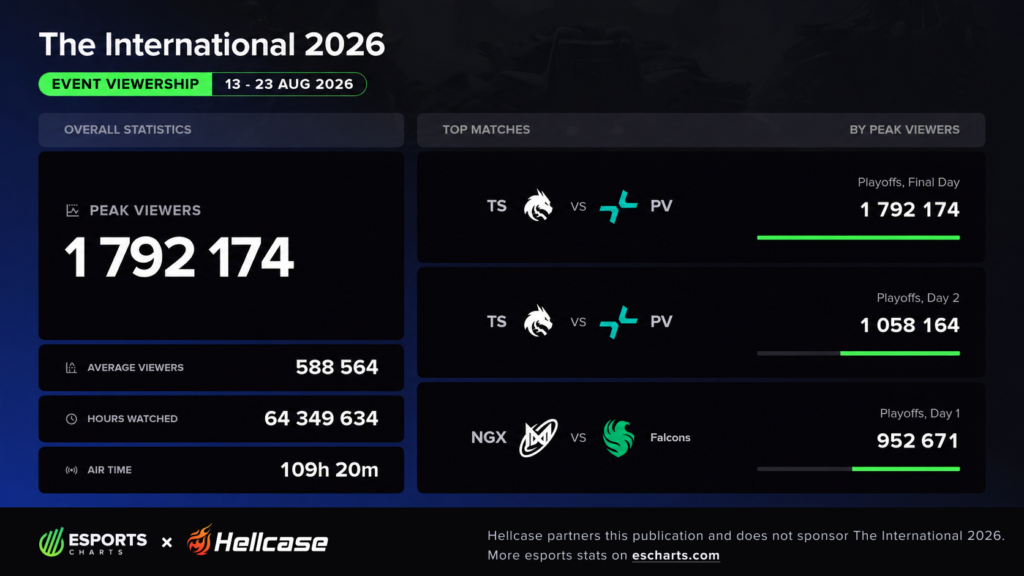
The final numbers went considerably higher. According to Esports Charts, TI 2026 finished with 1,792,174 peak viewers and 64.35 million hours watched across the tournament. The average audience was 588,564 over 109 hours of broadcast time. The grand final between Team Spirit and PVISION was the tournament’s most-watched match. The numbers show how quickly a major esports event can pull a large gaming audience into one place.
That kind of scale still leaves a reach problem for advertisers. Viewers are scattered across different platforms and devices, and the sliver worth paying for is whoever’s actually watching as the tournament happens. The total headcount is a rough proxy for that, at best. Broad gaming categories capture the headcount, while a tournament audience is a narrower thing entirely.
Generic advertising platforms like Meta and Google target people based on interests and behavior. They don’t automatically give advertisers the same level of control over an audience actively following a specific esports event at the moment attention peaks. Once that broad audience has been covered, the next challenge is finding additional gaming users outside it.
CS2’s BLAST Open Fall is the next wave
The next opportunity arrives almost immediately. CS2 BLAST Open Fall 2026 started on August 26 and will continue until September 6, with 16 Counter-Strike 2 teams competing for a $1.1 million prize pool. The group stage takes place in Copenhagen, while the playoffs move to Porto from September 4-6.
The lineup includes some of the biggest names in competitive CS2, including Team Spirit, Natus Vincere, MOUZ, and Aurora, alongside G2, Vitality, FURIA, and other top teams.
Some viewers will follow both tournaments, but the change to CS2 still creates a new audience opportunity for advertisers.
Dota 2 and CS2 attract different communities and game-specific interests. Reaching Dota 2 viewers during TI does not automatically extend a campaign to the CS2 audience around BLAST Open Fall.
How Bitmedia reaches gaming audiences beyond broad targeting
Bitmedia gives advertisers another way to approach that reach. Its gaming audience targeting is designed around gaming-specific engagement and interest signals. It gives advertisers another route to gaming users beyond broad categories such as “gamers” or “video game enthusiasts.”
It also gives advertisers room to move between gaming audiences as attention shifts. A campaign launched around TI 2026 can focus on Dota 2 audiences, then continue into September as CS2 takes over the esports calendar with BLAST Open Fall. The audience changes with the tournament, and yet the acquisition strategy stays in place.
Advertisers can also adjust campaign settings while a campaign is running, including where ads appear and how frequently users see them.
Skin-trading platforms and gaming marketplaces can use Bitmedia’s wallet-based audience targeting when they need a more specific trading-related audience. For general gaming campaigns, the broader gaming audience targeting is the more relevant option.
The promotion is available through August 31. It includes 5% off wallet top-ups and 63% off gaming wallet-based audience targeting. For advertisers planning to carry campaigns from late August into September, that deadline arrives just as the next major esports cycle begins.
Reach gamers beyond the usual ad channels with Bitmedia and start your campaign before BLAST Open Fall hits its September playoff stage!
Launch Your Campaign!
Related Posts